

Home / Field Notes — Land Clearing Knowledge Base / Oriental Bittersweet Removal in New Jersey
Oriental Bittersweet Removal in New Jersey
Published April 6, 2026 by Brush Busters • Last reviewed April 6, 2026
Oriental bittersweet (Celastrus orbiculatus) kills trees. Not quickly — slowly, over years, by wrapping around the trunk and branches with increasing pressure until the vine girdles the cambium layer and chokes off nutrient flow. A mature bittersweet vine can reach four to six inches in diameter and weigh hundreds of pounds, pulling down branches and eventually toppling the host tree.
On estate and wooded properties in Bernardsville, Peapack-Gladstone, Mendham, and Roxbury, individual mature hardwoods are worth thousands of dollars in landscape and property value. A single bittersweet vine that’s been climbing for ten years can destroy that investment. This is one of the few invasive species where the removal is genuinely urgent — every season the vine grows increases the damage to the host tree.
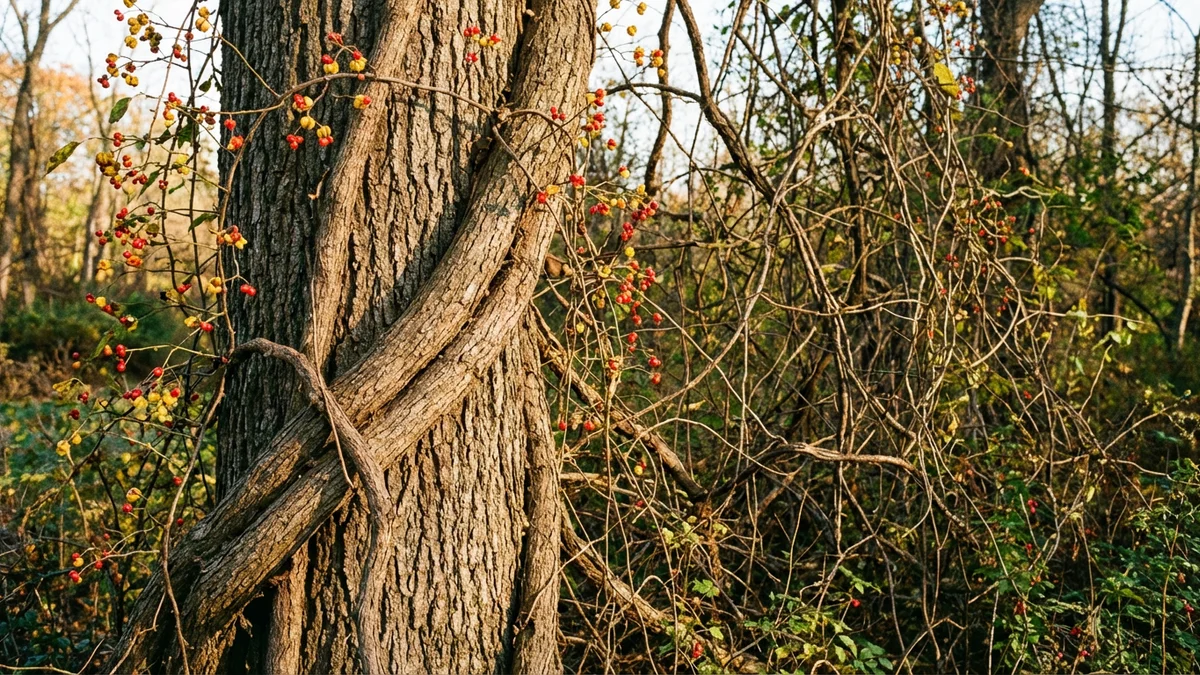
Identification
Oriental bittersweet is a deciduous woody vine that climbs by twining — wrapping its stem around the host in a tight spiral. The twining habit creates the characteristic “strangling” pattern visible on infested trees.
Stems: Woody, round in cross-section, brown to gray bark. Young stems are greenish-brown. Mature vines develop a distinctive orange inner bark visible when the outer bark is scraped. Vines reach one to four inches in diameter on mature plants, sometimes larger.
Leaves: Alternate, rounded to oval, two to four inches, with fine-toothed edges. Glossy green in summer, yellow in fall.
Fruit: The diagnostic feature. Small round capsules that split open in fall to reveal bright red-orange berries with yellow outer shells. The berries persist through winter and are conspicuous against bare branches. Birds eat them and spread seeds aggressively.
Growth form: Twining vine that climbs anything vertical — trees, fences, utility poles, structures. Also grows as dense ground cover in open areas, forming tangled mats that root at the nodes. The ground-level growth serves as the reservoir from which climbing vines ascend into the canopy.
Look-alike: American bittersweet (Celastrus scandens) is native and not invasive. The key difference: American bittersweet has fruit clusters only at the branch tips. Oriental bittersweet has fruit clusters along the entire length of the branches (axillary). In practice, Oriental bittersweet has largely displaced American bittersweet in NJ and is far more common.
The damage it causes
Girdling. The vine wraps tightly around the trunk with each year of growth, constricting the bark and eventually cutting into the cambium — the thin layer beneath the bark that transports water and nutrients. Once the cambium is girdled (interrupted around the full circumference), the tree above the girdle point dies. This can take five to fifteen years from initial vine establishment to tree death.
Branch loading. Mature bittersweet vines are heavy. The combined weight of vine mass and foliage overloads branches, causing breakage during storms or under snow load. On high-value specimen trees, this branch loss disfigures the canopy permanently.
Light competition. Bittersweet foliage in the upper canopy shades the host tree’s own leaves, reducing photosynthesis and gradually weakening the tree. The vine essentially parasitizes the tree’s own structure to reach sunlight, then outcompetes it for light at the top.
Ground smothering. Where bittersweet grows as ground cover (common in open areas and forest edges), it forms dense mats that suppress everything underneath — native groundcover, tree seedlings, and wildflowers.
Removal approach
Bittersweet removal is a two-level operation: cut the climbing vines to stop canopy damage, then clear the ground-level growth to prevent reestablishment.
Step 1: Cut climbing vines at the base. Every bittersweet vine climbing a tree needs to be severed at the base — ideally in two places about a foot apart, with the section between removed. This kills everything above the cut. The dead vine desiccates and drops from the canopy naturally over several months. Do NOT try to pull dead vines from the canopy — they’re entangled and pulling them can damage the branches they’re wrapped around.
Step 2: Clear ground-level growth. Forestry mulching handles the ground-level bittersweet along with all the other understory invasives. The mulcher grinds the vine mats, root crown areas, and associated brush at ground level. The mulch layer suppresses regrowth.
Step 3: Herbicide on cut stumps and resprouts. Bittersweet resprouts from root fragments. Apply triclopyr to cut vine stumps within 30 minutes of cutting (the “cut-stump” method). Any resprouts that appear in the following spring should be spot-treated with foliar triclopyr. Without herbicide follow-up, bittersweet will regrow from the root system within one to two seasons.
On estate properties where tree preservation is the primary goal, we prioritize cutting every climbing vine on the property first, then clear the ground-level growth in a second pass. This stops the canopy damage immediately while the full clearing is scheduled.
Costs
Bittersweet removal is typically part of a broader understory clearing project rather than a standalone service. Forest understory clearing that includes bittersweet vine cutting and ground-level mulching costs $2,500 to $4,500 per acre.
For targeted vine cutting on high-value trees (without full understory clearing), expect $200 to $500 per tree depending on vine diameter and number of vines. This is often hand work — the operator identifies and cuts each climbing vine at the base while the mulcher handles the surrounding understory.
Common Questions
Will cutting the vine save my tree?
If the tree isn’t fully girdled yet, cutting the vine stops damage and the tree can recover. Early intervention is critical — the sooner you cut, the better.
Should I pull dead bittersweet vines from the canopy?
No — pulling can damage branches. Dead vines desiccate and fall naturally over 6–12 months. An arborist can remove sections near structures if needed.
How do I tell oriental from American bittersweet?
Oriental has fruit clusters all along the branches. American has fruit only at branch tips. Oriental is far more common in NJ.
How much does bittersweet removal cost?
Understory clearing: $2,500–$4,500/acre. Targeted vine cutting: $200–$500/tree. Get a free estimate.
Will bittersweet grow back after removal?
Without herbicide, yes. Apply triclopyr to cut stumps immediately and treat resprouts the following spring. With follow-up, elimination takes 1–2 seasons.
When is the best time to remove bittersweet?
Cut climbing vines immediately — any season. Clear ground level in fall/winter. Herbicide on cut stumps immediately; foliar treatment on resprouts in late summer.
How fast does bittersweet grow?
Vines grow 10–15 feet/year and reach canopy in 3–5 years. Ground mats spread 6–10 feet/year. Early intervention prevents major damage.
Can forestry mulching remove bittersweet climbing high on trees?
The mulcher cuts vines at ground level, which kills everything above. The high-climbing portion dies and falls naturally. No need to reach the upper canopy.
Related Services
Invasive Species Removal
Japanese knotweed, multiflora rose, mile-a-minute vine, and other NJ invasives eliminated at ground level.
Relevant City Pages
These city pages are a good fit if you want to compare the article advice with the kind of properties we see on the ground.
Want the full New Jersey land clearing playbook?
This article covers one piece of the puzzle. The complete guide ties together methods, costs, permits, terrain, and contractor selection in one place.
Bittersweet is killing your trees. We stop it.
We cut every climbing vine and clear the ground-level growth in a single operation. Free estimates.
Or call (908) 774-9235.