

Home / Field Notes — Land Clearing Knowledge Base / Autumn Olive Removal in New Jersey
Autumn Olive Removal in New Jersey
Published April 8, 2026 by Brush Busters • Last reviewed April 8, 2026
Autumn olive (Elaeagnus umbellata) is the species most responsible for turning NJ’s fallow farmland into impassable brush. Originally promoted by the USDA in the 1950s and 60s for erosion control, wildlife habitat, and mine reclamation, it’s now classified as invasive in New Jersey and most eastern states. Birds eat the small red berries and deposit seeds across every field edge, fence line, and roadside in the state. Within five years of a field going fallow, autumn olive establishes. Within ten, it dominates. Within fifteen, you can’t walk through what used to be a hay field.
The species is the primary clearing target on agricultural and rural residential properties throughout Hunterdon and Warren counties. If you own fallow farmland in Alexandria, Delaware Township, Readington, Mansfield, or Pohatcong, autumn olive is almost certainly the dominant shrub on your property.
Identification
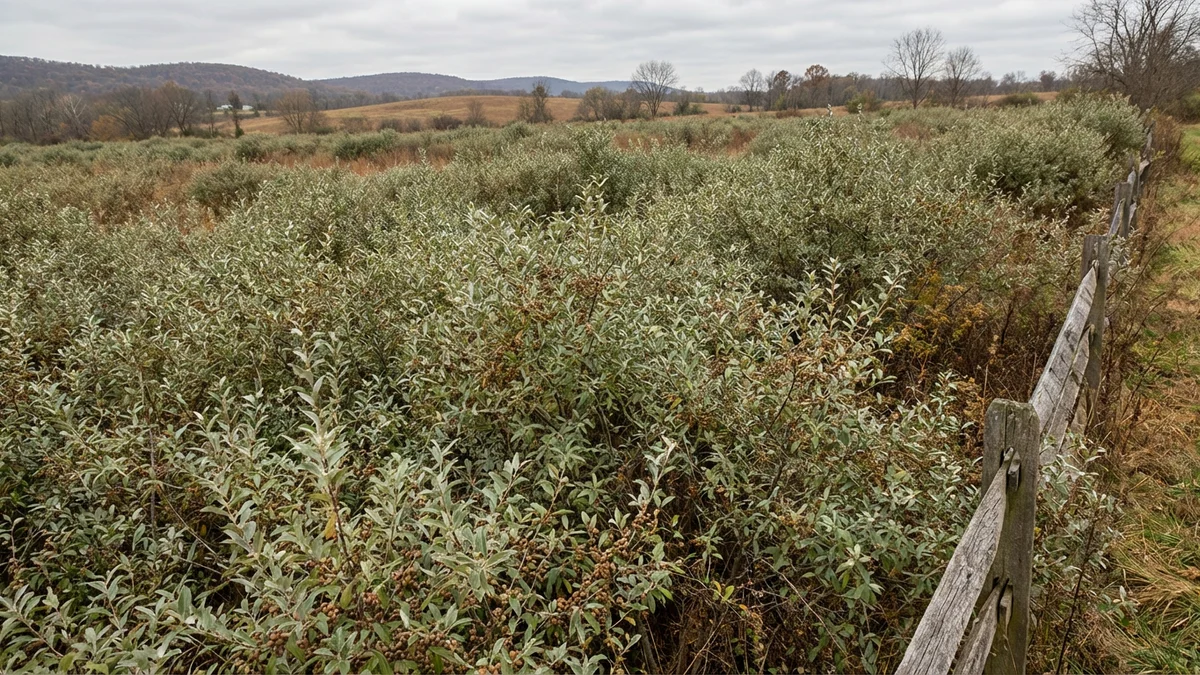
Autumn olive is easy to identify once you know what to look for. The leaves are the giveaway: alternate, oval, two to four inches long, with a distinctive silvery underside created by tiny scales on the leaf surface. When a breeze turns the leaves, the silvery flash is visible from a distance across an entire field.
The bark on mature stems is grayish-brown and develops a shreddy texture. Young stems are often thorny — short, sharp spines at the nodes that make hand removal painful. Mature plants range from eight to twenty feet tall with spreading, multi-stemmed growth that forms dense thickets.
Flowers appear in April and May — small, tubular, cream to pale yellow, fragrant. The berries ripen in September and October — small, round, red with silvery speckles, borne in clusters along the branches. Each berry contains one seed, and a single mature plant can produce 200,000+ seeds per year. Birds — especially robins, starlings, and cedar waxwings — eat the berries and spread seeds across the landscape.
Why autumn olive is a problem
Speed of colonization. A fallow field left unmowed for three years will have scattered autumn olive seedlings. By year five, those seedlings are six to eight feet tall with woody stems too thick for a bush hog. By year ten, the field is a closed canopy of autumn olive with trunks three to five inches in diameter. This timeline means any agricultural field that loses maintenance for even a few years begins the conversion to autumn olive thicket.
Nitrogen fixation. Unlike most invasive shrubs, autumn olive fixes atmospheric nitrogen through root nodules — the same mechanism legumes use. This gives it a competitive advantage on poor soils where native plants struggle, and it actually changes the soil chemistry to favor its own growth over native species.
Displacement. A mature autumn olive stand shades out native grasses, wildflowers, and young trees. The dense canopy and altered soil chemistry create conditions where almost nothing else can establish. Converting an autumn olive thicket back to native vegetation requires removing the plants AND waiting for the soil nitrogen levels to normalize.
Economic impact. Fallow fields overtaken by autumn olive lose their agricultural productivity and their farmland assessment value. The land can’t be mowed, can’t be grazed, can’t be hayed. Pasture reclamation on autumn olive fields is one of our highest-volume services.
Removal methods
Bush hogging works only on autumn olive under about two inches in stem diameter — roughly three to four years of growth. Beyond that, the stems are too thick and the bush hog bounces off or wraps around the shaft. If your field has been fallow for more than four years, don’t waste money on bush hogging — it won’t work.
Forestry mulching is the standard removal method for established autumn olive. The mulcher grinds stems up to eight inches in diameter at ground level in a single pass. A field of chest-high autumn olive that would take a hand crew weeks to clear goes down in a day or two with a production mulcher. The mulch layer left behind suppresses regrowth by blocking light to the root crowns.
Herbicide treatment complements mechanical removal. Autumn olive can resprout from root crowns after mulching, particularly on plants that have been established for more than five years. A follow-up application of triclopyr or glyphosate on any resprouts three to six weeks after mulching eliminates the root system. Without herbicide follow-up, expect moderate regrowth in the first season that requires a maintenance mow.
Hand removal is feasible only on scattered seedlings in garden beds or small areas. For anything at field scale, it’s impractical.
The recommended approach: Forestry mulching in late fall or winter (dormant season, firm ground), followed by herbicide on resprouts the following spring, followed by seeding or mowing to establish competing vegetation. This sequence eliminates the standing plants, kills the root systems, and establishes ground cover that prevents the seed bank from recolonizing.
Costs
Autumn olive removal on fallow fields costs $1,200 to $3,500 per acre with forestry mulching depending on stem density and size. Light infestations (scattered plants under six feet tall) fall at the low end. Dense, closed-canopy stands with three-to-five-inch trunks push toward the high end.
For reference, the flat valley-floor terrain in Pohatcong and Mansfield is the cheapest to clear — the mulcher runs at full production speed on flat ground. Hilly terrain in Lebanon Township or rocky ground in Oxford adds 30–50% for slower equipment operation.
Herbicide follow-up by a licensed applicator adds $200–$500 per acre. Total cost for complete autumn olive elimination (mulching + herbicide + one maintenance mow): $1,800–$4,500 per acre.
Common Questions
How do I identify autumn olive on my property?
Multi-stemmed shrub, 8–20 feet tall, with silvery-undersided leaves and red speckled berries. It’s the dominant species on fallow fields across Hunterdon and Warren counties.
How much does autumn olive removal cost per acre?
Mulching: $1,200–$3,500/acre. With herbicide follow-up: $1,800–$4,500/acre total. Get a free estimate.
Will autumn olive grow back after mulching?
Some resprouts are likely from root crowns. One herbicide application or maintenance mow handles them. By the second season, regrowth is negligible.
Can a bush hog handle autumn olive?
Only on growth under ~2 inches (3–4 years old). Older, thicker stands need a forestry mulcher. Read our bush hog vs. mulcher comparison.
When is the best time to remove autumn olive?
Late fall and winter for mulching. Late summer through early fall for herbicide. Read our seasonal guide.
Will removing autumn olive help my farmland assessment?
Yes — clearing fallow fields restores agricultural use and supports your assessment. Read about farm clearing.
Is autumn olive the same as Russian olive?
No — different species. Russian olive is a larger tree (30+ ft, single trunk). Autumn olive is a multi-stemmed shrub (8–20 ft). Autumn olive is far more common in NJ.
How fast does autumn olive spread?
A single plant produces 200,000+ seeds/year, spread by birds. A fallow field goes from zero to full coverage in 10–12 years without mowing.
Related Services
Invasive Species Removal
Japanese knotweed, multiflora rose, mile-a-minute vine, and other NJ invasives eliminated at ground level.
Relevant City Pages
These city pages are a good fit if you want to compare the article advice with the kind of properties we see on the ground.
Want the full New Jersey land clearing playbook?
This article covers one piece of the puzzle. The complete guide ties together methods, costs, permits, terrain, and contractor selection in one place.
Autumn olive took your field. We take it back.
One pass, ground level, soil intact. Get a free estimate for your property.
Or call (908) 774-9235.