
Home / Field Notes — Land Clearing Knowledge Base / Brush Hogging vs. Forestry Mulching in New Jersey: Which One Do You Actually Need?
Brush Hogging vs. Forestry Mulching in New Jersey: Which One Do You Actually Need?
Published April 7, 2026 by Brush Busters • Last reviewed April 7, 2026
These two services get confused more than any other in the land clearing world. A property owner calls asking for “brush hogging” when their field has six-inch autumn olive stems. A farmer calls asking for “mulching” when their hay field just needs its annual mow. The names sound similar. The machines look vaguely related (both are tracked/wheeled, both cut vegetation). But they’re designed for completely different jobs, and using the wrong one wastes money.
Here’s the honest breakdown — including when a bush hog is the right tool and we’re not the right call.
What brush hogging is
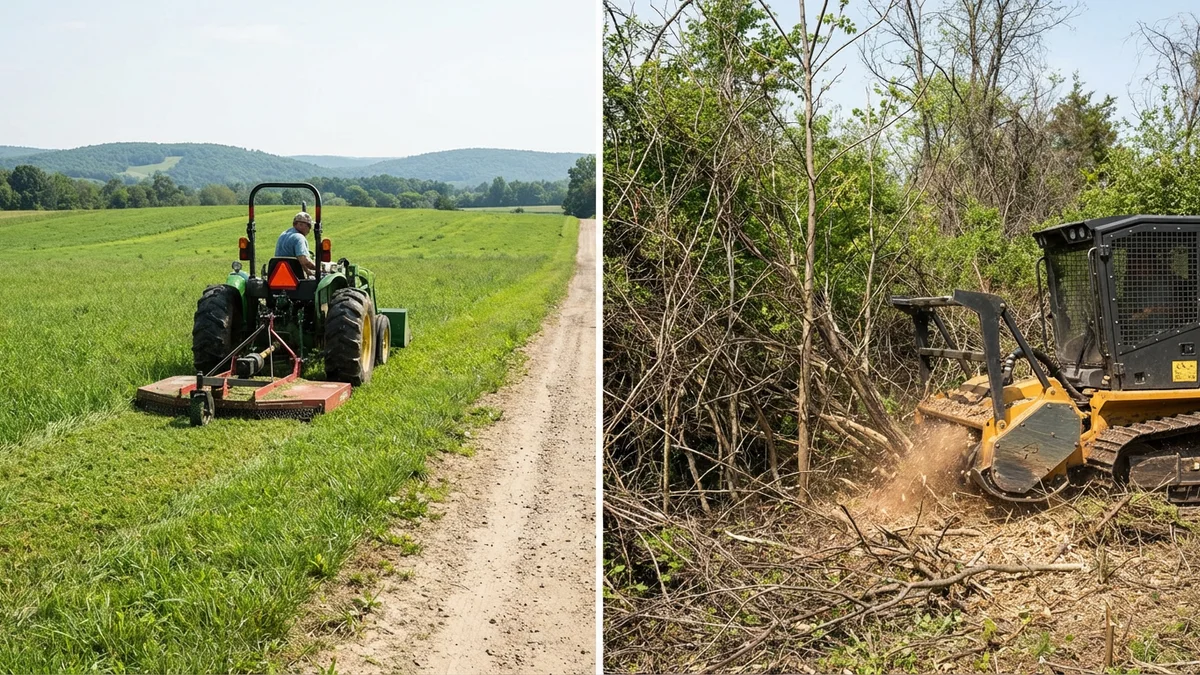
A brush hog (bush hog) is a heavy-duty rotary mower pulled behind a tractor. It cuts vegetation at three to six inches above ground level — essentially heavy mowing. The cutting mechanism is a set of swinging blades or a fixed deck with heavy blades, similar to a riding mower but much more powerful.
What it handles: Grass, weeds, goldenrod, light brush with stems under about two inches in diameter. Annual and biennial growth on fields that are mowed at least every year or two.
What it can’t handle: Woody stems over two inches. Multiflora rose with established canes. Autumn olive with three-to-five-inch trunks. Saplings of any species that have been growing for more than about three years. The bush hog blade bounces off these stems, wraps around the shaft, or damages the gearbox.
Cost: $150 to $500 per acre. Cheap — because the equipment is simpler, the tractor is smaller, and the work is faster on appropriate vegetation.
Best for: Annual hay field maintenance, meadow mowing, maintaining already-cleared fields, roadside right-of-way mowing on light growth, and any field that hasn’t gone more than two to three years without mowing.
What forestry mulching is
A forestry mulcher is a tracked machine with a high-speed rotary drum equipped with carbide-tipped teeth. It grinds vegetation — brush, saplings, small trees up to eight inches in diameter — to ground level and converts it into mulch in a single pass.
What it handles: Everything a bush hog handles, plus everything the bush hog can’t. Multiflora rose thickets, autumn olive stands, barberry carpets, cedar encroachment, sapling regrowth, vine tangles, and anything else up to about eight inches in trunk diameter.
Cost: $1,200 to $4,000 per acre. More expensive than brush hogging — because the equipment is specialized, the cutting mechanism is more powerful, and it handles vegetation that no other method except hand clearing can process.
Best for: Fallow fields with more than three to four years of neglect, wooded understory clearing, invasive species removal, fence line clearing with established woody growth, hillside work, and any area where the stems are thicker than what a bush hog can cut.
The decision framework
Use a bush hog if: – The field has been mowed within the last two to three years – The growth is grass, weeds, and light brush under two-inch stems – You’re maintaining an already-cleared field – Budget is the primary concern and the vegetation qualifies
Use a forestry mulcher if: – The field has been fallow for more than three to four years – The growth includes woody stems over two inches (autumn olive, rose, cedar, saplings) – You need the area cleared to ground level (not just mowed at three to six inches) – The terrain is steep, rocky, or inaccessible to a tractor – You need the mulch layer for erosion control or regrowth suppression
The crossover zone: Fields that have been fallow for about three to four years are in the gray area. Some stems are thick enough to challenge a bush hog but thin enough that a mulcher handles them easily. If there’s any question about whether the bush hog can handle it, it probably can’t — and a failed bush hog attempt doesn’t reduce the mulching cost. You’ve just spent money on a tool that didn’t work.
The honest comparison
| Factor | Brush hogging | Forestry mulching |
|---|---|---|
| Stem size limit | ~2 inches | ~8 inches |
| Cut height | 3–6 inches above ground | Ground level |
| Leaves mulch layer | No (just cut material) | Yes (processed into mulch) |
| Erosion control | None | Built-in (mulch layer) |
| Regrowth suppression | Minimal | Significant (light blocking) |
| Works on slopes | Limited (tractor stability) | Yes (tracked, up to 45%) |
| Works on rocky terrain | Limited | Yes (with adjusted speed) |
| Cost per acre | $150–$500 | $1,200–$4,000 |
| Best use case | Annual field maintenance | Fallow field reclamation, clearing |
When to call a bush hog operator instead of us
We believe in honesty about scope. If your field qualifies for brush hogging, you don’t need us — a local farmer or mowing contractor with a bush hog can handle it at a third to a fifth of our price. Here’s when that applies:
– Your hay field needs its annual mow – You’re maintaining a meadow that’s mowed every year or two – The growth is exclusively grass and soft weeds with no woody stems – You want a mowed appearance (short cut, not mulch)
If you call us and your property clearly needs a bush hog rather than a mulcher, we’ll tell you. We’d rather send you to the right tool than charge you for the wrong one.
Common Questions
Can a bush hog cut multiflora rose?
Only young rose with stems under ~2 inches. Established rose with 3–4 inch canes needs a forestry mulcher. Learn about forestry mulching.
Is brush hogging cheaper than forestry mulching?
Yes — $150–$500/acre vs. $1,200–$4,000/acre. But only when the vegetation qualifies. If stems are too thick, the bush hog can’t do the job at any price.
My field has been fallow for five years. Bush hog or mulcher?
Mulcher. Five-year fallow fields have woody stems that destroy bush hog equipment. Learn about pasture reclamation.
Can I bush hog first and then mulch what's left?
No benefit — the mulcher handles everything the bush hog does plus more. Bush hogging first just adds cost.
Do you offer brush hogging?
Yes — for properties where it’s the right tool. Most calls are for growth beyond bush hog capability. If yours qualifies for a bush hog, we’ll tell you honestly. Learn about our brush hogging service.
How do I know if my field is too overgrown for a bush hog?
Check stem thickness. Under 2 inches (thumb-width) → bush hog. Over 2 inches → mulcher. Send us photos and we’ll tell you. Send photos for a quick assessment.
Can a forestry mulcher maintain a field annually like a bush hog?
It can, but it’s overkill for annual maintenance. The mulcher does the initial clearing. A bush hog maintains it annually at a fraction of the cost.
What about brush mowers — where do they fit?
Brush mowers handle soft regrowth up to ~1.5 inches. They’re ideal for DIY maintenance of recently mulched areas. Not strong enough for established woody stems.
Related Services
Forestry Mulching
We grind brush, saplings, and small trees into mulch on the spot – no hauling, no burn piles, no mess.
Want the full New Jersey land clearing playbook?
This article covers one piece of the puzzle. The complete guide ties together methods, costs, permits, terrain, and contractor selection in one place.
Not sure which tool your field needs? Ask us.
We'll tell you honestly — even if the answer is a bush hog, not us.
Or call (908) 774-9235.