

Home / Field Notes — Land Clearing Knowledge Base / Tick Prevention Through Land Clearing in New Jersey
Tick Prevention Through Land Clearing in New Jersey
Published April 8, 2026 by Brush Busters • Last reviewed April 8, 2026
New Jersey has one of the highest Lyme disease rates in the country. The NJ Department of Health consistently reports thousands of confirmed and probable cases annually, concentrated in the wooded suburban and rural counties where we work — Hunterdon, Somerset, Warren, and Morris. The blacklegged tick (Ixodes scapularis), the primary vector for Lyme disease, thrives in a specific habitat: dense, humid understory with leaf litter — exactly the kind of vegetation that fills the woods on neglected residential and estate properties throughout our service area.
Land clearing doesn’t eliminate ticks from your property entirely. But removing the vegetation that creates their ideal habitat — particularly Japanese barberry — measurably reduces tick density and lowers your family’s exposure risk. This isn’t theoretical. Research from the Connecticut Agricultural Experiment Station and other institutions has demonstrated the link between barberry density and tick populations. Remove the barberry, open the understory, dry out the ground surface — and tick numbers drop.
The tick-barberry connection
Japanese barberry is the keystone species in New Jersey’s tick problem. The dense, thorny shrub creates a microenvironment at ground level that’s dramatically different from the open forest floor. Under a barberry canopy the air is humid, the soil stays moist, the leaf litter is thick, and the temperature is moderated — all conditions that blacklegged ticks require to survive through their two-year life cycle.
Researchers found that forests with heavy barberry infestations had significantly higher densities of blacklegged ticks compared to forests where barberry had been removed. The mechanism is straightforward: barberry provides the humid, sheltered conditions at ground level where ticks quest (climb onto low vegetation and wait for a host to walk by) and where they survive the desiccation that would kill them on an open, sun-exposed forest floor.
Barberry is everywhere in the wooded portions of our service area. It carpets the forest understory in Bernardsville, Peapack-Gladstone, Mendham, Roxbury, and every other community where residential lots back up to deciduous forest. Deer don’t eat it — they avoid the thorns and bitter foliage — so it spreads unchecked while deer browse every native understory plant into oblivion.
How land clearing reduces tick habitat
Clearing brush and invasive understory reduces tick habitat through four mechanisms:
Humidity reduction. Removing the dense shrub layer opens the forest floor to sunlight and air circulation. The ground surface dries faster after rain, and the ambient humidity at ground level drops. Ticks are highly sensitive to desiccation — they need sustained humidity above roughly 85% to survive. An open forest floor with mulch instead of barberry doesn’t maintain that humidity.
Leaf litter reduction. Dense understory traps and accumulates leaf litter in thick, moist layers. This litter is where ticks overwinter and where nymphal ticks (the life stage most responsible for transmitting Lyme disease to humans) reside. Forestry mulching processes the understory vegetation into coarse mulch that’s drier and less hospitable than undisturbed leaf litter.
Host habitat disruption. White-footed mice — the primary reservoir host for the Lyme disease bacterium (Borrelia burgdorferi) — thrive in dense understory. Barberry thickets provide cover, nesting habitat, and food for mice. Removing the barberry reduces mouse habitat density, which reduces the number of infected hosts available to feed larval ticks.
Questing zone elimination. Ticks quest by climbing onto low vegetation (6–24 inches above ground) and extending their front legs to grab onto passing hosts. In a barberry-filled understory, every square foot of forest floor has questing surfaces within reach of human legs. In a cleared, mulched understory, there’s nothing for ticks to climb onto — the questing zone is gone.
What to clear for tick reduction
You don’t need to clear-cut your property. Targeted clearing of the right vegetation in the right zones creates effective tick barriers.
Priority 1: Clear barberry from the woods around your house. A 50–100 foot buffer of cleared understory between your house and the dense woods reduces the tick population in the zone where your family spends time. This is the highest-ROI tick reduction investment on any property.
Priority 2: Clear along trails, paths, and play areas. Any route you walk regularly — the path to the mailbox through the woods, the trail to the back acreage, the kids’ play area at the forest edge — should have cleared understory for at least 6 feet on each side. This eliminates the questing vegetation within arm’s reach of the path.
Priority 3: Clear the full wooded understory. For properties with one to five acres of woods, clearing the entire understory — removing barberry, multiflora rose, bittersweet, and sapling regrowth while preserving the canopy trees — transforms the property from tick habitat to usable, walkable woodland. The mulch layer dries the ground surface and suppresses regrowth.
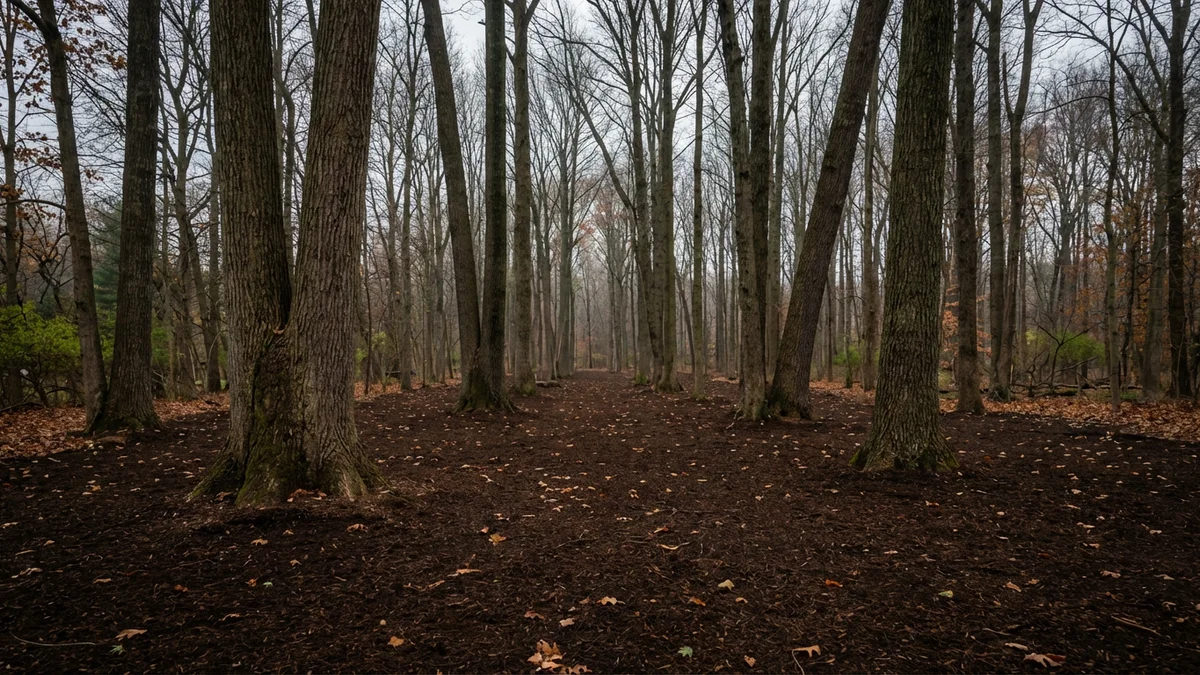
What to leave: The canopy trees stay. Mature oaks, maples, and other hardwoods don’t create tick habitat — it’s the understory below them that does. A mature forest with an open, mulched floor is dramatically less tick-dense than the same forest with a barberry-choked understory.
The clearing approach for tick management
Forestry mulching is the preferred method for tick habitat reduction because it handles the target vegetation (barberry, multiflora rose, bittersweet, low brush) in a single pass while preserving the canopy you want to keep.
The machine works through the understory grinding everything below about eight inches in diameter to ground level. The operator navigates around every canopy tree, stone wall, and feature flagged for preservation. What’s left is an open forest floor covered in a mulch layer — dry, well-lit, and inhospitable to ticks.
The mulch itself contributes to tick reduction. Coarse wood mulch dries faster than leaf litter, doesn’t compress into the moisture-trapping layers that ticks need, and creates a surface that’s easier to treat with acaricides (tick pesticides) if you choose to add chemical treatment on top of the habitat modification.
For maximum tick reduction, combine forestry mulching with: – Deer fencing around the property or high-use areas (deer carry adult ticks and spread them across the landscape) – Targeted acaricide application along the forest-lawn edge in spring and fall (a licensed applicator treats the perimeter) – Annual maintenance mowing of the cleared understory to prevent barberry regrowth
What the research says
The connection between barberry removal and tick reduction has been studied by entomologists at multiple institutions. The findings consistently show that forests with dense barberry have higher tick densities than forests without it, and that removing barberry reduces tick numbers in the treated area.
The practical implication for NJ property owners: if you’re spending money on tick spraying for your lawn but the woods behind your house are full of barberry, you’re treating the symptom while the source continues to produce ticks. Clearing the barberry first — then spraying the transition zone if needed — addresses the root of the problem.
This doesn’t mean clearing eliminates all ticks. Ticks are wildlife, and any property adjacent to woods or fields will have some tick presence. But the difference between a barberry-choked understory and a cleared, mulched one is measurable and significant — especially in the nymphal tick density, which is the life stage most likely to transmit Lyme to humans.
Common Questions
Does land clearing actually reduce ticks?
Yes — removing barberry and dense understory eliminates tick habitat. Research shows tick density drops in treated areas. Learn about our invasive removal services.
Why is Japanese barberry connected to ticks?
Barberry creates humid conditions at ground level that ticks need, and harbors white-footed mice — the primary Lyme disease reservoir host. Read about barberry removal.
How much does tick habitat clearing cost?
Understory clearing costs $3,000–$8,000 for 1–3 acres. A targeted buffer around the house runs $1,500–$3,500. Get a free estimate.
How big of a buffer do I need around my house?
50–100 feet of cleared understory between your house and dense woods. Preserve canopy trees — it’s the understory below that creates tick habitat.
Will ticks come back after clearing?
If the understory regrows, tick habitat returns. Annual maintenance mowing prevents this. One pass per year keeps the habitat modified permanently.
Is tick habitat clearing better than tick spraying?
They work best together. Clearing removes habitat (lasting effect). Spraying kills present ticks (seasonal). Clearing first makes spraying more effective.
What time of year should I clear for tick reduction?
Late fall and winter — before the spring tick season. Clear in winter, treat the perimeter in April, and you’re protected before peak nymphal season in May-June.
Do I need to remove all the brush, or just the barberry?
Barberry is the priority, but all dense understory contributes to tick habitat. For maximum reduction, clear the full understory — the mulcher handles everything in one pass.
Does deer fencing help with ticks?
Yes — deer carry adult ticks and spread them. Fencing reduces the ongoing influx. Combine with habitat clearing for the best results.
Can clearing help with lone star ticks and other species too?
Yes — clearing reduces habitat for lone star ticks too. The approach — open understory, dry ground, eliminate questing vegetation — works across tick species.
Related Services
Invasive Species Removal
Japanese knotweed, multiflora rose, mile-a-minute vine, and other NJ invasives eliminated at ground level.
Brush Clearing
Thick undergrowth, vines, and overgrown fence lines cleared down to clean, walkable ground.
Relevant City Pages
These city pages are a good fit if you want to compare the article advice with the kind of properties we see on the ground.
Helpful Resources
Homeowners
Related Articles
How to Clear an Overgrown Backyard in New Jersey
How to clear an overgrown backyard in New Jersey: when DIY works, when it doesn’t, what it costs, and how long it takes.
Want the full New Jersey land clearing playbook?
This article covers one piece of the puzzle. The complete guide ties together methods, costs, permits, terrain, and contractor selection in one place.
Ticks thrive in your understory. We remove it.
Clear barberry and dense brush from your wooded property. Reduce tick habitat and reclaim your yard.
Or call (908) 774-9235.