

Home / Field Notes — Land Clearing Knowledge Base / How to Clear an Overgrown Backyard in New Jersey
How to Clear an Overgrown Backyard in New Jersey
Published March 16, 2026 by Brush Busters • Last reviewed March 16, 2026
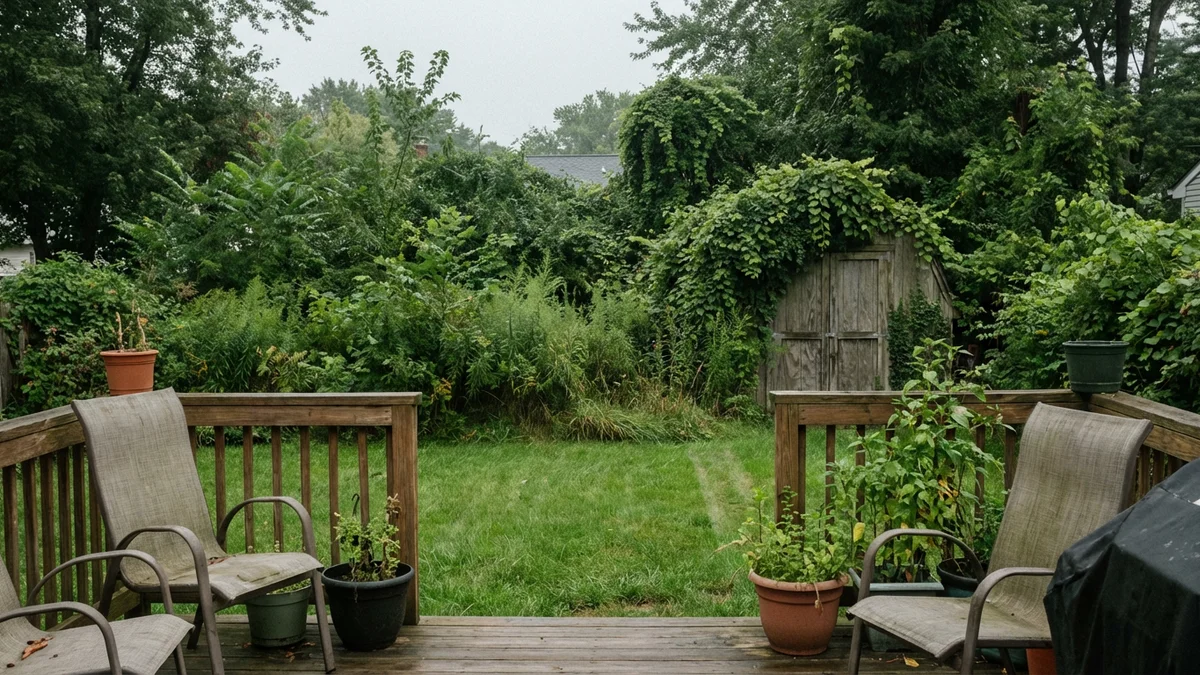
An overgrown backyard usually does not happen all at once. It creeps up. First the fence line gets shaggy. Then vines start climbing into the shrubs. Then the far corner becomes too dense to mow. Then a few volunteer trees show up, and before long there is a whole section of the property you barely use because it feels like more work than it is worth.
That is how a lot of backyard clearing projects start in New Jersey. The owner is not dealing with hundreds of acres. They are dealing with a space that used to be part of their everyday property and now feels like dead ground. The kids do not go back there. The dog disappears into it. The HOA or neighbors start noticing. You know it needs to be handled. The question is whether it is still a weekend project or whether it has crossed into something bigger.
Start by being honest about the scale
The first thing to do is stop judging the yard by the lot size on paper. A half-acre lot can have a backyard problem that feels much bigger because the overgrowth is concentrated in the hardest section. The real questions are different. Can you still walk the area? Is the growth mostly grass and weeds, or is it woody? Are there vines, thorny brush, and saplings mixed through it? Are fences, sheds, or trees buried inside the mess?
If the answer is that the space is still accessible and the growth is mostly soft material, you may be able to chip away at it yourself. If the answer is that the yard has become a thicket, the effort changes fast. Once multiflora rose, bittersweet, volunteer trees, and heavy brush get involved, a backyard stops behaving like a normal yard project.
This is especially common on the backs of properties that border woods, streams, or neglected side lots. The growth pressure comes in from the edges, and if it goes too long, the whole back section becomes a reset job rather than a cleanup.
When DIY still makes sense
There are absolutely times when a homeowner can handle the work. If the area is small, the slope is mild, and the material is mostly weeds, light brush, and a few isolated saplings, you can make progress with hand tools, a brush cutter, and patience. That is especially true if your goal is modest and you are willing to do the job in stages.
The catch is that DIY works best before the site gets away from you. Once the growth is chest-high, thorny, interlocked, or hiding stumps and debris, progress gets slow and frustrating. Many owners do fine on the first twenty percent and then hit a wall on the last eighty.
There is also the cleanup issue. Cutting a backyard down is one thing. Dealing with everything you cut is another. If you are not prepared to drag, stack, chip, or haul the material, the yard can look worse halfway through than it did before you started.
The signs the job is beyond DIY
The biggest sign is simple: you cannot see or safely walk the ground. That usually means there are hidden obstacles, old wire, loose branches, holes, rocks, or fence sections buried in the growth. Working blind with homeowner equipment is where people waste time or get hurt.
Another sign is when the vegetation is woody enough that it no longer responds to normal mowing or trimming. If you are dealing with thick vines, thorns, saplings, and repeated regrowth, the job has moved from cleanup into brush clearing. That is where professional equipment starts making sense.
Time is another factor. A contractor may clear in a day what would take a homeowner several weekends, plus a trailer full of debris trips. If your goal is to get the yard usable again quickly, the do-it-yourself route can cost more in time and frustration than owners expect.
What professional clearing changes
Professional backyard clearing is not just about using a bigger machine. It is about using the right method so the job ends in a usable finish instead of a pile of material and a dirt scar. On the right kind of property, forestry mulching is often the best tool because it grinds brush, vines, and small woody growth where it stands and leaves a mulch layer instead of debris piles.
That finish matters in a backyard. Most homeowners do not want stacked brush along the lot line or a ripped-up surface that still needs another contractor. They want room back. They want the fence visible again. They want to walk the back part of the yard without fighting through thorns.
Selective control matters too. A good operator can clear right around sheds, fences, ornamental trees, and yard edges without flattening everything that makes the property usable. That is one of the biggest differences between homeowner cleanup and a properly planned reset.
Fences and property edges are usually part of the problem
Backyard clearing and fence line clearing often overlap. A lot of “overgrown backyard” calls are really fence-row calls that have spilled outward. The vines climb the fence, the brush hides the property edge, and once the line disappears the rest of the yard starts feeling smaller too.
This matters because clearing the middle of the yard without addressing the edges often means the problem comes back fast. If the back boundary is still feeding vines and brush into the space, the owner never really catches up. That is why a good backyard clearing plan usually looks at the borders, not just the open patch in the center.
It is also why neighbors and HOAs get involved. When overgrowth crosses a visible boundary, it stops feeling like a private problem.
Backyard clearing costs depend on density, not just size
Pricing on these jobs usually comes down to how bad the overgrowth actually is. A lightly neglected backyard is not priced like a section you cannot walk through. Dense brush, invasive vines, woody stems, slope, and access all change the number. So does selectivity. Working carefully around fences, sheds, patios, or valuable trees is slower than simply opening up a rough wooded edge.
In dense counties like Bergen County and Essex, access can be a real factor too. A small backyard does not guarantee a small price if the machine has to move through a narrow gate, around septic areas, or past landscaped sections to get to the work zone.
The good news is that many homeowner jobs are still manageable because the area is limited, even when the growth is heavy. The only real way to price it honestly is to see the conditions, not just hear the lot size.
How long it usually takes
Most overgrown backyard projects move faster than owners think once the right equipment is on-site. Many can be handled in a day. Heavier sites may take longer, especially if the work involves a lot of selective edge cleanup or difficult access. But in general, production changes dramatically once you stop attacking the problem with homeowner tools.
The bigger timeline issue is usually not the clearing itself. It is how long the owner waited before deciding the yard had gone too far. A lot of the projects that feel overwhelming are actually very fixable once the site is approached the right way.
That is why the smartest time to bring in help is usually before the yard turns into a full-on thicket. But even if it already has, that does not mean the space is lost. It just means you are past the stage where trimming around the edges will solve it.
What happens after the clearing
The goal is not just to remove the problem. The goal is to keep it from becoming the same problem again. Once the site is opened up, maintenance gets much easier. A yard that could not be touched for years can usually be kept in shape with regular mowing, trimming, or seasonal touch-ups once the heavy growth is gone.
That is the real win for homeowners. You are not buying one dramatic day of work. You are buying back a section of property that becomes manageable again. Maybe it turns into a play area, garden space, dog run, or just a backyard you are not embarrassed by. The practical value is in the reset.
How to decide what to do next
If the growth is light and you still have clean access, DIY may be worth trying. If the area is dense, woody, thorny, or hiding the ground, it is probably time to stop thinking in terms of yard work and start thinking in terms of site clearing. That shift helps owners make better decisions faster.
The first real step is simple. Take a few photos. Stand at the edge of the area and ask yourself whether you can describe the ground underneath it. If you cannot, you are probably past homeowner-tool territory. That is when it makes sense to talk to a contractor or start with our homeowners page to see how these projects usually go.
The bottom line is that overgrown backyards are fixable. The mistake is waiting so long that the problem keeps getting harder while the usable part of the property keeps getting smaller. Once the space is reset, keeping it under control is usually the easy part.
Common Questions
Can I clear an overgrown backyard myself?
Sometimes, if the area is small and the growth is light. Once the space is dense with vines, saplings, thorns, or hidden obstacles, DIY gets much harder and slower.
What tools work for light backyard overgrowth?
For light growth, owners often use pruners, a string trimmer, a brush cutter, and a mower once the area is opened up.
When should I call a professional?
Call a pro when the yard is no longer walkable, the growth is woody or thorny, the slope is rough, or you need the area opened up quickly and cleanly.
How long does backyard clearing take?
Many backyard projects can be cleared in a day once equipment is on-site, though heavier growth can take longer.
Will brush grow back after the yard is cleared?
Some regrowth is normal. The key is getting the site back to a manageable condition so maintenance becomes easy again.
Can you clear around fences and sheds?
Yes. Selective clearing around fences, sheds, trees, and property edges is one of the main reasons owners bring in professional equipment.
What if I do not know the exact area size?
That is fine. Photos and a basic description are usually enough to start the conversation.
Does an HOA matter for backyard clearing?
It can. Some owners call because the HOA wants the overgrowth handled, especially along rear lot lines and common boundaries.
Is forestry mulching too aggressive for a backyard?
Not when the equipment and operator match the site. On the right property, mulching is one of the fastest ways to restore usable yard space.
What is the first step if my yard is completely overgrown?
Start by defining the goal, taking a few photos, and deciding whether you need simple cleanup or a full reset with professional clearing.
Related Services
Brush Clearing
Thick undergrowth, vines, and overgrown fence lines cleared down to clean, walkable ground.
Forestry Mulching
We grind brush, saplings, and small trees into mulch on the spot – no hauling, no burn piles, no mess.
Fence Line Clearing
Buried fence rows and overgrown property borders opened up and made visible again.
Relevant City Pages
These city pages are a good fit if you want to compare the article advice with the kind of properties we see on the ground.
Related Articles
Forestry Mulching vs. Bulldozing: Which Is Right for Your NJ Property?
Forestry mulching vs. bulldozing for NJ properties: compare cost, speed, soil impact, and when each method makes sense.
See Forestry Mulching vs. Bulldozing: Which Is Right for Your NJ Property?
Land Clearing Cost Per Acre in New Jersey: Pricing Guide
New Jersey land clearing cost per acre explained: method, terrain, tree size, access, and how to compare quotes without getting burned.
See Land Clearing Cost Per Acre in New Jersey: Pricing Guide
Japanese Knotweed Removal in New Jersey: How to Actually Kill It
How to remove Japanese knotweed in New Jersey: identification, why it spreads, why cutting fails, and how mulching plus follow-up treatment works.
See Japanese Knotweed Removal in New Jersey: How to Actually Kill It
Want the full New Jersey land clearing playbook?
This article covers one piece of the puzzle. The complete guide ties together methods, costs, permits, terrain, and contractor selection in one place.
Want Help Sorting Out the Next Step?
If the article answered part of the question but you still need a site-specific answer, send us the address and a few photos.
Or call (908) 774-9235.