

Home / Field Notes — Land Clearing Knowledge Base / Japanese Knotweed Removal in New Jersey: How to Actually Kill It
Japanese Knotweed Removal in New Jersey: How to Actually Kill It
Published March 18, 2026 by Brush Busters • Last reviewed March 18, 2026
Japanese knotweed is one of those plants that makes property owners feel like they are losing an argument with the ground itself. You cut it, mow it, or knock it down, and a few weeks later it looks like nothing happened. In some cases it comes back thicker. In others it spreads sideways and shows up where it was not obvious before.
That frustration is why people search for knotweed removal in New Jersey over and over again. They are not just looking for somebody to cut it back. They want to know how to actually beat it. The hard truth is that knotweed is rarely a one-step problem. The good news is that if you understand how it spreads and use the right sequence, you can get it under control instead of just feeding the cycle.
Why knotweed is such a problem in New Jersey
Knotweed loves the kinds of places New Jersey has a lot of: stream edges, roadside embankments, disturbed fill, drainage corridors, old home sites, and property lines where years of unchecked growth have piled up. It is especially common where water and disturbance meet. That is why owners often notice it near creeks, wet swales, retention edges, and places where soil has been moved in the past.
The plant also spreads in a way that makes casual cleanup risky. New Jersey agriculture guidance notes that knotweed spreads primarily by rhizome fragmentation. In plain language, that means broken pieces of the underground root system can help it start over somewhere else. So the “just knock it down and move it out” approach can make the infestation worse if it is handled carelessly.
Another wrinkle is that many properties do not just have Japanese knotweed alone. They may have related knotweed species or hybrids mixed in, plus vines, brush, and volunteer saplings growing right through the patch. By the time owners call us, the problem is often no longer a neat ornamental planting gone bad. It is a dense, unusable section of ground.
How to identify it before you start cutting
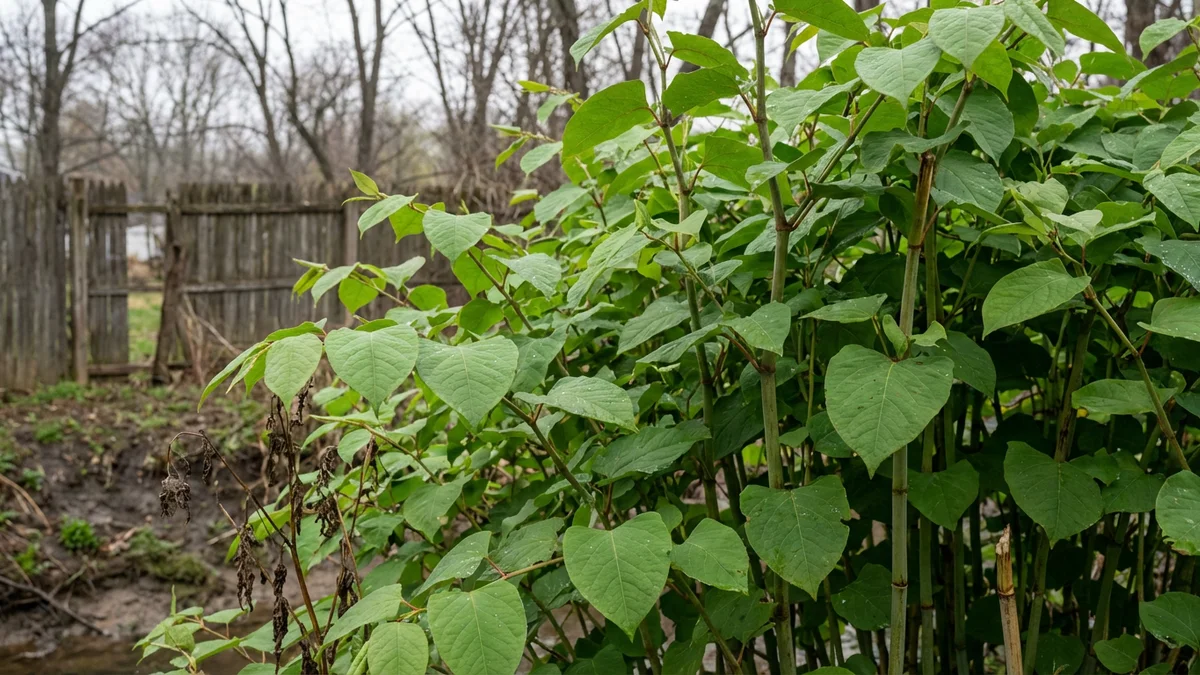
Knotweed usually shows itself with upright, hollow, jointed stems that remind people of bamboo. The leaves are broad, green, and fairly clean-edged, and by mid to late season the patch often looks like a solid wall. In winter, the brown canes remain standing and mark out the footprint pretty clearly.
The shape of the patch matters. Knotweed often forms a colony instead of a few scattered plants. If you are seeing a tight stand expanding every year from the same base area, that is a sign you are not dealing with ordinary brush. If it is near water, the growth may follow the bank or ditch line rather than staying in a perfect circle.
If you are unsure what you are looking at, that is the first thing to figure out. Misidentifying knotweed leads people into the wrong plan. Treating it like generic brush can waste a whole season.
Why cutting it back is not enough
This is where most people lose ground. They think visible growth equals the whole problem. It does not. The canes you see are only the top of the system. The real issue is below ground. When you cut knotweed once and walk away, the rhizomes still have stored energy and usually send up new shoots.
That is why a knotweed patch can look “cleared” for a short time and still be very much alive. In fact, repeated top-cutting without a bigger plan can train owners into a loop where they spend time every year and never get ahead. The patch may look tidier for a few weeks, but the underground system stays in control.
That does not mean mechanical clearing has no role. It just means mechanical clearing needs to be used correctly. The goal is not to pretend the top growth is the whole story. The goal is to remove the mass above ground so the area becomes accessible and the follow-up work becomes realistic.
Where forestry mulching fits in
When knotweed is mixed with heavy brush, vines, and other overgrowth, forestry mulching can be the fastest way to reset the site. It takes the tall, tangled mess down to a manageable level in one mobilization. That matters when the infestation has swallowed a bank, an overgrown side yard, or the edge of a larger property.
Mulching is especially useful when knotweed is not the only problem. Many New Jersey sites also have bittersweet, multiflora rose, volunteer trees, and general brush pressure around the patch. A clean mechanical pass opens the area up and makes it possible to see what the real footprint looks like. Without that step, follow-up treatment can be guesswork.
But this is the part that needs to be said plainly: mulching is usually the first step, not the whole solution. If you mulch knotweed and stop there, regrowth is likely. The underground network is still in place. That is why knotweed control is usually a combination approach, not a one-and-done clearing job.
Why follow-up treatment matters
Long-term knotweed control usually means pairing mechanical reduction with a follow-up plan. Depending on the site, that may involve repeated monitoring and targeted treatment once regrowth comes back in a more manageable form. The exact approach depends on where the patch sits, how large it is, and whether there are nearby environmental limits on what can be done.
This matters even more on properties near streams or wetlands. If the knotweed is growing along a bank or inside a wet corridor, you cannot just charge in as if it were a dry backyard hedge. New Jersey wetland and transition-area rules may affect what can be cleared or treated there. That is why we talk through location, access, and regulatory context before acting like every patch should be handled the same way.
On dry upland sites, the follow-up sequence can be simpler. Near water, it often needs more planning. The mistake is thinking the plant cares about your shortcut. Knotweed is built to punish shortcuts.
Why DIY control often stalls out
There are knotweed cases where a very small patch can be managed by a disciplined owner over time. But most calls we get involve patches that are already beyond that stage. The canes are tall, the stand is dense, the surrounding brush is thick, and the owner has already spent at least one season trying to keep up with it.
DIY control usually breaks down for one of three reasons. First, the owner underestimates how wide the underground spread may be. Second, the patch is mixed into too much other growth to work safely or efficiently by hand. Third, the work gets inconsistent. Knotweed loves inconsistency because it does not need you to miss many steps before it retakes the ground.
That is especially true on larger residential edges and semi-rural properties in places like Passaic County or Morris County, where knotweed often runs right along drainage features and property margins. Once the patch is part of a bigger overgrowth problem, mechanical clearing plus a management plan usually makes a lot more sense than trying to win with loppers and weekends.
What knotweed removal usually costs
There is no single price because knotweed jobs vary a lot. A small, isolated patch on accessible dry ground is one thing. A thick infestation mixed into brush on a slope or stream edge is something else entirely. The main price drivers are the size of the patch, how much other growth is mixed in, whether access is clean, and whether the job is simple clearing or part of a longer control plan.
Brush clearing can sometimes be enough if the infestation is light and the goal is basic access. On more serious sites, the cost reflects both the initial clearing and the reality that knotweed control may need follow-up. That is actually the honest way to price it. Cheap one-step promises are usually just another version of kicking the problem down the road.
If the patch is near wetlands, steep drainage corridors, or regulated buffers, the project may also involve more review before work starts. That does not always mean the job cannot be done. It just means the site conditions matter.
The smartest way to handle a heavy infestation
The best knotweed plan usually starts with seeing the whole site, not just the canes. What else is growing there? How close is the patch to water? Is the owner trying to reclaim usable yard space, reopen a fence line, or prepare the site for another project? Is access simple, or does the machine have to work through tight residential space?
Once that is clear, the job becomes easier to sequence. First reduce the mass and regain access. Then watch the regrowth. Then follow through. That kind of plan is not flashy, but it is how stubborn invasive plants get beaten in real life.
The owners who make the fastest progress are usually the ones who stop looking for a magic cut-and-done answer and start treating knotweed like the aggressive root-driven problem it is. Once that mindset changes, the right approach becomes much clearer.
The bottom line
Japanese knotweed is hard to kill because the visible plant is only part of the fight. If you only attack the top growth, the rhizomes keep the infestation alive. That is why so many DIY attempts fail and so many owners end up right back where they started the next season.
The better approach is usually a combination of mechanical clearing and follow-up management. On heavily overgrown New Jersey properties, that often means starting with invasive species removal or a mulching pass to make the site usable again, then following through instead of stopping the minute the patch looks better.
If the area is thick, tangled, or close to water, the smartest first move is a site review. Knotweed is beatable, but only if the plan matches how the plant actually behaves.
Common Questions
What does Japanese knotweed look like?
Japanese knotweed grows in dense stands with hollow bamboo-like stems, broad leaves, and fast summer growth.
Is Japanese knotweed common in New Jersey?
Yes. Knotweed is common in many parts of New Jersey, especially around streams, roadsides, disturbed ground, and older residential properties.
Can you kill knotweed by cutting it once?
No. Cutting alone almost never solves the problem because knotweed regrows from underground rhizomes.
Does mowing make knotweed spread?
It can. Broken stems and rhizome fragments can help spread knotweed if the material is moved or disturbed carelessly.
Can forestry mulching remove knotweed?
Forestry mulching can clear the top growth quickly, but long-term control usually requires follow-up treatment because the underground system remains active.
Why is knotweed so hard to get rid of?
It spreads aggressively through underground rhizomes and can come back from small fragments left in the soil.
Is knotweed worse near water?
Yes. Knotweed often thrives along streambanks, drainage corridors, and wet edges, which can also add regulatory concerns.
How long does knotweed treatment take?
Serious knotweed control usually takes more than one visit or growing season because regrowth monitoring is part of the process.
Will knotweed come back after mulching?
It can if there is no follow-up plan. Mulching is often the first step, not the last one.
Who should I call for heavy knotweed on my property?
If the infestation is thick, widespread, or close to structures, slopes, or waterways, it is smart to start with a professional site review.
Related Services
Invasive Species Removal
Japanese knotweed, multiflora rose, mile-a-minute vine, and other NJ invasives eliminated at ground level.
Brush Clearing
Thick undergrowth, vines, and overgrown fence lines cleared down to clean, walkable ground.
Forestry Mulching
We grind brush, saplings, and small trees into mulch on the spot – no hauling, no burn piles, no mess.
Relevant City Pages
These city pages are a good fit if you want to compare the article advice with the kind of properties we see on the ground.
Related Articles
Forestry Mulching vs. Bulldozing: Which Is Right for Your NJ Property?
Forestry mulching vs. bulldozing for NJ properties: compare cost, speed, soil impact, and when each method makes sense.
See Forestry Mulching vs. Bulldozing: Which Is Right for Your NJ Property?
Land Clearing Cost Per Acre in New Jersey: Pricing Guide
New Jersey land clearing cost per acre explained: method, terrain, tree size, access, and how to compare quotes without getting burned.
See Land Clearing Cost Per Acre in New Jersey: Pricing Guide
Do You Need Permits for Land Clearing in New Jersey?
Do you need a permit to clear land in New Jersey? Learn when tree ordinances, wetlands, and the Highlands Act can affect your project.
Want the full New Jersey land clearing playbook?
This article covers one piece of the puzzle. The complete guide ties together methods, costs, permits, terrain, and contractor selection in one place.
Want Help Sorting Out the Next Step?
If the article answered part of the question but you still need a site-specific answer, send us the address and a few photos.
Or call (908) 774-9235.