

Home / Field Notes — Land Clearing Knowledge Base / Land Clearing Cost Per Acre in New Jersey: Pricing Guide
Land Clearing Cost Per Acre in New Jersey: Pricing Guide
Published March 19, 2026 by Brush Busters • Last reviewed March 19, 2026
People love to search “land clearing cost per acre” because it sounds like a clean, simple pricing formula. The truth is that land clearing in New Jersey does not work that way. You can absolutely talk in acreage, but acreage by itself does not tell you much. One acre of thin field edge and one acre of tangled saplings on a steep, rocky slope are two completely different jobs.
That is why online per-acre numbers often create more confusion than clarity. They can be useful as a starting point, but they are not a quote. If you want to understand what land clearing really costs in New Jersey, you need to look at what is growing there, how the ground lays, how the equipment gets in, and what you need the site ready for when the work is done.
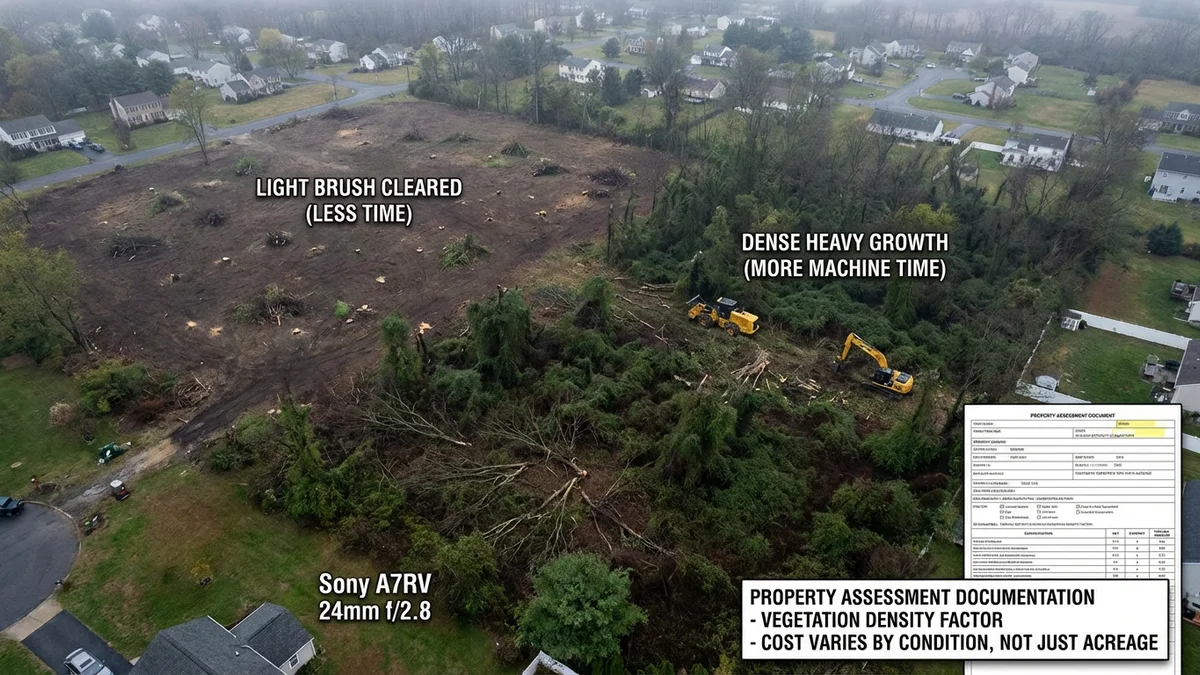
Why acreage is only part of the story
Landowners naturally think in acres because that is how the property is described on paper. Contractors do too, but we cannot stop there. The acreage tells us size. It does not tell us density, selectivity, terrain, or how much production we can actually get in a day.
A one-acre backyard with thorny undergrowth, multiflora rose, and scattered six-inch saplings can easily take more effort than a two-acre open parcel with lighter growth. An acre tucked behind a house with narrow access is different from an acre with a straight shot from the road. An acre in the hills of Sussex County is different from an acre on flatter suburban ground.
That is why experienced contractors usually look at acreage as one pricing factor, not the pricing factor. When you hear “cost per acre,” think of it as shorthand, not a universal number.
The method changes the price
The clearing method is one of the biggest cost drivers. If the job is a good fit for forestry mulching, the price structure is often better because the machine clears and processes the vegetation in one pass. That cuts down on labor, hauling, dump fees, and extra cleanup. It is one reason mulching is often the most efficient choice for residential and light-commercial clearing in New Jersey.
If the job needs land clearing for a construction sequence, the scope may widen quickly. Maybe the owner needs broad site access, more aggressive removal, staking lanes for builders, or a cleaner transition into excavation. Now you may be pricing coordination, utility marking, selective tree protection, or work around future house footprints and driveway locations.
If the property is headed toward full commercial site work, the number can change again. A parcel that needs large-scale staging, tighter scheduling, or coordination with engineers and other trades belongs in a different category than a backyard reclamation job.
Vegetation density matters more than most owners expect
The faster a machine can move, the better the cost per acre looks. Dense growth slows everything down. That includes thorny brush, interlocked vines, heavy understory, and saplings that force the operator to work more deliberately. In New Jersey, invasive species are often a hidden price driver because they pack a lot of growth into a small footprint.
Japanese knotweed, bittersweet, porcelainberry, mile-a-minute vine, and multiflora rose all affect production differently. Knotweed can be thick and wet around stream corridors. Multiflora rose tangles into tight masses. Porcelainberry and bittersweet climb and wrap through everything around them. Even when the acreage is modest, that kind of growth can turn a simple-looking job into a slow one.
Tree size matters too. An acre of brushy growth under three inches is not the same as an acre with repeated six- to eight-inch stems mixed through it. Even if the machine can handle the material, heavier stems reduce production and change the final number.
Terrain can swing price fast in New Jersey
New Jersey terrain is a big reason national averages do not help much here. Slopes, ledge, drainage crossings, rock, and uneven ground are all normal on local jobs. An acre on rolling ground in Warren County or a wooded hillside in western Morris County does not move like an acre of open, accessible land.
Steep slopes slow production because the operator has to work with the contour, maintain footing, and manage the machine carefully. Rocky soil matters because it changes line choice and pace. Soft ground matters because certain areas may need to be approached differently or left alone until conditions improve. Tight suburban setbacks matter because there is less room to work and less room to stage.
This is one reason two contractors can look at the same acreage and come back with very different numbers. The experienced one is often pricing the real site, not just the map.
Access is a price factor all by itself
Owners sometimes focus on what needs to be cleared and forget how the machine actually gets there. Access can make or break production. A property with a wide driveway, open approach, and direct line to the work area is simpler than one where the machine has to thread around structures, ornamental plantings, septic areas, or narrow property edges.
Long travel distances across a property matter too. If a contractor spends a big part of the day just getting in and out or repositioning, that time becomes part of the project cost. The same goes for jobs where the machine has to work carefully around trees, stone walls, fencing, utility corridors, or wet ground.
In dense counties like Bergen or Essex, tight access can be one of the biggest reasons a small lot is not a cheap lot. The acreage is small, but the work is controlled, detailed, and slower.
The end goal affects what should be in the quote
Pricing only makes sense when it matches the goal. If the owner wants the property opened up so it is walkable and maintainable again, that is one scope. If the owner wants the property ready for survey crews, excavation, driveway work, or a new build, that is another. If the site needs to be marketable for a resale within a few weeks, that can shape the schedule and priorities too.
This is where a lot of quote comparisons go sideways. One contractor may be pricing simple vegetation removal. Another may be including more selectivity, cleaner edge work, or prep for the next phase. On paper, one looks more expensive. In practice, they may not be quoting the same outcome.
That is why it helps to state the goal clearly when you ask for pricing. “I need this brush knocked down” is different from “I need this cleared for a builder and surveyor in two weeks.”
Red flags when comparing estimates
The lowest number is not always the best number. A quote can look cheap because it leaves out the messy parts. Maybe it does not address debris handling. Maybe it assumes broad clearing when you actually want selective work. Maybe it is based on a day rate that can keep rising if the job takes longer than expected.
Look closely at what is included. Is the price fixed, or is it an open-ended hourly estimate? Does it describe the actual area and the type of growth being cleared? Does it mention access challenges, slopes, or trees you want kept? Does it explain what the finished surface will look like?
If a quote is vague, you are not comparing apples to apples. That is how owners end up frustrated even when they thought they saved money up front.
Why photos help, but site visits still matter
Photos are useful. They help us understand the density, vegetation type, and general scale. They are a great way to get a rough first conversation going. But photos rarely tell the full story. They flatten slope, hide rock, and miss access issues. They also make it hard to judge how far the work area really runs once you get into the property.
That is why the most accurate pricing usually comes after a site visit. We can walk the property, see what needs to stay, flag any wet areas or utility concerns, and price the job based on the real conditions instead of guesswork. If you want the cleanest path to a reliable number, get a quote with photos and the property address, then plan on having the site reviewed.
There is no honest shortcut around the real conditions
People want a per-acre number because they are trying to budget. That makes sense. But the fairest number comes from understanding the work, not from pretending every acre behaves the same way. The more unique the property, the less helpful a generic average becomes.
That does not mean pricing is arbitrary. It means good pricing is tied to production. Density, stem size, access, slope, selectivity, and the final goal all shape production. Production shapes price. That is the real chain.
When a contractor explains the job that way, that is usually a good sign. It means they are looking at your site like a real project, not throwing out a number to win the call.
How to get a quote that actually helps you make a decision
Start with the property address and a simple description of the goal. Tell the contractor what is overgrown, how much area you think is involved, and what you need the land ready for next. Mention any steep areas, wet spots, fences, or structures nearby. Share photos from a few angles if you can.
Then ask the right follow-up questions. Is the price fixed? What is the finish going to look like? Are there any obvious permit or access issues? Does the job look like a forestry mulching project, a lot-prep project, or something bigger? Those answers matter more than chasing a generic statewide average.
The best clearing estimate is not the one that sounds lowest. It is the one that reflects what is actually on your property and gets you to the next step without surprises.
Common Questions
What is the average land clearing cost per acre in New Jersey?
There is no single statewide average that fits every site. New Jersey clearing costs vary widely based on brush density, tree size, slope, access, and whether the work is mulching, excavation prep, or full construction clearing.
Why do some properties cost much more per acre than others?
Because an acre of light field growth is not the same as an acre of rocky woods packed with vines, saplings, and limited access.
Is forestry mulching charged by the acre?
Sometimes, but many jobs are priced by the actual scope and production conditions rather than a flat per-acre number.
Does tree size affect price?
Yes. Larger stems slow production and may require different equipment or a different clearing approach.
Do steep slopes increase land clearing costs?
Yes. Slopes usually slow production, limit machine movement, and require a more controlled approach.
Is it cheaper to clear land in winter?
Sometimes. Frozen or firmer ground can help production on some sites, but the real cost still depends on the vegetation and site conditions.
What makes a quote suspiciously low?
Low quotes are often missing important pieces like debris handling, access work, selectivity, stump treatment, or follow-up cleanup.
Does access change the total price?
Absolutely. Tight driveways, long mobilization paths, soft ground, and limited turning room can all affect price.
Can you quote land clearing without seeing the site?
A rough range is possible from photos, but an accurate quote usually requires seeing the property.
How do I get the most accurate clearing estimate?
Provide the property address, your goal for the land, a few photos, and any information about terrain, boundaries, wetlands, or trees you want to keep.
Related Services
Land Clearing / Lot Prep
Residential and small commercial lots cleared and prepped for building, grading, or landscaping.
Forestry Mulching
We grind brush, saplings, and small trees into mulch on the spot – no hauling, no burn piles, no mess.
Commercial Land Clearing
Forestry mulching and site clearing for builders, developers, municipalities, and HOA common areas across New Jersey.
Relevant City Pages
These city pages are a good fit if you want to compare the article advice with the kind of properties we see on the ground.
Related Articles
Forestry Mulching vs. Bulldozing: Which Is Right for Your NJ Property?
Forestry mulching vs. bulldozing for NJ properties: compare cost, speed, soil impact, and when each method makes sense.
See Forestry Mulching vs. Bulldozing: Which Is Right for Your NJ Property?
Japanese Knotweed Removal in New Jersey: How to Actually Kill It
How to remove Japanese knotweed in New Jersey: identification, why it spreads, why cutting fails, and how mulching plus follow-up treatment works.
See Japanese Knotweed Removal in New Jersey: How to Actually Kill It
Do You Need Permits for Land Clearing in New Jersey?
Do you need a permit to clear land in New Jersey? Learn when tree ordinances, wetlands, and the Highlands Act can affect your project.
Want the full New Jersey land clearing playbook?
This article covers one piece of the puzzle. The complete guide ties together methods, costs, permits, terrain, and contractor selection in one place.
Want Help Sorting Out the Next Step?
If the article answered part of the question but you still need a site-specific answer, send us the address and a few photos.
Or call (908) 774-9235.