
Home / Guide / Land Clearing in New Jersey
The Complete Guide to Land Clearing in New Jersey
If you own property in New Jersey and you’re dealing with overgrown land — whether it’s a half-acre backyard that’s gotten away from you or fifty acres of inherited farmland you’ve never been able to walk — this guide is for you. We wrote it because most of the information online about land clearing is either generic national content that doesn’t apply to New Jersey’s specific regulations, terrain, and vegetation, or it’s a sales pitch disguised as an article.
This is neither. This is everything we know about clearing land in this state — the methods, the costs, the permits, the species you’re fighting, the terrain you’re working on, and the decisions you need to make before a single machine touches your property. We’re Brush Busters, an owner-operated forestry mulching company based in Annandale, NJ. We clear land across Hunterdon, Somerset, Warren, and Morris counties. We know this ground because we work on it every week.
Use the table of contents to jump to the section that matters most to you, or read the whole thing. Either way, you’ll walk away knowing more about land clearing in New Jersey than most contractors.
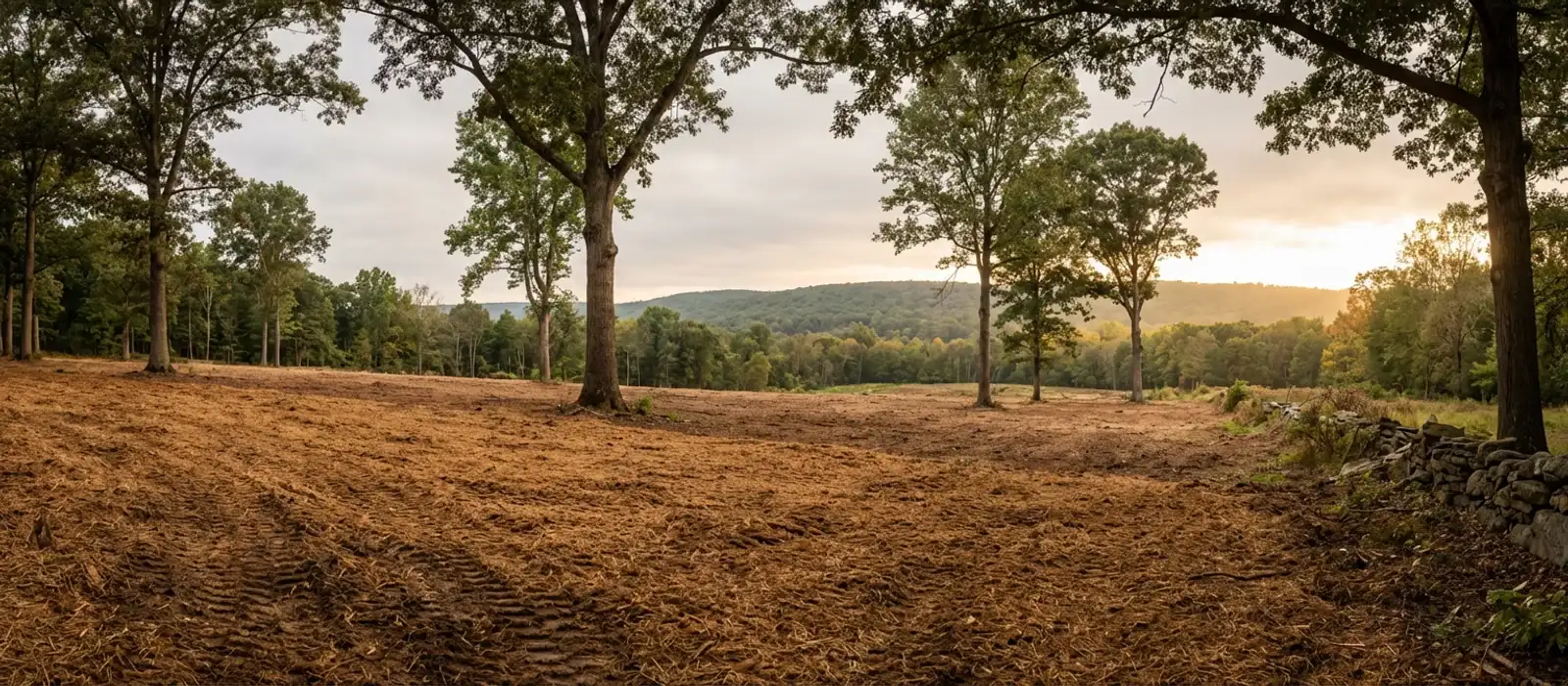
Table of Contents
- What land clearing actually means
- The five methods of clearing land
- What land clearing costs in New Jersey
- New Jersey’s regulatory landscape
- When you need a permit — and when you don’t
- The vegetation you’re clearing
- Common project types in New Jersey
- Choosing the right contractor
- The terrain of New Jersey — county by county
- When to clear: the seasonal guide
- What to expect during and after clearing
- Frequently asked questions
What land clearing actually means
Land clearing is the process of removing unwanted vegetation from a property — brush, saplings, small trees, vines, invasive species, and overgrowth — to make the ground usable. That’s the simple definition, but the scope of what “land clearing” covers varies dramatically depending on who’s talking.
When a homeowner says “I need my land cleared,” they usually mean they want the brush and small trees removed from an area so they can see, walk through, and use the space. When a builder says it, they mean they need everything off a lot — vegetation, stumps, and sometimes topsoil — so they can pour a foundation. When a farmer says it, they mean a fallow field needs to be returned to productive ground.
What land clearing is NOT: it’s not tree removal in the arborist sense (taking down a single large tree near a house), it’s not landscaping (planting and maintaining ornamental beds), and it’s not excavation (moving earth with heavy equipment). Land clearing handles the vegetation layer between the ground and the canopy. Some projects overlap with those other services, but the core of clearing is taking an area from overgrown to usable.
In New Jersey, land clearing almost always involves dealing with invasive species. The state has one of the most aggressive invasive plant profiles on the East Coast, and any property that’s been neglected for more than a few years has been colonized. That’s not optional information — it shapes the method you use, the cost, and whether follow-up treatment is needed. If the problem is already affecting daily use, our guides on tick prevention through clearing, poison ivy removal, and giant hogweed and poison hemlock show how overgrowth becomes a health and safety issue, not just a cleanup job.
The five methods of clearing land
There are five ways to clear land. Each one has a specific set of conditions where it’s the right choice, and conditions where it’s the wrong one. Most properties in New Jersey are best served by forestry mulching, but not all.
Forestry mulching
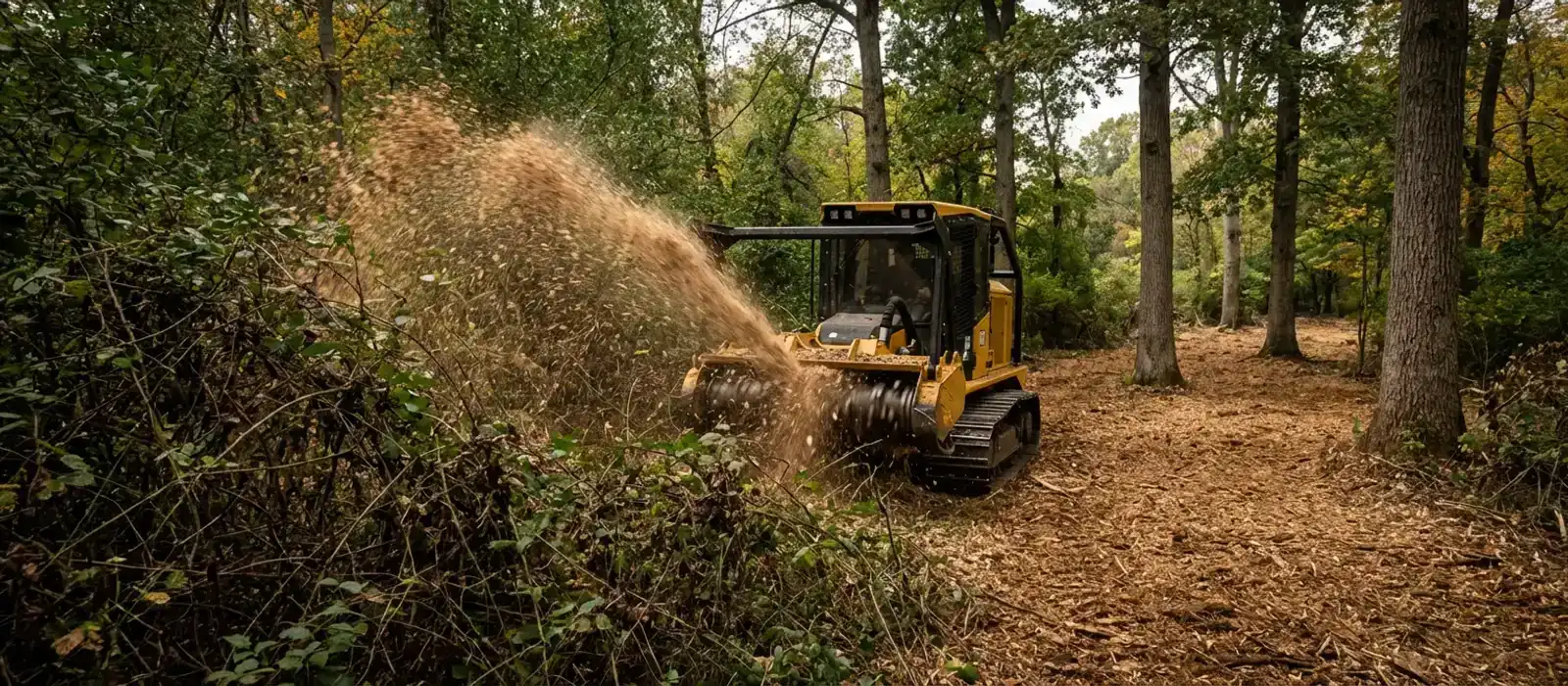
Forestry mulching uses a tracked machine with a high-speed rotary cutting head that grinds brush, saplings, and small trees (up to about 8 inches in diameter) into mulch at ground level. Everything is processed in a single pass. Nothing is hauled off the property. The shredded material stays on the ground as a natural mulch layer that suppresses regrowth, prevents erosion, and decomposes into the soil over six to eighteen months. If you want the real timeline, our breakdown of what happens after mulching covers regrowth, settlement, and what the site looks like over the next year.
This is the method we use on the vast majority of jobs, and for good reason. It handles New Jersey’s invasive brush, works on slopes and rocky terrain, preserves the topsoil, and leaves the property looking finished — not stripped. The machine is selective, meaning the operator can clear around trees, structures, and features you want to keep.
Forestry mulching is the right choice for residential backyards, overgrown lots, fence line clearing, pasture reclamation, trail cutting, invasive species removal, and hillside work. It’s NOT the right choice if you need every stump removed below grade for construction — that requires excavation.
Cost range in NJ: $1,200 to $4,000 per acre for field conditions, $2,000 to $6,000 per acre for dense wooded understory, higher for extreme terrain.
Bulldozing / conventional clearing
Bulldozing uses a tracked dozer with a blade to push vegetation, stumps, and topsoil off the clearing area. Everything gets pushed into windrows or piles that are then either burned, hauled off, or buried. This method is fast on flat ground and removes everything, including stumps — which makes it the standard for commercial construction site prep where the ground needs to be graded anyway.
The downside is destruction. A dozer strips the topsoil along with the vegetation. On New Jersey’s thin, rocky Highland soils, that topsoil took centuries to build and won’t come back in your lifetime. The exposed subsoil erodes immediately, which is why erosion control after clearing matters so much on bulldozed sites. The method also creates massive debris piles that need secondary handling — burning (which requires permits and may not be allowed), hauling (which is expensive), or on-site burial (which creates future problems if the land is ever developed).
Bulldozing is the right choice for commercial construction sites where grading is the next step anyway. It’s the WRONG choice for residential clearing, pasture reclamation, hillside work, or any project where you want to preserve the soil.
Cost range in NJ: $1,500 to $5,000 per acre plus debris disposal.
Hand clearing
Hand clearing uses a crew with chainsaws, brush cutters, and loppers to cut vegetation manually. Everything that’s cut needs to be hauled, chipped, stacked, or burned. This method is precise — the crew can work around any feature — but it’s extremely labor-intensive, slow, and expensive on anything larger than a quarter acre.
Hand clearing makes sense for small, tight spaces where no machine can access — a narrow side yard between two houses, a fenced courtyard, or the immediate perimeter of a structure. It also works for selective clearing where individual plants need to be identified and either removed or preserved (for example, a woodlot where the owner wants specific invasive species removed and native plants left).
Cost range in NJ: $3,000 to $10,000 per acre. A hand crew takes three to five times longer than a forestry mulcher for the same area.
Brush hogging / bush hogging
Brush hogging uses a tractor-mounted rotary mower (the “bush hog”) to mow vegetation at a height of three to six inches above ground level. It’s essentially heavy-duty mowing. This method handles grass, weeds, and light brush with stems under about two inches in diameter. Anything thicker bounces off the mower or wraps around the shaft.
In New Jersey, brush hogging is useful for maintaining fields that are mowed annually — hay fields, meadows, and agricultural ground that hasn’t been neglected long enough for woody plants to establish. It’s NOT useful for overgrown properties where autumn olive, multiflora rose, and cedar have established, because those plants are far too woody for a bush hog to cut. This is the method most farmers try first on fallow fields — and the one that fails as soon as the growth passes the two-inch stem mark.
Cost range in NJ: $150 to $500 per acre. Cheap, but only works on light growth.
Excavation
Excavation uses a hydraulic excavator to dig out vegetation, root balls, and soil. This is the most extreme method — it removes everything including the root systems. It’s used when stumps need to be extracted below grade for construction, when contaminated soil needs to be removed, or when the site needs to be regraded to a specific elevation.
Excavation is NOT a vegetation management method — it’s earthwork. The cost is an order of magnitude higher than any other method, and the site disturbance is total. It’s the right tool for a construction project, not for clearing an overgrown backyard.
Cost range in NJ: $5,000 to $15,000+ per acre depending on depth and disposal.
Which method should you use?
For most residential and agricultural land clearing in New Jersey, forestry mulching is the answer. It handles the woody invasive species that dominate NJ properties, preserves topsoil, works on slopes, and costs less per acre than hand clearing or bulldozing. The only common exceptions are: commercial construction sites where grading follows clearing (bulldozing), very small or inaccessible spaces (hand clearing), and annually maintained fields with light grass growth (brush hogging). If you are comparing edge cases, our articles on tree removal vs. forestry mulching and brush hogging vs. forestry mulching explain where those lines actually get drawn.
If you’re not sure which method your property needs, a good contractor will tell you during the site visit — before you’ve committed to anything.
Want to know which method is right for your property?
We’ll walk your land, assess the terrain, and tell you exactly what the job requires — no sales pitch, no commitment.
What land clearing costs in New Jersey
Clearing costs in New Jersey are driven by five factors: method, acreage, vegetation density, terrain, and access. Here’s what each one means for your project.
Method is the biggest variable. Forestry mulching runs $1,200 to $4,000 per acre on moderate terrain, but the real number depends on the same production factors we break down in our guide to how forestry mulching is priced. Hand clearing runs three to five times that. Bulldozing is in between but adds debris disposal costs. If your job is mostly thorny overgrowth and edge cleanup, our brush removal cost guide is the better pricing reference.
Acreage affects per-acre pricing in your favor — larger projects have lower per-acre costs because the equipment setup and travel time is spread over more ground. A single half-acre job might cost $2,500, but a ten-acre job doesn’t cost $50,000 — it might cost $15,000 to $25,000 depending on conditions.
Vegetation density is the difference between a field that’s been fallow for three years (light brush, mostly autumn olive and grass) and one that’s been fallow for fifteen (closed-canopy young forest with six-inch trees and impenetrable understory). Light growth clears two to three times faster than dense growth.
Terrain slows equipment. Flat valley-floor properties in Pohatcong or the Flemington area clear at full production speed. Steep hillsides in High Bridge or the Berkshire Valley take thirty to fifty percent longer because the machine operates at reduced speed for safety and erosion control. Rocky terrain like Oxford Township adds wear on cutting teeth and requires more careful operation.
Access affects whether full-size or compact equipment is used. Wide farm gates and open fields accept the full-size mulcher. Narrow suburban side yards in Bridgewater or tight driveways may require compact equipment, which is slower.
Quick cost reference for New Jersey
| Project type | Typical range | Notes |
|---|---|---|
| Residential backyard (0.25–1 acre) | $1,500–$5,000 | Suburban lots, moderate brush |
| Lot prep for construction (0.5–2 acres) | $2,500–$8,000 | Depends on tree density |
| Pasture reclamation (5–10 acres) | $8,000–$25,000 | Fallow field with autumn olive/cedar |
| Fence line clearing (per 100 linear feet) | $300–$600 | Depends on growth density |
| Hillside clearing (1–3 acres) | $4,000–$12,000 | Steep terrain adds 30–50% |
| Full-parcel rural clearing (10–20 acres) | $15,000–$40,000 | Multi-day production work |
These are forestry mulching prices for central-western New Jersey as of 2025. Your property will fall somewhere in these ranges based on the five factors above. The only way to get an accurate number is a site visit and written quote.
New Jersey’s regulatory landscape
New Jersey has more environmental regulation affecting land clearing than most states. This isn’t a complaint — the regulations exist because the state’s water supplies, wetlands, and forested highlands are worth protecting. But you need to understand what applies to your property before you clear it.
The Highlands Act
The New Jersey Highlands Water Protection and Planning Act is the single most important regulation for land clearing in our service area. Passed in 2004, it covers roughly 860,000 acres across portions of seven counties in northwestern New Jersey. The Act created two zones with very different implications.
The Highlands Preservation Area is the stricter zone. It covers the most environmentally sensitive land — steep slopes, critical aquifer recharge areas, and forested watersheds. Projects involving “major Highlands development” in the Preservation Area require a Highlands Preservation Area Approval (HPAA) from NJ DEP. This includes new construction, significant grading, and major land disturbance.
However — and this is the critical distinction — routine vegetation management is generally exempt from HPAA. Clearing brush, removing invasive species, maintaining existing trails, and managing existing agricultural land are not considered “major Highlands development.” This is why forestry mulching works well in the Preservation Area — it qualifies as vegetation management, not land disturbance, because it processes vegetation at the surface without grading, excavating, or changing the contour of the land.
The Highlands Planning Area is the less restrictive zone. Municipal master plans within the Planning Area must conform to the Highlands Regional Master Plan, but land clearing activities face fewer constraints than in the Preservation Area.
Which zone is your property in? Check the NJ Highlands Council interactive map. In our service area, High Bridge, western Roxbury, and portions of Lebanon Township and Tewksbury are in the Preservation Area. Chester, Bedminster, Mendham, and Clinton are in the Planning Area. Flemington, Alexandria, Delaware Township, and Pohatcong are outside the Highlands entirely.
Freshwater Wetlands Protection Act
New Jersey’s wetlands rules are among the strictest in the nation. The NJ DEP regulates activities within freshwater wetlands and their transition areas (buffers). Buffer zones can extend 50 to 150 feet from the wetland edge — and in some cases, 300 feet from Category One (C1) waterways.
If your property contains mapped wetlands or borders a stream, clearing within the buffer zone is restricted. Forestry mulching is one of the most buffer-compatible clearing methods because it doesn’t expose bare soil or generate sediment runoff — the two primary concerns in buffer areas. But “compatible” doesn’t mean “unrestricted.” The specifics depend on your property’s relationship to the wetland and the stream classification. Low wet edges that stay open after cutting often need ongoing control for phragmites and similar wet-ground invasives.
Properties along the South Branch Raritan (which runs through Clinton and High Bridge), the Musconetcong River (bordering Lebanon Township, Hackettstown, and Pohatcong), and the Delaware River (Delaware Township) should be aware of riparian buffer requirements.
Municipal tree ordinances
Several New Jersey municipalities regulate the removal of “significant” trees — usually defined as trees above a certain diameter at breast height (DBH), commonly 6 to 8 inches or larger. These ordinances vary town by town.
In our service area, Mendham and Bernardsville have some of the stricter tree ordinances. Bridgewater regulates significant trees on residential and commercial properties. Most rural townships in Hunterdon and Warren counties do NOT have standalone tree ordinances — the Highlands Act (where applicable) is the primary regulatory layer.
Tree ordinances typically do NOT restrict brush clearing, invasive species removal, or vegetation management below the caliper threshold. They apply to individual mature trees, not to brush, saplings, or undergrowth. Check with your municipality’s planning or zoning office before removing large trees.
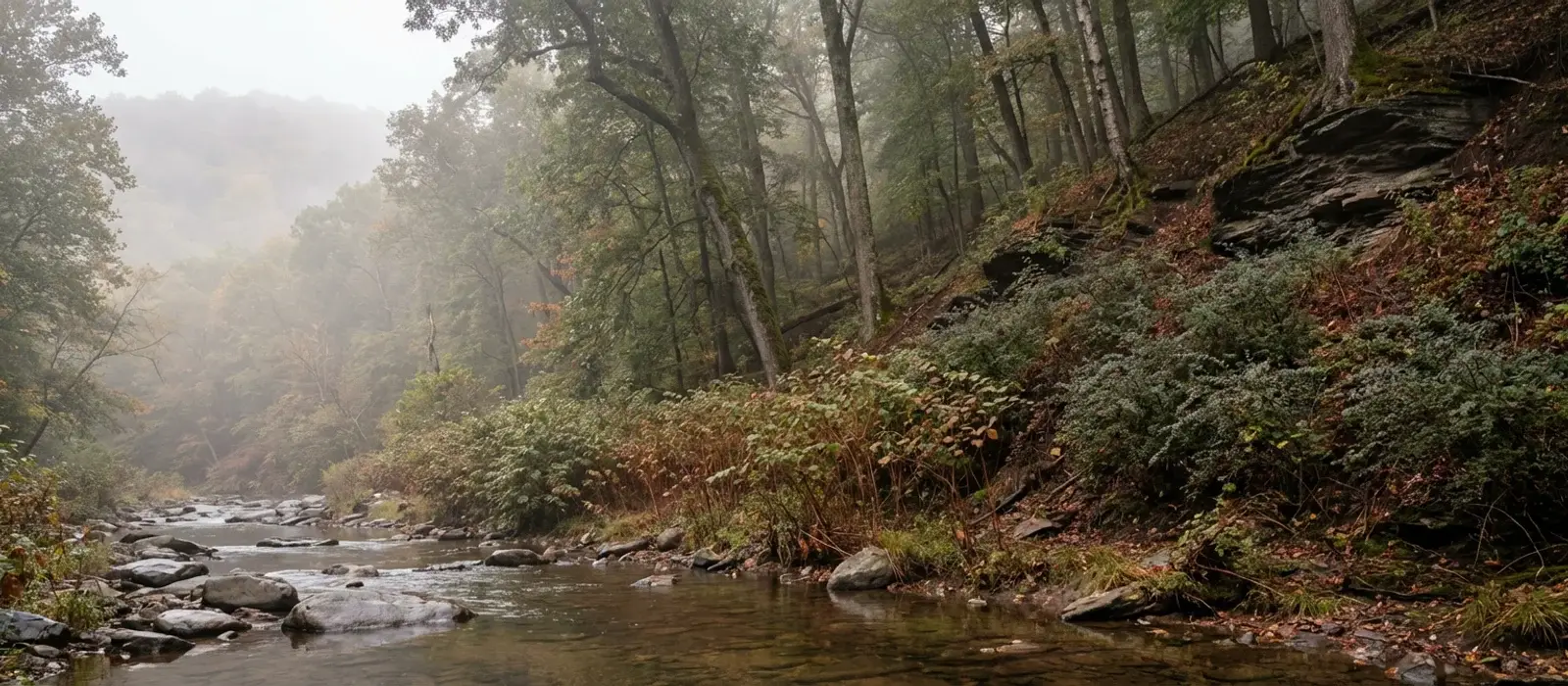
811: Call Before You Dig
This one is simple and non-negotiable. Before any land clearing work begins, call 811 or submit a request online at nj1call.org. Utility companies will mark the locations of underground gas, electric, water, sewer, and telecommunications lines on your property within a few business days. This is free, required by law, and prevents catastrophic accidents.
Forestry mulching doesn’t dig — the cutting head operates above the soil surface — but 811 marking is still required because the machine’s tracks can compact ground over shallow utilities, and the operator needs to know where lines run to avoid driving the machine across them.
When you need a permit — and when you don’t
This is the question we get asked more than any other. Here’s the framework.
You almost certainly DON’T need a permit for: Routine brush clearing on your own residential property. Removing invasive species from your yard. Mowing or clearing a field you own. Maintaining existing trails and paths. Clearing fence lines on agricultural property. Removing dead or fallen trees. Clearing brush that’s encroaching on your house, driveway, or structures.
You MIGHT need a permit for: Removing mature trees above your municipality’s caliper threshold (if your town has a tree ordinance). Clearing within a wetland buffer zone. Clearing within the Highlands Preservation Area if the project is associated with new construction or development. Clearing on commercially zoned property if a site plan is required for the intended use. On ridge and wooded-edge properties, this is also where defensible space planning starts to overlap with ordinary brush management.
You almost certainly DO need a permit for: New construction (home, garage, shed) on cleared land — the construction needs permits, not necessarily the clearing. Grading or changing the contour of the land. Any work within a mapped wetland (not just the buffer — the wetland itself). Clearing within a flood hazard area if it involves fill or grading. Commercial development site prep as part of a site plan application.
The gray area is narrow. For most homeowners clearing an overgrown backyard, most farmers reclaiming a fallow field, and most landowners managing their property, no permit is required for the clearing itself. For builders and developers, the clearing is typically covered under the broader construction permit application.
When in doubt, call your municipal zoning office. They can tell you in five minutes whether your project needs any approvals. We also help property owners navigate this during the site visit — if we see something that might trigger a regulatory requirement, we’ll tell you before quoting the job.
Not sure what regulations apply to your property?
We check the Highlands designation, buffer zones, and municipal rules for every property we quote. You’ll know exactly where you stand before any work begins.
The vegetation you’re clearing
Every property we clear in New Jersey is fighting the same battle — native vegetation versus invasive species, with the invasives winning. Here’s what’s actually growing on NJ properties and how each species affects the clearing approach.
Invasive species dominant in our service area
Japanese knotweed — The bamboo-like stalks reach eight to ten feet tall and form dense monocultures along waterways and drainage channels. Found throughout Clinton, Hackettstown, High Bridge, and every stream corridor in the service area. Mulching removes above-ground growth in one pass, but the rhizome network (which can extend fifteen feet from visible stems) requires follow-up herbicide treatment to prevent regrowth.
Multiflora rose — The single most common invasive on every rural and suburban property in the service area. Thorny arching canes form impenetrable thickets that expand six to eight feet per year and root wherever a cane tip touches the ground. Dominant on fence lines, field edges, and forest understory throughout all four counties. Forestry mulching grinds it at ground level and the mulch layer suppresses regrowth.
Autumn olive — A tall shrub with silvery leaves that birds spread aggressively. Dominates fallow agricultural fields in Alexandria, Delaware Township, Readington, and Mansfield. Produces woody stems three to five inches thick within a decade. A bush hog can’t cut it; a forestry mulcher handles it in one pass.
Japanese barberry — A dense, thorny shrub that carpets the forest floor in every shaded woodland across Morris and Somerset counties. Deer won’t eat it (they avoid the thorns), so it spreads unchecked while native understory gets browsed into oblivion. Research has shown that barberry creates humid microhabitats that dramatically increase blacklegged tick density — removing it reduces Lyme disease risk.
Oriental bittersweet — A climbing vine that wraps around and girdles mature trees, eventually killing them. Common on estate and wooded properties in Bernardsville, Peapack-Gladstone, Mendham, and Roxbury. Requires cutting at the base to stop canopy damage, then ground-level mulching.
Tree of heaven (Ailanthus) — A fast-growing invasive tree that’s also the primary host plant for spotted lanternfly. Prevalent along the I-80 corridor in Mount Olive, the Route 22 corridor in Bridgewater, and roadside edges throughout the service area. Root-suckers aggressively — cutting without herbicide follow-up creates dozens of satellite stems worse than the original. On suburban edge lots, the same cleanup conversation often includes bamboo colonies or volunteer Callery pear saplings spreading out of old landscaping.
Mile-a-minute vine — An annual vine that grows up to six inches per day and blankets everything it touches. Found on disturbed ground in Flemington, Hillsborough, and Branchburg. Mulching kills the current year’s growth; repeat treatment exhausts the seed bank over one to two seasons.
For a deeper look at specific species removal, see our articles on Japanese knotweed removal, multiflora rose removal, and tree of heaven removal.
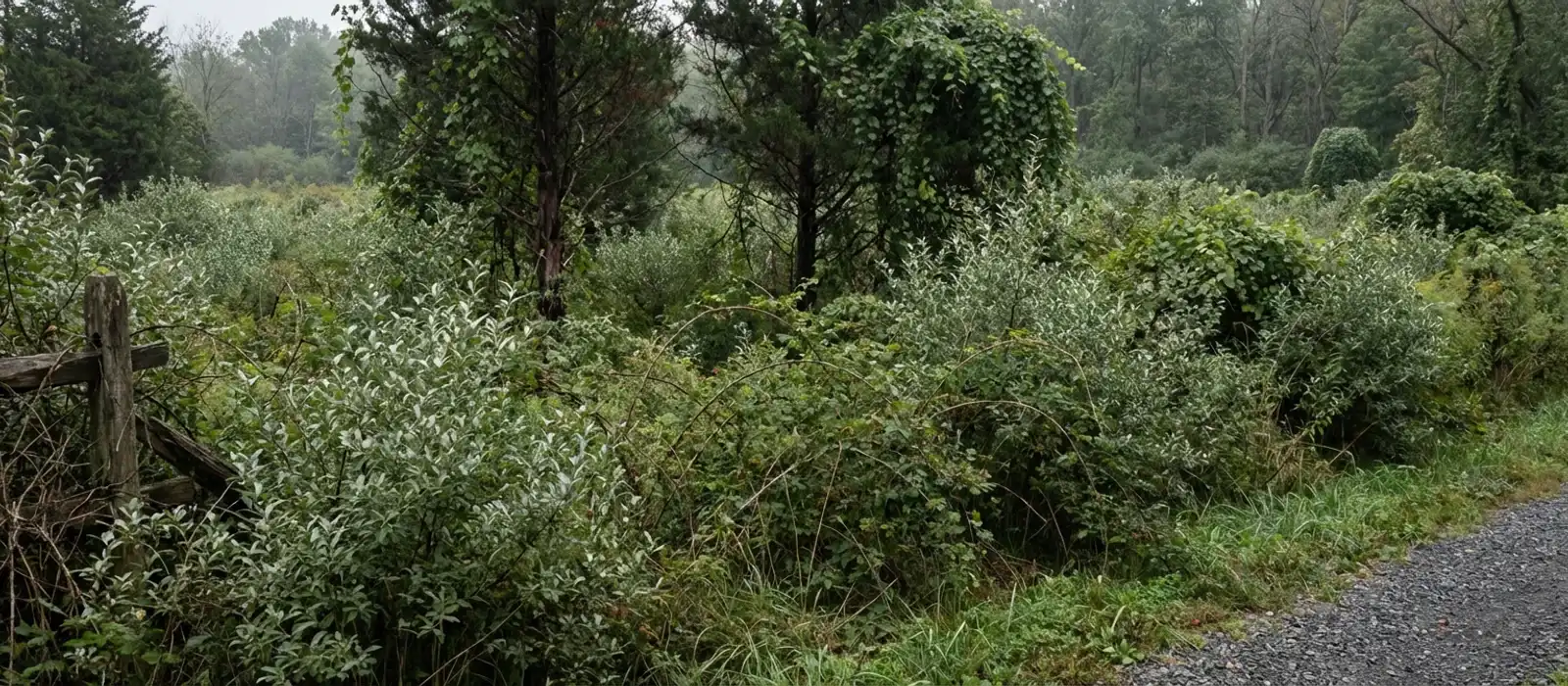
Native succession — what happens when you stop mowing
Understanding succession helps you understand what you’re looking at when you walk an overgrown property. A hay field that’s been fallow for two years has goldenrod, asters, and grass. By year five, autumn olive and red cedar have established from bird-dropped seeds. By year ten, the field has sapling trees — sweet gum, red maple, black cherry — and the invasive shrubs are chest-high. By year fifteen, you can’t walk through it. By year twenty, it’s young forest with a closed canopy.
This timeline matters because it determines the method needed. A two-year fallow field can be brush hogged. A five-year field needs a forestry mulcher. A fifteen-year field needs a production mulcher running full days. Each stage requires more machine time and costs proportionally more to clear.
Common project types in New Jersey
Land clearing serves different purposes for different property owners. Here’s how the work breaks down by project type.
Lot prep for construction — Clearing a residential or commercial parcel to construction-ready ground. Coordination with builders and developers, 811 marking, and often a survey before the machine enters the property. Common in growing towns like Flemington and Mount Olive. Most owners planning a build also end up reading our guides on clearing for home building and septic system site prep before they finalize the sequence.
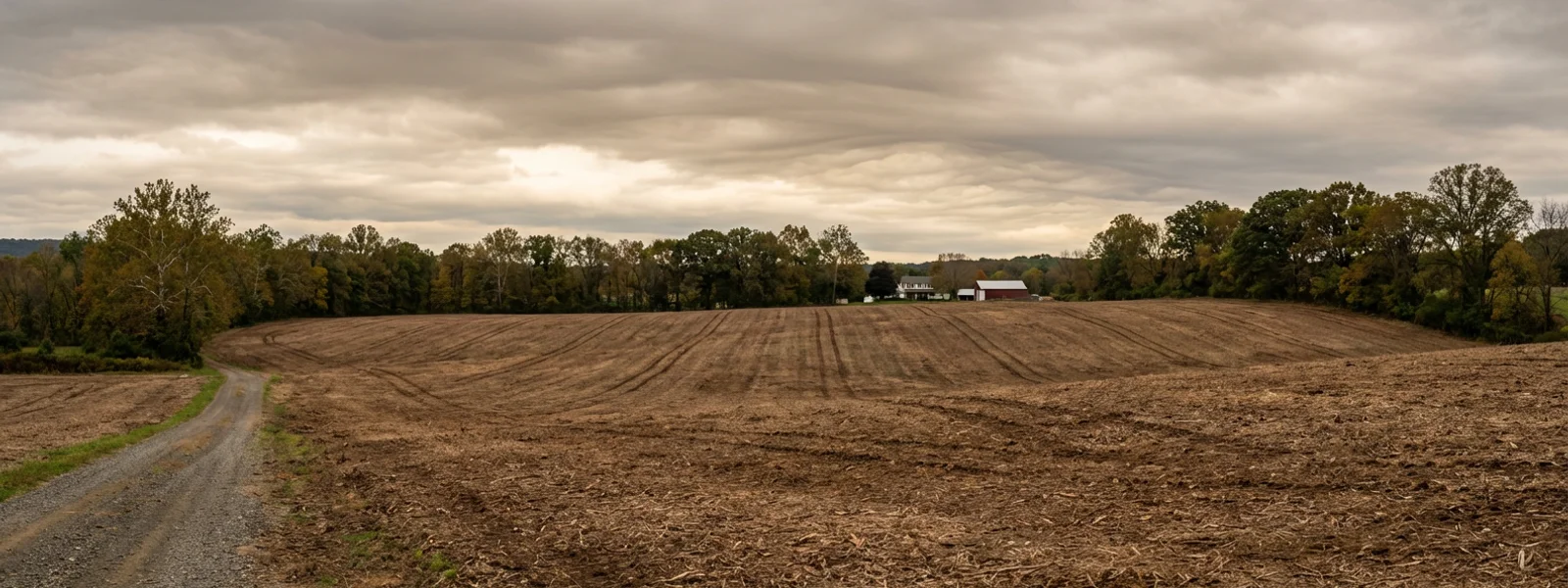
Pasture and field reclamation — Returning fallow agricultural land to productive use. The signature project in Hunterdon and Warren counties, where hay fields and pastures that went fallow during the last generation are now overrun with autumn olive and multiflora rose.
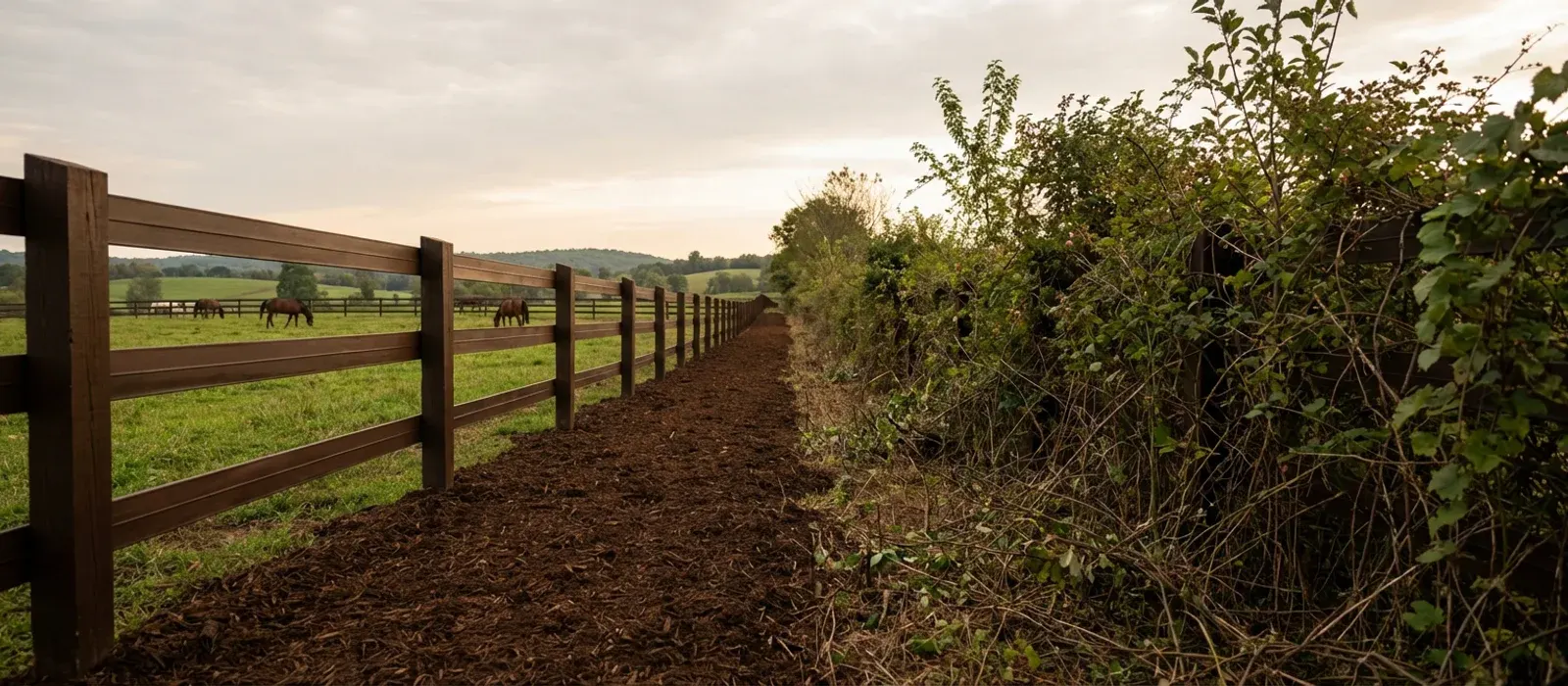
Fence line clearing — Restoring visibility and access along fence rows buried under decades of growth. Especially common on horse properties in Tewksbury, Bedminster, Chester, and Peapack-Gladstone.
Brush clearing — General removal of overgrown brush, vines, and undergrowth on residential and rural properties. The broadest project category and the most common call from homeowners. It is also a common first move before listing a neglected parcel, which is why our guide to clearing before selling fits so many of these jobs.
Hillside and steep terrain clearing — Working on slopes where standard equipment can’t operate. Requires tracked machines with low ground pressure and careful mulch placement for erosion control. Common in High Bridge, the Watchung ridge in Bridgewater, and the Berkshire Valley in Roxbury.
Invasive species removal — Targeted clearing of specific invasive plants. Often combined with follow-up herbicide treatment for species that resprout (knotweed, tree of heaven, bittersweet). See our invasive species removal service page for the full approach.
Trail cutting — Creating hiking, ATV, hunting, or riding trails through wooded property. The mulched surface is immediately walkable and compacts into a durable path over time. Popular on recreational properties in Lebanon Township and throughout Warren County.
Right-of-way clearing — Opening access roads, utility easements, and private drives that have grown in. Often the first step on undeveloped parcels before any other work can happen.
Commercial land clearing — Site prep for commercial development, municipal projects, and HOA common areas. Scalable to multi-acre projects with coordination around construction timelines. If that is your lane, our commercial clearing guide goes deeper on scope, sequencing, and expectations.
Choosing the right contractor
Not all land clearing companies are the same, and the wrong hire can cost you more than money. Here’s what to evaluate.
Are they actually a land clearing company? Many tree services, landscapers, and excavation companies offer “land clearing” as a side service. They may not own forestry mulching equipment — they’ll show up with a skid steer, a chainsaw crew, or a bush hog and try to make it work. Ask specifically what equipment they’ll use and whether they own it. Our equipment spotlight shows the kind of machine details worth asking about.
Do they carry insurance? Land clearing involves heavy equipment on your property. If a machine damages a neighbor’s fence, a buried utility line, or your driveway, the contractor’s liability insurance covers the repair. Ask for a certificate of insurance before work begins. If they hesitate, walk away.
Do they give you a written quote with a fixed price? Hourly billing on land clearing is a red flag. It creates an incentive for the contractor to work slowly, and you have no way to predict the final cost. A competent contractor walks your property, assesses the scope, and gives you a project price in writing. The number doesn’t change unless the scope changes.
Can they handle your terrain? New Jersey has steep slopes, rocky ground, wet areas, and tight suburban access. Ask whether they’ve worked on terrain similar to yours. A contractor who clears flat commercial lots may not have the equipment or experience for a thirty-percent grade in the Highlands.
Will they tell you what they CAN’T do? A good contractor identifies limitations upfront. If your property has a wetland buffer they can’t clear into, or a tree ordinance that restricts what can be removed, or rocky terrain that will slow the job — they should tell you during the estimate, not after the invoice.
Do they have a track record? Google reviews, photos of completed work, and references from past clients tell you more than a sales pitch. Ask to see before-and-after photos of properties similar to yours.
We’re obviously biased, but we built Brush Busters around every one of these standards. Owner-operated, fully insured, fixed project pricing, before-and-after photos of real jobs, and we’ll tell you straight if your project needs something we can’t provide. Get a free estimate and see for yourself.
See what Brush Busters can do for your property
Free site visit. Written quote. Fixed price. No surprises. Call (908) 774-9235 or fill out the form.
The terrain of New Jersey — county by county
New Jersey is not one landscape. The terrain changes dramatically within a thirty-mile radius, and those differences affect every clearing job. Here’s what makes each county in our service area unique.
Hunterdon County — Our home county. Rolling farmland, horse country, and river valleys. The South Branch Raritan runs through the center. Lots range from compact borough parcels in Clinton and High Bridge to twenty-acre agricultural tracts in Alexandria and Lebanon Township. The northern portion has Highlands coverage. The western edge along the Delaware River has scenic bluff properties with preserved farmland. Soil is predominantly clay and shale-derived, with thin rocky soils on the ridgetops.
Somerset County — The Watchung Mountains cross the northern portion, creating steep basalt terrain in Bridgewater and Bernardsville. Western Somerset is horse country — Bedminster, Peapack-Gladstone, and Far Hills — with large estate lots and equestrian properties. The Sourland Mountain creates steep terrain pockets in Hillsborough. Soils vary from deep valley-floor alluvials to thin volcanic basalt on the ridges.
Warren County — The most agricultural county in our service area. Flat to rolling valley-floor terrain along the Delaware and Musconetcong rivers. Pohatcong and Mansfield have the deepest, richest soils — ideal for production-speed clearing. Oxford sits on a limestone and dolomite belt with the rockiest terrain in the service area, requiring slower equipment operation.
Morris County — The most varied terrain. Southern Morris (Chester, Mendham) has rolling horse country similar to Somerset. Western Morris (Washington Township, Long Valley) is deep Highlands with steep wooded slopes. Northern Morris (Roxbury, Mount Olive) transitions from Highlands forest to suburban I-80 corridor. The terrain can change dramatically within a single township.
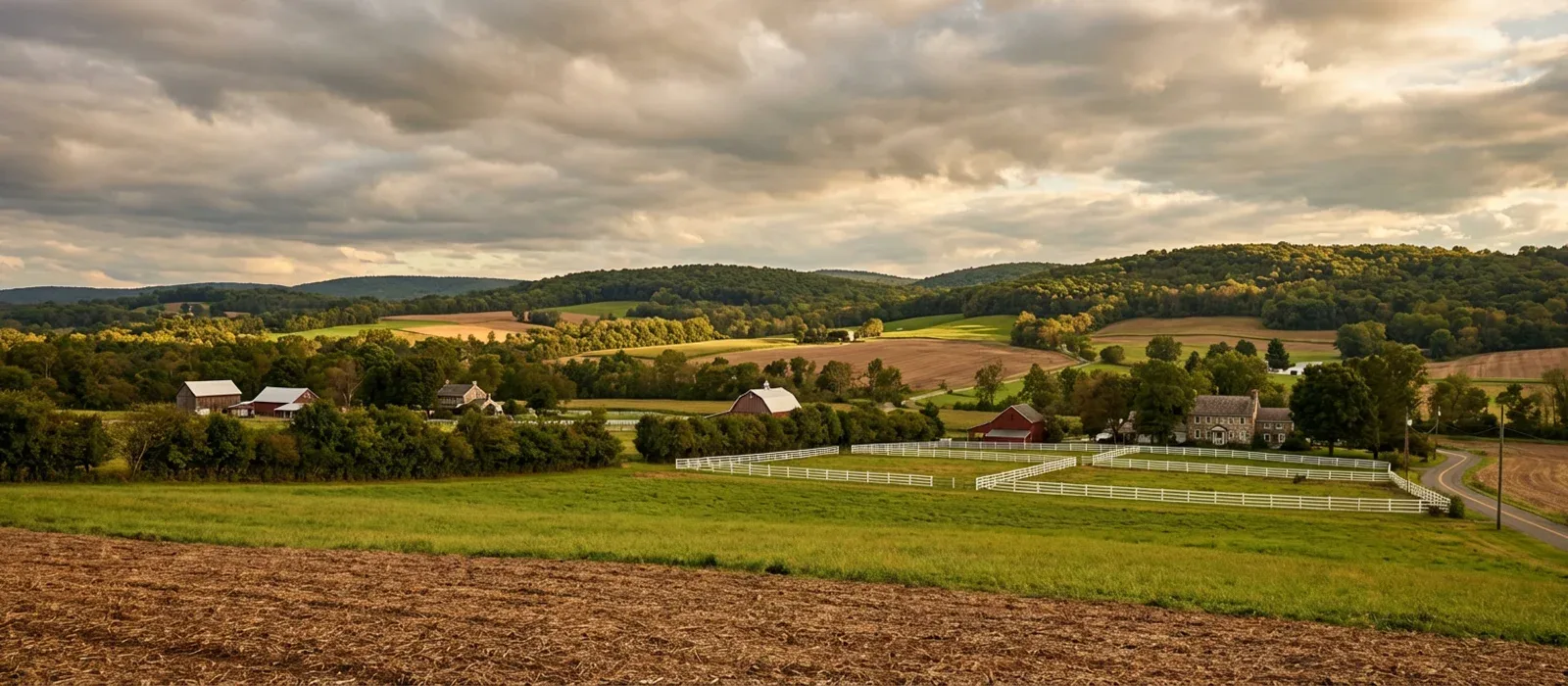
When to clear: the seasonal guide
New Jersey has four genuine seasons, and each one affects land clearing differently. Read our full seasonal clearing guide for detailed analysis.
Late fall (October–November) — The best overall window. Leaves are off the trees so the operator can see the terrain. The ground is firm. Invasive species are dormant. Equipment can work without concern for nesting birds. Demand is lower so scheduling is easier. Our full guide to fall clearing covers why this is usually the cleanest window.
Winter (December–March) — Excellent for clearing when the ground is frozen. Frozen ground supports heavy equipment on soft soils that would rut in spring. Dormant vegetation is easier to process. The downside: snow and ice can delay work, and frozen soil means you can’t start any construction until spring thaw. If that tradeoff works for you, our guide to winter clearing shows why frozen ground can be a real advantage.
Spring (April–May) — Soft ground is the enemy. Saturated soils rut under heavy equipment, and the damage takes months to recover. Spring is the worst season for clearing on clay-heavy or low-lying properties. The exception: well-drained, sandy, or rocky soils that don’t hold water. Our article on spring clearing breaks down where that window still works.
Summer (June–September) — Works fine operationally, but full foliage limits visibility and dense vegetation is at peak volume, which slows the machine. Heat affects crew endurance on long days. Nesting season restrictions may apply in certain areas. For land that has already been opened up, our guide to summer land management is the better playbook than a full first-pass clearing job.
The short answer: schedule your clearing for fall or winter whenever possible. If timing is driven by a construction deadline or a property closing, we work year-round — just know that spring on wet soils is the one condition we’ll recommend delaying for.
What to expect during and after clearing
The day of
The machine arrives on a trailer. Setup takes about thirty minutes — offloading, walk-around inspection, and a final review of the clearing boundaries with the property owner. Clearing proceeds from the access point inward, with the operator working in systematic passes.
The noise level is comparable to a large wood chipper — loud enough that hearing protection is required for anyone near the machine, but not the building-shaking volume of a rock crusher. Neighbors will hear it. On suburban properties, we recommend giving adjacent homeowners a heads-up before the work date.
Most residential properties (half acre to two acres) are cleared in one to two days. Larger acreage takes proportionally longer. We give you a timeline with the quote so you know what to plan for.
The mulch layer
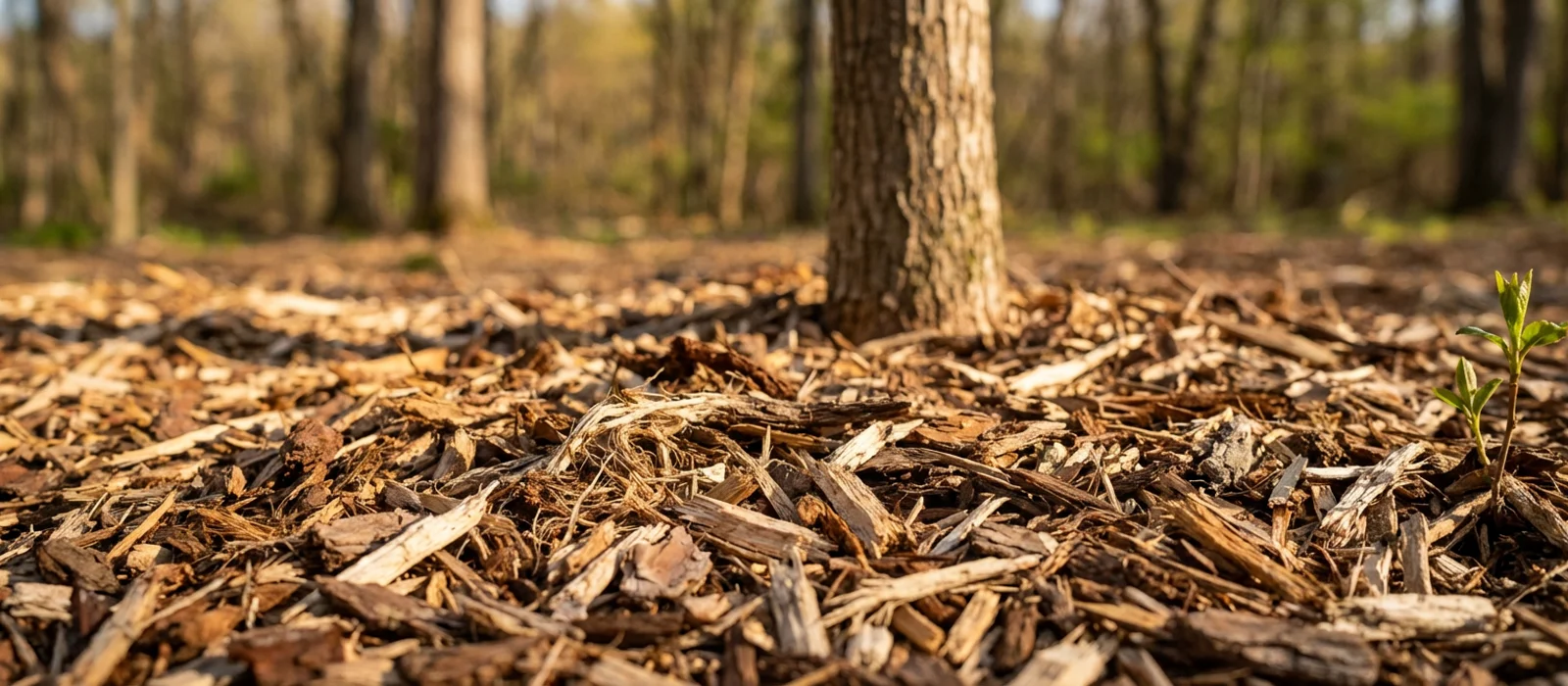
After clearing, the ground is covered in a layer of shredded wood material — the mulch. On moderate clearing, this layer is two to four inches deep. On heavy clearing with larger trees, it can be six inches or more.
The mulch serves three purposes: it suppresses regrowth by blocking sunlight from reaching root crowns and seed banks, it prevents erosion by absorbing rainfall and protecting the soil surface, and it decomposes into organic material that enriches the soil.
Decomposition time depends on climate and mulch depth. In New Jersey’s climate, a two-inch layer decomposes in six to twelve months. A six-inch layer takes twelve to eighteen months. The mulch darkens in color as it decomposes, eventually becoming indistinguishable from the surrounding soil.
Regrowth and maintenance
Some species resprout from root systems after mulching. The persistent ones include Japanese knotweed (always resprouts without herbicide follow-up), tree of heaven (aggressive root suckering without treatment), and multiflora rose (occasional regrowth from root fragments). A single follow-up mowing pass or spot herbicide treatment in the season after clearing handles most regrowth.
For properties where the clearing goal is permanent — a lawn, a garden, a construction site — the mulch can be removed, tilled in, or covered with topsoil and seeded. For properties where the goal is managed woodland or meadow, the mulch stays in place and natural vegetation recolonizes through it.
Annual or biannual maintenance mowing keeps cleared areas from reverting. A property that’s mulched and then mowed once a year stays clear indefinitely. A property that’s mulched and then ignored will begin reverting within three to five years as new seeds germinate through the decomposing mulch.
Frequently asked questions
How much does land clearing cost per acre in New Jersey?
Forestry mulching costs $1,200–$4,000/acre for moderate conditions, $2,000–$6,000/acre for dense growth, and 30–50% more on steep or rocky terrain. Get a free estimate for your property.
Do I need a permit to clear land in New Jersey?
For routine brush clearing on residential or agricultural land, no permit is typically needed. Permits may apply in the Highlands Preservation Area, for mature tree removal under municipal ordinances, or within wetland buffer zones. Call your municipal zoning office to confirm.
What is forestry mulching and how does it work?
Forestry mulching grinds brush, saplings, and small trees into mulch at ground level in a single pass. Nothing is hauled. The mulch layer prevents erosion and suppresses regrowth. Learn how forestry mulching works.
Is forestry mulching better than bulldozing?
For most NJ clearing, yes. Forestry mulching preserves topsoil, prevents erosion, and costs less than bulldozing plus disposal. Bulldozing makes sense only for commercial sites that need grading. Read our full comparison.
What is the Highlands Act and does it affect my property?
The Highlands Act covers ~860,000 acres in NW New Jersey. Routine clearing is generally exempt from the stricter Preservation Area requirements. New construction may need NJ DEP review. Read our detailed Highlands Act guide.
How long does land clearing take?
Residential lots take 1–2 days. Five-acre fields take 2–4 days. Ten-acre parcels take 4–7 days. Steep and rocky terrain adds time. We provide specific timelines with every quote.
What happens to the mulch after clearing?
Mulch decomposes in 6–18 months, suppressing regrowth and enriching the soil. Seed germinates through it for hay or pasture. For construction, it can be removed or tilled in.
Can you clear around trees I want to keep?
Yes — the operator clears within inches of trees, fences, and structures without contact. We walk the site with you beforehand and flag everything to preserve.
Will my land grow back after clearing?
Most species don’t regrow through the mulch layer. A few persistent ones (knotweed, tree of heaven) may need follow-up treatment. Annual mowing keeps cleared areas permanent.
What invasive species are common in New Jersey?
The most common are multiflora rose, autumn olive, Japanese knotweed, barberry, bittersweet, tree of heaven, mile-a-minute vine, and phragmites. Learn about our invasive species removal approach.
Can you clear steep hillsides in New Jersey?
Yes — our tracked equipment handles slopes up to 45%. The mulch layer prevents erosion on cleared slopes. Learn about our hillside clearing capabilities.
How do I get a quote for land clearing?
Call (908) 774-9235 or fill out our contact form. We schedule a free site visit within a week and give you a written quote with a fixed price. No hourly billing, no vague estimates.
What’s the best time of year to clear land in New Jersey?
Late fall and winter are ideal — firm ground, dormant vegetation, maximum visibility. Spring is worst on wet soils. Summer works but foliage slows the job. Read our full seasonal guide.
Do you handle the permits and regulatory checks?
We identify applicable regulations during the site visit and tell you exactly what you need. For most routine clearing, no permits are needed. Read our permits guide.
What areas do you serve?
We’re based in Annandale, NJ and serve all towns within 30 miles — across Hunterdon, Somerset, Warren, and Morris counties. See our full service area map.
Ready to take your property back?
Call (908) 774-9235 or fill out the form. Free site visit, written quote, fixed price.
Or call (908) 774-9235.