

Home / Field Notes — Land Clearing Knowledge Base / Spring Land Clearing in New Jersey: Timing, Ground Conditions, and What to Plan Around
Spring Land Clearing in New Jersey: Timing, Ground Conditions, and What to Plan Around
Published April 7, 2026 by Brush Busters • Last reviewed April 7, 2026
Spring is when most people think about clearing land — the weather’s warming up, the construction season is starting, and the property that looked manageable in January now has six inches of new growth on top of last year’s brush. The impulse is right. The timing can be wrong.
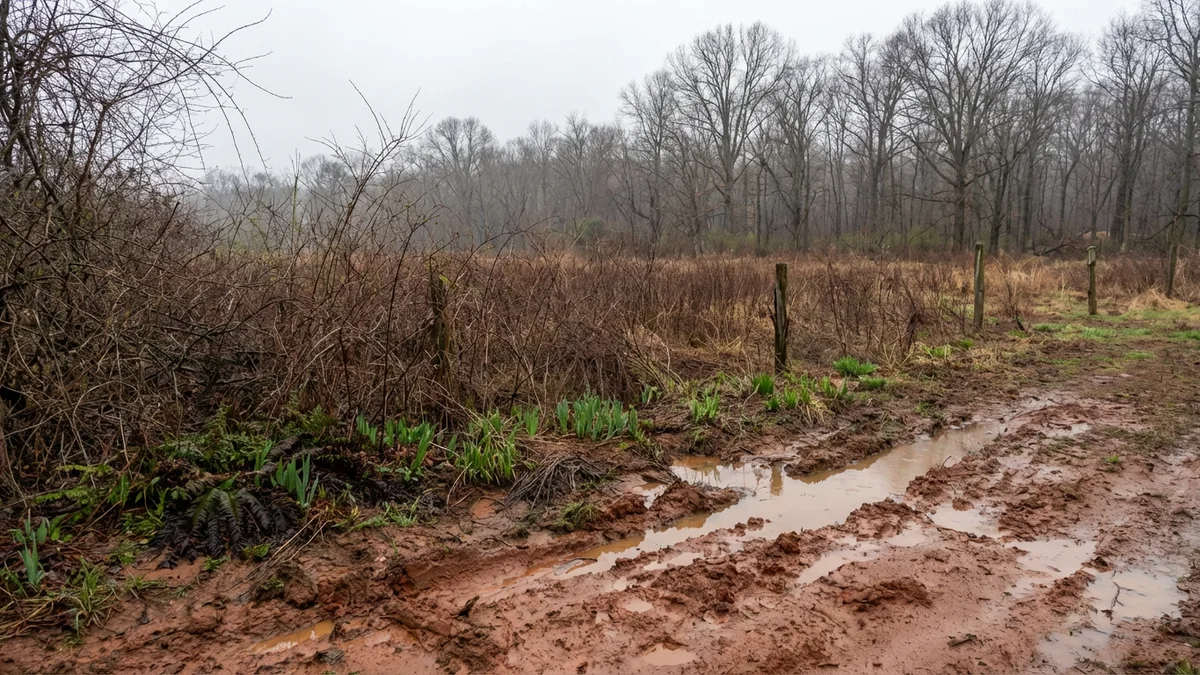
Spring in New Jersey is the wettest season for soil conditions. Snowmelt, spring rains, and the annual water table rise saturate the ground from March through mid-May. Clay-heavy soils — which cover most of the valley floors in Hunterdon, Somerset, and Warren counties — hold that moisture for weeks. A tracked mulcher on saturated clay soil ruts, compacts the ground, and creates damage that takes months to recover.
That doesn’t mean spring clearing is impossible. It means you need to understand the soil conditions on your specific property and time the work accordingly. Some properties clear fine in April. Others shouldn’t be touched until mid-May or later. Here’s how to tell the difference.
The soil moisture problem
New Jersey receives an average of four to five inches of precipitation per month in March, April, and May. Add snowmelt from higher elevations in the Highlands and the Watchung ridge, and the total water input to the soil is significant. The result: saturated ground from the surface down, particularly in low-lying areas and on clay soils.
A forestry mulcher weighs roughly 15,000 pounds. Distributed across the track footprint, that’s manageable on firm or frozen ground. On saturated clay, the tracks sink, rut, and compact the soil. The compaction reduces the soil’s ability to drain, which makes the rutting worse with each pass. On residential properties, this means torn-up lawn edges and damaged access routes. On agricultural land, it means compacted soil that takes years to recover its drainage capacity.
The soils that handle spring well: Sandy soils, gravelly soils, and rocky ground. These drain quickly and firm up within days of a rain event. Properties on the ridgetops of Oxford, the rocky terrain of High Bridge, and the well-drained Highlands slopes firm up faster than the valley floors.
The soils that don’t: Heavy clay, alluvial valley-floor soils, and low-lying areas near streams and ponds. The flat farmland of Pohatcong, Mansfield, and the Raritan valley holds water longest. These properties may not be firm enough for equipment until mid-May or later in a wet spring.
The spring timing window
There are two windows for spring clearing in NJ:
Early spring (March 1–April 15): The ground may still have residual frost, particularly in the Highlands and on north-facing slopes. If the frost is in the ground, clearing works perfectly — the frozen surface is firm. Once the frost breaks and the soil thaws, there’s a brief period (typically a few days to two weeks) where the thawing soil is at peak saturation and too soft for equipment. This window varies by year.
Late spring (May 1–June 1): By early May, most NJ soils have drained enough for equipment access. The exception is low-lying clay-heavy properties that stay wet into late May after a particularly rainy spring. By Memorial Day, virtually every property in the service area is accessible.
The gap (mid-April to early May): This is the highest-risk window. The ground has thawed, the spring rains are at peak intensity, and the soil hasn’t had time to drain. This is when we get the most calls — and when we most often have to tell property owners to wait two to three weeks. It’s better to delay than to damage the site.
We assess ground conditions at every spring estimate. If the soil isn’t ready, we’ll tell you and recommend a date. We don’t clear on ground that will rut — it creates problems for you and liability for us.
What's growing in spring
Spring clearing has a unique vegetation profile. In addition to the dormant woody brush from last year, you’re dealing with the first wave of new growth:
Knotweed. Japanese knotweed is one of the earliest and most aggressive spring emergers. New shoots push through the soil in April and grow inches per day. By late May, the shoots are four to six feet tall. Clearing knotweed in early spring (when the shoots are small) is faster and easier than waiting until midsummer when they’re overhead height.
Garlic mustard. The biennial invader blankets forest floors in April and May with masses of white flowers. Second-year plants are easy to mulch in spring. If you wait until they’ve seeded (June), the seed bank is replenished.
Poison hemlock. Poison hemlock rosettes overwinter and bolt to full height (six to eight feet) in May and June. Spring clearing catches them at the rosette stage — easier to process and lower toxin exposure risk than the mature plant.
New invasive seedlings. Spring germination produces a flush of new invasive seedlings — autumn olive, multiflora rose, barberry — from the seed bank. Clearing these while they’re small is far more efficient than waiting until they establish woody stems.
The flip side: spring is also bird nesting season. Properties near wetlands or in conservation buffer zones may have nesting restrictions from April through July. This is most relevant for properties adjacent to state-managed land or in areas with known endangered species habitat. We check for applicable restrictions during the estimate.
When spring clearing makes sense
Spring clearing is the right choice when:
Your soil drains well. Rocky, sandy, or well-drained slopes firm up quickly. Properties on Highlands ridges, the Oxford limestone belt, and sandy alluvial terraces handle spring moisture without rutting.
You have a summer deadline. Pool installation, construction start, event prep — if the project has a fixed summer date and winter clearing has already passed, spring is when it happens. We schedule around the soil conditions to minimize site impact.
You’re targeting spring-emerging invasives. Knotweed, garlic mustard, and hemlock are most efficiently cleared in spring when they’re small and actively emerging. Waiting adds biomass and makes the job slower and more expensive.
The ground is firm. Not every spring is equally wet. In dry spring years, the ground firms up weeks earlier than normal. We monitor conditions and schedule accordingly.
Costs: spring considerations
Per-acre pricing doesn’t change by season. What changes is the potential for additional access planning.
On properties with soft access routes (lawn, unpaved driveway, field edge), we may need to lay temporary ground-protection mats for the equipment path. These prevent rutting on the access route while the clearing area itself is firm enough to work. Ground protection adds a small charge to the project but prevents thousands in restoration costs.
On properties where the clearing area is accessible via gravel driveway or hard surface, spring clearing costs are identical to any other season.
Common Questions
Can you clear land in spring in New Jersey?
Yes, but timing depends on soil. Well-drained soils work from March onward. Clay soils may need until May. We assess conditions at every estimate. Schedule a spring site visit.
When is the ground firm enough in spring?
Well-drained soils: April. Clay soils: May. Simple test: if your boots sink more than an inch, it’s too soft. If the surface is firm underfoot, we can work.
Will spring clearing damage my lawn?
On soft soil, the access route can rut. We use ground-protection mats when needed. The clearing area itself isn’t lawn — it’s brush being converted to mulch.
Is spring or fall better for clearing?
Fall is generally best (firm ground, leaf-off, dormant). Spring works on well-drained soils and for summer deadlines. Read our fall clearing guide.
Does spring clearing cost more?
Same per-acre price. Ground-protection mats add a small charge if the access route is soft. Hard-surface access: no difference.
Should I clear knotweed in spring?
Yes — early spring when shoots are small is ideal. Waiting adds biomass. Spring clearing + herbicide follow-up is the most effective sequence. Read our knotweed guide.
Are there nesting restrictions in spring?
Possible near wetlands and conservation areas (April-July). On typical residential and agricultural properties, nesting restrictions don’t apply to routine clearing. We check during the estimate.
What if it rains the week of my scheduled clearing?
Single-day rain on well-drained soil: usually no delay. Extended rain on clay: may push back a few days. We communicate immediately and reschedule quickly.
Related Services
Forestry Mulching
We grind brush, saplings, and small trees into mulch on the spot – no hauling, no burn piles, no mess.
Want the full New Jersey land clearing playbook?
This article covers one piece of the puzzle. The complete guide ties together methods, costs, permits, terrain, and contractor selection in one place.
Spring clearing works — on the right soil at the right time.
We assess your ground conditions and schedule accordingly. No ruts, no damage. Free estimates.
Or call (908) 774-9235.