
Home / Field Notes — Land Clearing Knowledge Base / Giant Hogweed and Poison Hemlock in New Jersey
Giant Hogweed and Poison Hemlock in New Jersey
Published April 6, 2026 by Brush Busters • Last reviewed April 6, 2026
Two plants in New Jersey can put you in the hospital just from touching them. One causes severe chemical burns. The other is fatally toxic if ingested. Both are increasingly common on neglected properties in our service area, and both look deceptively similar to harmless plants that grow alongside them.
If you have either of these on your property, this is not a DIY project. Here’s how to identify them, what makes them dangerous, and how professional removal works.
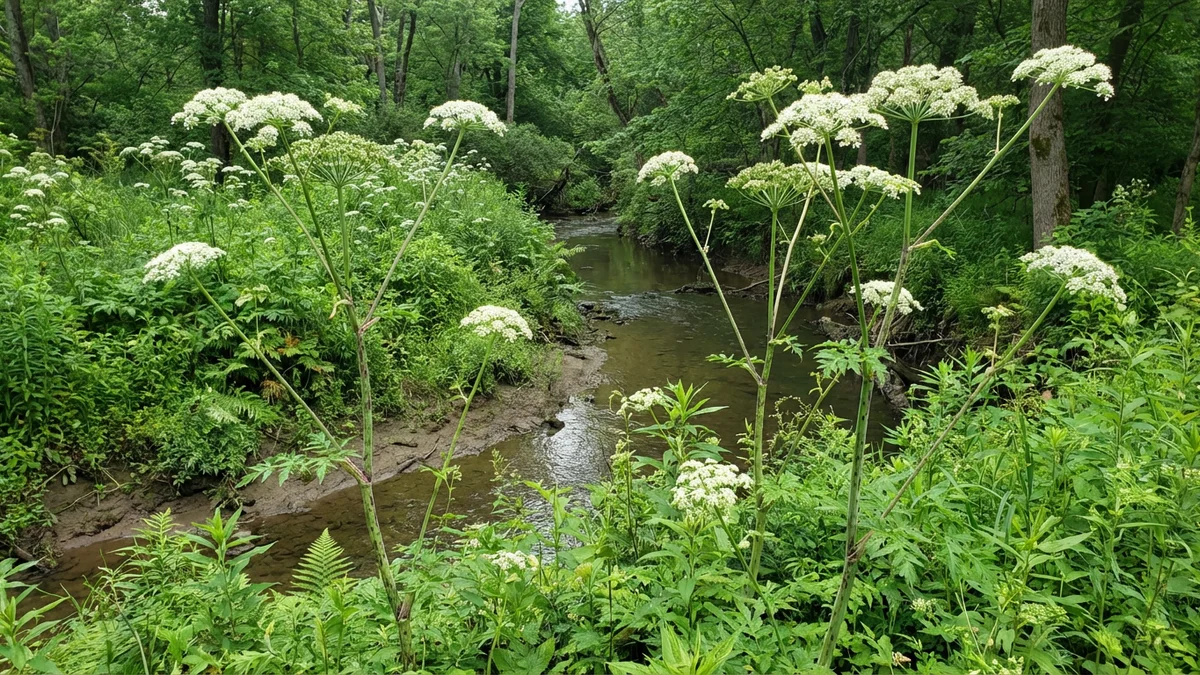
Giant hogweed (Heracleum mantegazzianum)
Giant hogweed is a federally listed noxious weed and one of the most dangerous plants in North America. It causes phytophotodermatitis — the sap contains furocoumarins that, when activated by sunlight, cause severe chemical burns on human skin. The burns blister, can cause permanent scarring, and in cases of eye exposure, temporary or permanent blindness.
Identification: – Height: 10–15 feet tall at maturity (this is the most immediate distinguishing feature — it’s enormous) – Stem: thick, hollow, 2–4 inches in diameter, covered in coarse white hairs with purple blotches – Leaves: deeply lobed, up to 5 feet across. Much larger than any native look-alike. – Flowers: large white umbrella-shaped clusters (umbels) up to 2.5 feet across – Habitat: stream banks, roadsides, disturbed areas. Prefers moist, rich soils.
Look-alikes: Cow parsnip (Heracleum maximum) is native and much smaller (6–8 feet, smaller umbels). Queen Anne’s lace (Daucus carota) is 2–4 feet tall with much smaller umbels. Angelica species are 4–6 feet. If you see something over 10 feet tall with umbrella flowers and purple-blotched stems — assume it’s giant hogweed.
NJ status: Giant hogweed has been confirmed in scattered locations across northern New Jersey. NJ DEP tracks reported sightings and has a removal program. If you find giant hogweed, report it to NJ DEP before attempting any removal.
Poison hemlock (Conium maculatum)
Poison hemlock is one of the most toxic plants in North America. Every part of the plant — leaves, stems, roots, seeds — contains piperidine alkaloids that cause respiratory failure and death if ingested. It’s the plant that killed Socrates (historically, at least). Livestock deaths from poison hemlock occur every year, and human poisonings — usually from misidentification as wild carrot or parsley — happen with disturbing regularity.
Identification: – Height: 3–8 feet tall – Stem: smooth, hollow, with distinctive purple or reddish-purple blotches and spots. This is the key identifier. No native NJ umbellifer has this stem pattern. – Leaves: finely divided, fern-like. Resemble parsley or carrot tops. – Flowers: small white umbrella-shaped clusters – Smell: unpleasant, musty odor when crushed. Often described as “mousy.” – Habitat: roadsides, ditches, stream banks, field edges, disturbed areas. Tolerates a wide range of conditions.
Look-alikes: Queen Anne’s lace has hairy stems (hemlock is smooth). Wild parsnip has yellow flowers. Wild carrot looks similar but doesn’t have purple-blotched stems.
NJ status: Poison hemlock is widespread throughout New Jersey and expanding. It’s common along road margins, stream corridors, and on neglected agricultural land across all four counties in our service area. It’s a biennial — it grows a rosette of leaves in year one and flowers/seeds in year two.
Why these require professional removal
Giant hogweed: Any skin contact with the sap, followed by sunlight exposure, causes burns. Mowing, weed-whacking, or cutting the plant sprays sap — onto your skin, into your eyes, onto your clothing. Even residual sap on equipment or clothing can cause burns hours later when exposed to UV light. Professional removal uses full protective equipment (chemical-resistant suit, face shield, goggles) and herbicide application to kill the plant without cutting or disturbing it.
Poison hemlock: While skin contact alone usually doesn’t cause the same severity as giant hogweed, the plant is fatally toxic if ingested, and handling large quantities can cause skin irritation and absorption of alkaloids through the skin. Mowing large stands of hemlock creates plant debris that remains toxic for weeks. On properties with children, pets, or livestock, any accessible hemlock is an emergency.
For both species: The forestry mulcher can process these plants as part of a larger clearing operation — the operator is inside an enclosed cab with filtered air, eliminating both skin and respiratory exposure. However, for isolated stands of giant hogweed, NJ DEP may want to be involved before removal. For hemlock, mulching kills the above-ground plant, but the biennial root system means second-year plants may emerge from first-year rosettes that weren’t visible at clearing time. Follow-up monitoring is essential.
What removal costs
As with poison ivy, giant hogweed and poison hemlock removal is typically part of a broader clearing job rather than a standalone service. When we clear an overgrown property that contains these species, they’re removed with everything else — no extra charge.
For targeted professional removal of isolated stands: – Poison hemlock (herbicide application by licensed applicator): $200–$800 depending on area – Giant hogweed (specialized removal with PPE): $500–$1,500 per site. Contact NJ DEP first — they may coordinate or fund removal through their management program.
If you suspect giant hogweed on your property, photograph it (from a safe distance — do not touch any part of the plant) and contact NJ DEP’s invasive species program. They can confirm the identification and advise on next steps.
Common Questions
How do I tell giant hogweed from cow parsnip?
Giant hogweed is 10–15 feet tall with 5-foot leaves and 2.5-foot flower clusters. Cow parsnip is 6–8 feet. If unsure, photograph it (don’t touch) and contact NJ DEP.
What do I do if I touch giant hogweed?
Wash immediately with soap and cold water. Avoid sunlight on the area for 48+ hours. Cover it. If blisters develop, see a doctor. Eye contact requires emergency care.
Is poison hemlock dangerous to touch?
Brief contact is less severe than hogweed, but the plant is fatally toxic if eaten. Properties with children, pets, or livestock should remove it immediately.
Can forestry mulching remove giant hogweed and poison hemlock?
Yes — the operator is in an enclosed cab. For giant hogweed, contact NJ DEP first. Both species need follow-up monitoring for regrowth.
Should I report giant hogweed to NJ DEP?
Yes — NJ DEP tracks locations and has a management program. Report with photos and location. Don’t attempt removal without proper PPE and training.
How do I identify poison hemlock on my property?
Smooth stems with purple blotches, fern-like leaves, white umbrella flowers, musty smell. Grows 3–8 feet along roads and streams. The purple-blotched stem is the key identifier.
When does poison hemlock appear in NJ?
First-year rosettes appear in fall. Second-year plants bolt to 3–8 feet and flower in June-July. The rosette stage (fall/early spring) is the easiest treatment window.
Can poison hemlock affect my pets or livestock?
Fatal to horses, cattle, sheep, goats, pigs, and dogs. Remove from pastures immediately. The plant stays toxic even after drying — mowed debris is still dangerous.
Related Services
Invasive Species Removal
Japanese knotweed, multiflora rose, mile-a-minute vine, and other NJ invasives eliminated at ground level.
Helpful Resources
Farms & Agriculture
Related Articles
Poison Ivy Removal in New Jersey
How to identify and remove poison ivy on NJ properties. Ground vines, climbing vines, and thickets. Professional clearing methods, costs, and what actually works.
Japanese Knotweed Removal in New Jersey: How to Actually Kill It
How to remove Japanese knotweed in New Jersey: identification, why it spreads, why cutting fails, and how mulching plus follow-up treatment works.
See Japanese Knotweed Removal in New Jersey: How to Actually Kill It
Want the full New Jersey land clearing playbook?
This article covers one piece of the puzzle. The complete guide ties together methods, costs, permits, terrain, and contractor selection in one place.
Dangerous plants on your property? Don't touch them.
We remove giant hogweed and poison hemlock from inside an enclosed cab. No exposure risk. Free estimates.
Or call (908) 774-9235.