

Home / Field Notes — Land Clearing Knowledge Base / What Happens After Forestry Mulching? The Regrowth and Decomposition Timeline
What Happens After Forestry Mulching? The Regrowth and Decomposition Timeline
Published April 5, 2026 by Brush Busters • Last reviewed April 5, 2026
The machine leaves. The property looks great — clean mulch, standing trees, open sight lines. Now what? Most property owners have the same three questions: how long does the mulch last, will anything grow back, and when can I plant or use the ground?
Here’s the month-by-month timeline for what happens after forestry mulching in New Jersey’s climate. This applies to residential backyards, fallow fields, wooded understory clearing, and every other clearing type in our service area.
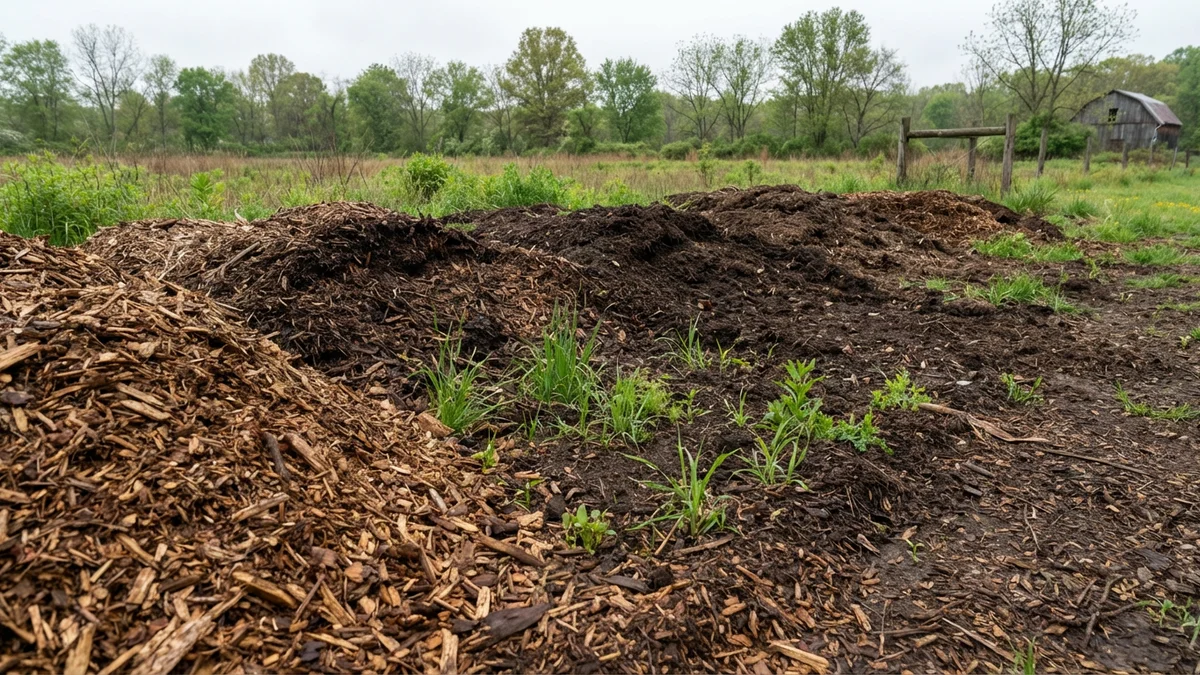
The mulch layer: month by month
Month 1 (clearing month). Fresh mulch is light brown, coarse, and two to six inches deep depending on the density of what was cleared. The mulch smells like fresh-cut wood. It’s firm underfoot but not compacted. You can walk on it, drive on it, and work on it immediately.
Months 2–3. The mulch begins to darken as microbial decomposition starts. White fungal mycelium (thin white threads) appears on the surface and between the chips. This is completely normal and beneficial — the fungi are breaking down the wood fiber. Rain saturates the mulch and begins leaching tannins (you may see amber-colored water draining from the mulch after heavy rain — also normal).
Months 4–6. The mulch has noticeably settled. A layer that started at four inches may be down to two to three inches. The color is dark brown. The chip texture is less distinct — the pieces are softer and beginning to merge with the soil surface. Earthworms and soil organisms are moving into the mulch layer from below, pulling organic matter into the soil.
Months 6–12. The mulch is integrating into the soil. The surface layer is thin (one to two inches) and looks like rich organic material rather than distinct wood chips. The soil underneath is measurably changed — more organic content, better water retention, improved structure. In thin spots (where the original mulch was shallow), the underlying soil is visible and new plants are establishing.
Months 12–18. On most sites, the mulch has fully decomposed into the soil. What remains is a darker, richer topsoil layer than what existed before clearing. The ground is ready for whatever comes next — permanent ground cover, landscaping, construction, or continued natural succession.
The timeline varies with mulch depth, climate conditions, and sun exposure. Mulch in full sun decomposes faster than mulch in deep shade. Mulch on warm, south-facing slopes decomposes faster than mulch on cold, north-facing slopes. Dry years slow decomposition; wet years accelerate it.
Regrowth: what comes back and when
Week 2–4: Annual weeds. The first green you’ll see through the mulch is annual weeds — mostly horseweed, ragweed, and crabgrass. These germinate from the existing seed bank in the soil. On thin mulch spots, they emerge faster. On thick mulch, they’re suppressed. Annual weeds are not a problem — they die with the first frost and don’t establish permanent root systems.
Month 1–2: Invasive resprouts. Species with established root systems push new shoots through the mulch. The most likely offenders in NJ: multiflora rose (from root fragments), autumn olive (from root crowns), Japanese barberry (from root fragments), and tree of heaven (aggressive root suckering). These resprouts are weaker and smaller than the original plants — typically six to twelve inches in the first season. A single mowing pass or spot herbicide treatment handles them.
Month 2–4: Native volunteers. Native plants from the soil seed bank begin germinating through the mulch: goldenrod, asters, native grasses, tree seedlings (oak, maple, cherry). These are generally desirable — they’re the beginning of natural succession. On properties where the goal is meadow or natural ground cover, let them grow.
Month 3–6: Grass establishment (if seeded). If you broadcast seed after clearing (see our farm and garden clearing guide), grass establishes through the mulch during this window. Cool-season grasses (fescue, ryegrass) seeded in September establish by late fall. Warm-season grasses and wildflower mixes seeded in spring establish by midsummer.
Year 1–2: Woody regrowth test. The first full growing season after clearing is the test. If you mow the resprouts and manage the invasive regrowth (see our summer management guide), the cleared area stays clear. If you don’t, woody invasives begin reestablishing from the seed bank and surviving root systems. By year two without maintenance, you’ll have small shrubs and saplings re-emerging. By year three to five, the property starts reverting to pre-clearing conditions.
The maintenance reality: Annual mowing (one to two passes per year) keeps cleared land clear permanently. The mulch suppresses the hardest regrowth in year one. Your mower handles year two onward. The commitment is minimal but non-negotiable.
Soil changes
Forestry mulching improves soil over time. The decomposing mulch adds organic matter, which increases the soil’s water-holding capacity, nutrient content, and microbial activity. On NJ’s clay-heavy valley floors, this organic matter improves drainage by creating soil structure (pore spaces) that clay alone doesn’t have. On thin, rocky Highlands soils, the organic matter adds depth and fertility that the thin native soil lacks.
The soil improvement is measurable. A soil test taken before clearing and one year after shows increased organic matter percentage, improved cation exchange capacity (nutrient-holding ability), and often higher potassium and phosphorus from the decomposed wood.
For agricultural properties being restored from fallow, this soil improvement is a tangible benefit — the cleared and mulched field has better growing conditions than the same field would after bulldozing and reseeding on bare mineral soil.
Common Questions
How long does forestry mulch take to decompose?
6–18 months depending on depth and conditions. 2-inch layer: 6–12 months. 6-inch layer: 12–18 months. Sun and moisture accelerate it.
Will anything grow through the mulch?
Annual weeds, some invasive resprouts, and native volunteers all emerge through the mulch. The mulch suppresses most but not all growth. Read our regrowth management guide.
Do I need to do anything after mulching?
Mow resprouts once or twice in the first summer. Apply herbicide on knotweed/tree of heaven. Seed if desired. Annual mowing after year one keeps it clear permanently.
Is the white fungus on my mulch a problem?
No — it’s beneficial fungi decomposing the wood. Completely harmless. Fades within a few weeks as the mulch dries.
When can I seed after mulching?
Immediately — broadcast seed onto the mulch. September is best for cool-season grasses. April–May is second-best. No soil prep needed.
How fast will cleared land revert if I don't maintain it?
Woody regrowth by year 2–3 without maintenance. Full reversion by year 5. Annual mowing (1–2 passes/year) prevents this completely and costs a fraction of re-clearing.
Does the mulch attract termites or pests?
No — scattered forestry mulch on open ground doesn’t create the sustained moisture termites need. Keep mulch 6 inches from foundations as standard practice.
Will the mulch wash away on slopes?
The mulch interlocks into a mat and stays on slopes up to ~25%. On steeper slopes, our operators build contour berms during clearing to prevent displacement. Learn about hillside clearing.
Related Services
Forestry Mulching
We grind brush, saplings, and small trees into mulch on the spot – no hauling, no burn piles, no mess.
Want the full New Jersey land clearing playbook?
This article covers one piece of the puzzle. The complete guide ties together methods, costs, permits, terrain, and contractor selection in one place.
The clearing is the beginning, not the end.
We clear the property. You mow the regrowth. The result lasts as long as you maintain it.
Or call (908) 774-9235.