

Home / Field Notes — Land Clearing Knowledge Base / Japanese Barberry Removal in New Jersey
Japanese Barberry Removal in New Jersey
Published April 7, 2026 by Brush Busters • Last reviewed April 7, 2026
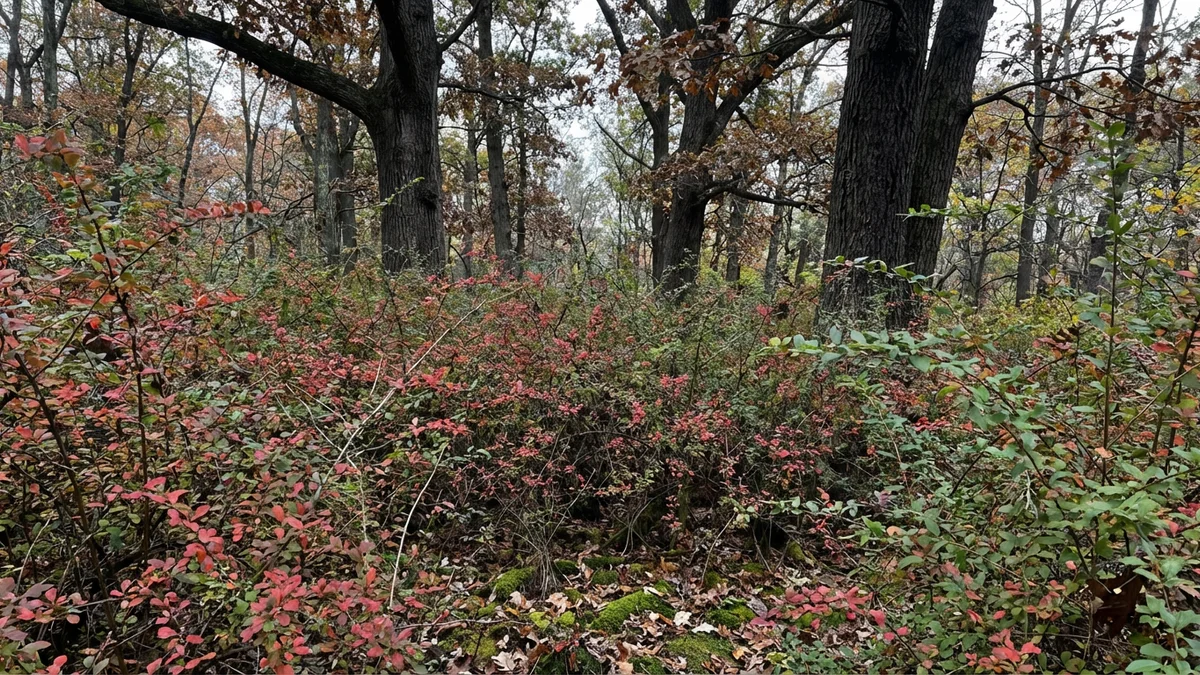
Japanese barberry (Berberis thunbergii) is the invasive species you’re standing in before you realize it. The low, dense, thorny shrub carpets the forest floor across every wooded property in Somerset and Morris counties and most of Hunterdon. It forms a continuous ground cover one to four feet tall that nothing can walk through, nothing can grow through, and deer refuse to eat.
But the thorns and the impenetrability aren’t the most important reason to remove it. Japanese barberry is a scientifically documented tick habitat amplifier. Research has shown that forests infested with barberry have significantly higher densities of blacklegged ticks — the species that transmits Lyme disease — compared to forests where barberry has been removed. On properties in NJ’s Lyme disease epicenter, removing barberry isn’t just land management. It’s a health decision.
Identification
Japanese barberry is a compact, deciduous shrub with arching branches densely packed with small, oval leaves and sharp single spines at each node. It reaches one to six feet tall depending on light conditions — taller in partial shade, more compact in full sun.
Leaves: Small (half to one inch), oval to spatula-shaped, smooth-edged. Green in the common wild form, though ornamental varieties planted in landscapes come in purple, red, and gold. The wild-type green form is the one that blankets NJ forests.
Spines: Single sharp spines at each leaf node (not the triple spines of native barberry species). The thorns make hand removal miserable.
Berries: Small, bright red, oval, hanging in clusters. Persist through winter — visible on bare branches from November through March. Each berry contains one to two seeds, spread by birds.
Growth form: Dense, mounded, arching. In forest settings, individual plants merge into continuous ground cover. A forest with heavy barberry looks like someone carpeted the floor with a thorny hedge.
Where it grows: Everywhere that deer browse has eliminated native understory. Barberry thrives in full shade to full sun, wet to dry soils, and rocky to deep ground. Its dominance in NJ forests is directly linked to the deer population — deer eat competing native plants but refuse barberry, creating a monoculture by selective browsing.
The barberry-tick-Lyme connection
This is the section that matters most for NJ property owners.
Japanese barberry creates a microhabitat at ground level that dramatically increases blacklegged tick survival. The dense canopy of the barberry shrub traps humidity, moderates temperature, and maintains the moisture conditions ticks require. The leaf litter under barberry stays wetter and decomposes more slowly than litter on an open forest floor. This creates ideal conditions for all life stages of the blacklegged tick — larvae, nymphs, and adults.
Additionally, the barberry thickets provide optimal habitat for white-footed mice — the primary reservoir host for the Lyme disease bacterium (Borrelia burgdorferi). More barberry means more mice, more mice mean more infected ticks, more infected ticks mean more Lyme disease risk for every person who walks through those woods.
The research finding is straightforward: remove barberry, reduce ticks. The mechanism works through humidity reduction (the open forest floor dries out), mouse habitat reduction (less cover for the primary host), and questing surface elimination (ticks have nothing to climb onto to grab passing hosts). See our tick prevention through land clearing article for the full ecological breakdown.
Removal approach
Forestry mulching is the most effective mechanical method for barberry removal at property scale. The mulcher grinds barberry at ground level — stems, root crowns, and all — and covers the cleared area with a mulch layer that blocks light and suppresses regrowth. The machine works through continuous barberry ground cover at a steady pace, clearing one to two acres of infested forest understory per day depending on density.
The operator works between the canopy trees, clearing everything below about eight inches in diameter. Mature oaks, maples, and other hardwoods stay. The barberry and everything growing with it — multiflora rose, bittersweet seedlings, garlic mustard — goes. The result is an open, parklike forest floor that’s walkable, drier, and dramatically less tick-dense.
Herbicide can supplement mechanical removal. Barberry is a persistent species — some root fragments survive mulching and produce new shoots in the following season. A spring application of triclopyr on any resprouts eliminates the remaining root systems. Without follow-up treatment, expect 10–20% regrowth that requires a second mowing or spot treatment.
Hand removal is feasible for ornamental barberry in landscape beds (dig out the root ball) but impractical for forest-scale infestations. A one-acre barberry removal by hand would take a crew of four an estimated two to three weeks and cost five to ten times what forestry mulching costs.
Where barberry is worst in our service area
Barberry is present in virtually every forest in our service area, but the heaviest infestations are in the older, more established wooded communities where deer populations have been high for decades:
– Bernardsville and Peapack-Gladstone: Estate properties with mature forest. The combination of high deer density, old-growth canopy, and decades without understory management creates textbook barberry monocultures. – Mendham and Chester: Rolling horse country with wooded borders. Barberry invades from the forest into pasture edges and paddock perimeters. – Roxbury and Mount Olive: Highlands forest with barberry in the Berkshire Valley corridor and throughout the Succasunna wooded neighborhoods. – Bridgewater: Watchung ridge properties with barberry-dominated understory under the mature basalt-ridge forest.
Costs
Forest understory clearing targeting barberry (and the other invasives growing with it) costs $2,500 to $4,500 per acre with forestry mulching. This is higher than fallow-field clearing because forest work is slower — the operator navigates around canopy trees rather than running in open passes.
A targeted one-to-two-acre buffer around a house (the most effective zone for tick reduction) costs $3,000 to $7,000. This is a one-time investment that reduces tick habitat for years with annual maintenance mowing.
Common Questions
Does removing barberry actually reduce ticks?
Yes — research confirms barberry removal reduces tick density. Read our full tick prevention guide.
How much does barberry removal cost?
Forest understory clearing: $2,500–$4,500/acre. A 1–2 acre buffer around your house: $3,000–$7,000. Get a free estimate.
Will barberry grow back after mulching?
Expect 10–20% regrowth in the first season. One follow-up treatment eliminates it. Annual mowing keeps the forest floor open permanently.
Why don't deer eat barberry?
Thorns and bitter alkaloid compounds (berberine) make barberry unpalatable. Deer eat every competing native plant while leaving barberry — creating the monoculture.
Is Japanese barberry banned in NJ?
NJ has restricted sales of certain cultivars, but millions of plants are already established in forests. Removing existing barberry from your property is voluntary but strongly recommended.
Can I just clear barberry around my house, or do I need to clear the whole forest?
A 50–100 foot cleared buffer around your house is the best cost-effective approach. The more you clear, the greater the reduction. Read our tick prevention guide.
What grows back after barberry is removed?
Native ferns, wildflowers, and tree seedlings recolonize over 2–5 years. The seed bank is still in the soil. Annual mowing prevents barberry from returning during recovery.
How long does barberry removal take?
One to two acres per day. A one-acre buffer takes a full day. Larger properties take 2–4 days.
Related Services
Invasive Species Removal
Japanese knotweed, multiflora rose, mile-a-minute vine, and other NJ invasives eliminated at ground level.
Relevant City Pages
These city pages are a good fit if you want to compare the article advice with the kind of properties we see on the ground.
Want the full New Jersey land clearing playbook?
This article covers one piece of the puzzle. The complete guide ties together methods, costs, permits, terrain, and contractor selection in one place.
Barberry is the ticks' favorite plant. Remove it.
Forest understory clearing that reduces Lyme disease risk and makes your woods walkable again.
Or call (908) 774-9235.