

Home / Field Notes — Land Clearing Knowledge Base / Erosion Control After Land Clearing in New Jersey
Erosion Control After Land Clearing in New Jersey
Published April 5, 2026 by Brush Busters • Last reviewed April 5, 2026
Every land clearing project exposes ground that was previously protected by vegetation. What happens next depends entirely on two things: the clearing method you used and the erosion control measures you put in place afterward.
NJ gets an average of 46–50 inches of precipitation annually, with the heaviest periods in spring and during late-summer thunderstorms. That rainfall hits cleared ground with force. If the soil is bare — stripped by a bulldozer with no protective cover — it washes. The steeper the slope and the heavier the clay content, the faster it moves. Sediment flows downhill into streams, onto neighboring properties, into roadways, and into storm drains. That’s not just a property damage problem — it’s an NJ DEP violation.
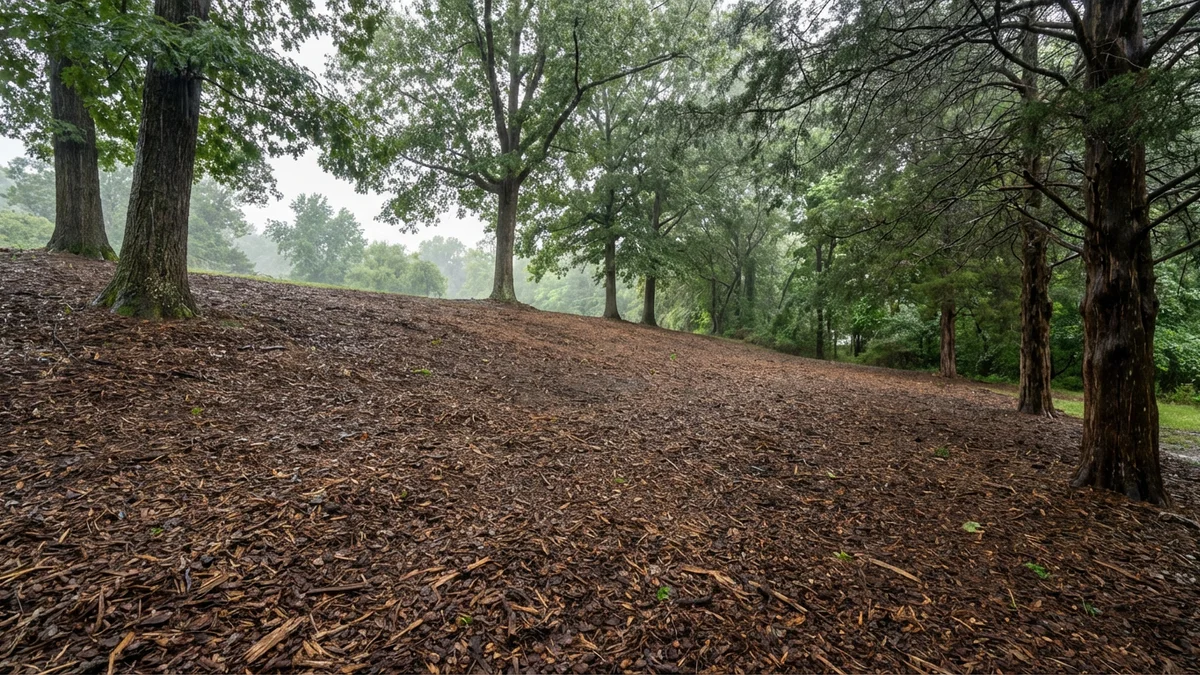
If you chose forestry mulching, your erosion control is already 80% done. The mulch layer IS the erosion control. But even mulched sites need attention on steep slopes, near waterways, and during the transition from cleared ground to permanent ground cover.
Why the clearing method matters
Bulldozing creates the worst erosion conditions. The blade strips vegetation AND topsoil, leaving exposed subsoil — typically clay in NJ’s valley floors or thin rocky earth on ridgetops. This subsoil has almost no organic matter, no root structure, and no water-absorbing capacity. The first heavy rain sheet-flows across it, picks up sediment, and carries it downhill. On steep sites, this can create gullies within a single storm event. Bulldozed sites require extensive post-clearing erosion control: silt fence, erosion blankets, temporary seeding, and often structural measures like check dams or sediment basins.
Forestry mulching leaves the soil intact and covered. The mulch layer does four things that prevent erosion: it absorbs rainfall impact (raindrops hit mulch instead of bare soil), it slows surface runoff (water percolates through the mulch rather than flowing over it), it holds moisture in the soil (preventing the dry-cracking that leads to erosion in summer), and it physically weighs down the soil surface (the mulch interlocks into a mat on slopes).
On flat to moderate terrain, forestry mulch alone is sufficient erosion control. No additional measures needed. On steep slopes (over 15–20%), near waterways, and on construction sites where the mulch will be disturbed, additional measures are warranted.
Erosion control measures for cleared sites
The mulch layer (built-in with forestry mulching). A two-to-four-inch layer of forestry mulch reduces soil loss by an estimated 90%+ compared to bare soil. On flat to moderate slopes, this is the only measure needed. The mulch decomposes over six to eighteen months, during which time you establish permanent ground cover.
Seeding. The fastest way to establish permanent erosion protection on cleared ground is to seed with a quick-establishing ground cover. In NJ, the standard post-clearing seed mixes include: – Annual ryegrass — germinates in 5–10 days, establishes quickly, provides immediate cover, dies after one season – Perennial ryegrass + fescue mix — longer-term cover, survives NJ winters – White clover — fixes nitrogen, tolerates mulch, fills in gaps – Native NJ meadow mix — slower to establish but permanent, low-maintenance, and ecologically appropriate
Seed can be broadcast directly over forestry mulch — it germinates through the mulch layer. This is one of the advantages of mulching over bulldozing: you can seed immediately after clearing without any soil prep. On bulldozed sites, you need to grade, add topsoil or compost, and then seed — three steps versus one.
Silt fence. On slopes above 15% or where the cleared area drains toward a stream, road, or neighboring property, install silt fence along the downhill edge. Silt fence captures sediment-laden runoff before it leaves the site. NJ DEP requires silt fence (or equivalent) on any project disturbing more than 5,000 square feet. Most clearing projects exceed this threshold.
Erosion control blankets. On steep, bare slopes (typically bulldozed sites, not mulched), biodegradable erosion blankets (jute, coconut coir, or straw) hold the soil in place while seed establishes. These are rarely needed on forestry-mulched slopes because the mulch performs the same function.
Check dams. On steep sites where water concentrates into channels, small check dams (stone, logs, or silt-sock) across the flow path slow the water and trap sediment. Common on construction site clearing but rarely needed on residential or agricultural clearing with forestry mulching.
Temporary diversion berms. On large cleared areas with significant slope, a berm of mulch or soil along the contour (perpendicular to the slope) diverts sheet flow and prevents it from building velocity. The mulcher operator can create these during the clearing operation by leaving a windrow of mulch along the contour lines.
NJ regulatory requirements
Soil Erosion and Sediment Control Act. New Jersey requires a certified soil erosion and sediment control plan for any project that disturbs more than 5,000 square feet of soil. The plan must be approved by the local Soil Conservation District before work begins. For residential clearing where construction follows, the builder typically handles this as part of the construction permit application.
For standalone vegetation management (clearing without subsequent construction), the 5,000 square foot threshold still applies if the clearing method exposes bare soil. Here’s the practical distinction: forestry mulching may not trigger the SESC requirement on many projects because it doesn’t “disturb” the soil in the regulatory sense — the soil surface remains covered by mulch. Bulldozing always triggers it because the soil is exposed.
This is a meaningful cost and timeline advantage for forestry mulching. An SESC plan adds $1,000–$3,000 in engineering costs and two to six weeks of review time. Avoiding the need for one (by using a clearing method that doesn’t expose soil) keeps the project simpler and faster.
Riparian buffers. Clearing within NJ DEP riparian buffer zones (50–300 feet from waterways) requires that erosion control measures be in place before, during, and after clearing. Forestry mulching is one of the most buffer-compatible methods because the mulch layer provides immediate erosion control from the moment the machine passes.
Timeline: from clearing to stable ground
Day 1 (clearing day). Mulch covers the ground. Erosion protection is immediate.
Week 1–2. If seeding, broadcast seed over the mulch. If the project is on a slope above 15%, install silt fence along the downhill perimeter.
Week 3–6. Seed germinates through the mulch. Annual ryegrass shows green within 10–14 days. Perennial grasses take three to four weeks. During this period, the mulch is doing the heavy lifting on erosion control.
Month 3–6. Grass cover is established. The mulch is partially decomposed and integrated into the soil surface. Silt fence can be removed once vegetation provides full cover.
Month 6–18. Mulch fully decomposes into organic matter. The ground is stabilized by permanent vegetation. The site is in its long-term stable state.
On flat terrain with forestry mulching and seeding, you reach stable ground in about three months. On steep terrain or bulldozed sites, it takes six months to a year with active management.
Common Questions
Does forestry mulching prevent erosion?
Yes — mulch reduces soil loss by 90%+ compared to bare soil. On flat to moderate terrain, no additional measures are needed. Learn about forestry mulching.
Do I need an erosion control plan for land clearing in NJ?
NJ requires SESC plans for 5,000+ sq ft of soil disturbance. Forestry mulching may not trigger this because soil stays covered. Bulldozing always does. Check with your Soil Conservation District.
How soon should I seed after clearing?
Within two weeks of clearing. Broadcast seed directly over the mulch — no soil prep needed. The mulch holds moisture that aids germination.
What seed mix should I use after clearing in NJ?
Annual ryegrass for quick cover (5–10 days). Perennial ryegrass + fescue for permanent cover. White clover for farmland. Native meadow mix for restoration. Rutgers Extension has NJ-specific recommendations.
Will erosion damage my neighbor's property after clearing?
It can if erosion isn’t controlled. Sediment leaving your property is your liability. Forestry mulching prevents erosion from day one. Add silt fence on slopes above neighboring properties.
How long does forestry mulch last before it decomposes?
Six to eighteen months depending on depth. A 2-inch layer decomposes in 6–12 months. It provides erosion control the entire time and enriches the soil as it breaks down.
Is forestry mulching better than erosion blankets?
On mulched sites, the mulch IS the erosion blanket — it comes free with the clearing. Erosion blankets are for bare soil on bulldozed sites that have no other cover.
What about erosion on steep hillside clearing?
Slopes over 15–20% need silt fence and may need contour berms in addition to the mulch. Our operators build contour berms during clearing at no extra charge. Learn about hillside clearing.
Related Services
Forestry Mulching
We grind brush, saplings, and small trees into mulch on the spot – no hauling, no burn piles, no mess.
Hillside Clearing
Steep terrain and rocky slopes cleared safely with tracked, low-ground-pressure equipment.
Related Articles
Forestry Mulching vs. Bulldozing: Which Is Right for Your NJ Property?
Forestry mulching vs. bulldozing for NJ properties: compare cost, speed, soil impact, and when each method makes sense.
See Forestry Mulching vs. Bulldozing: Which Is Right for Your NJ Property?
Want the full New Jersey land clearing playbook?
This article covers one piece of the puzzle. The complete guide ties together methods, costs, permits, terrain, and contractor selection in one place.
The clearing method IS the erosion plan.
Forestry mulching covers the ground from the moment we pass. No bare soil, no washouts, no violations.
Or call (908) 774-9235.