

Home / Forestry Mulching / Delaware Township, New Jersey
Forestry Mulching in Delaware Township, New Jersey
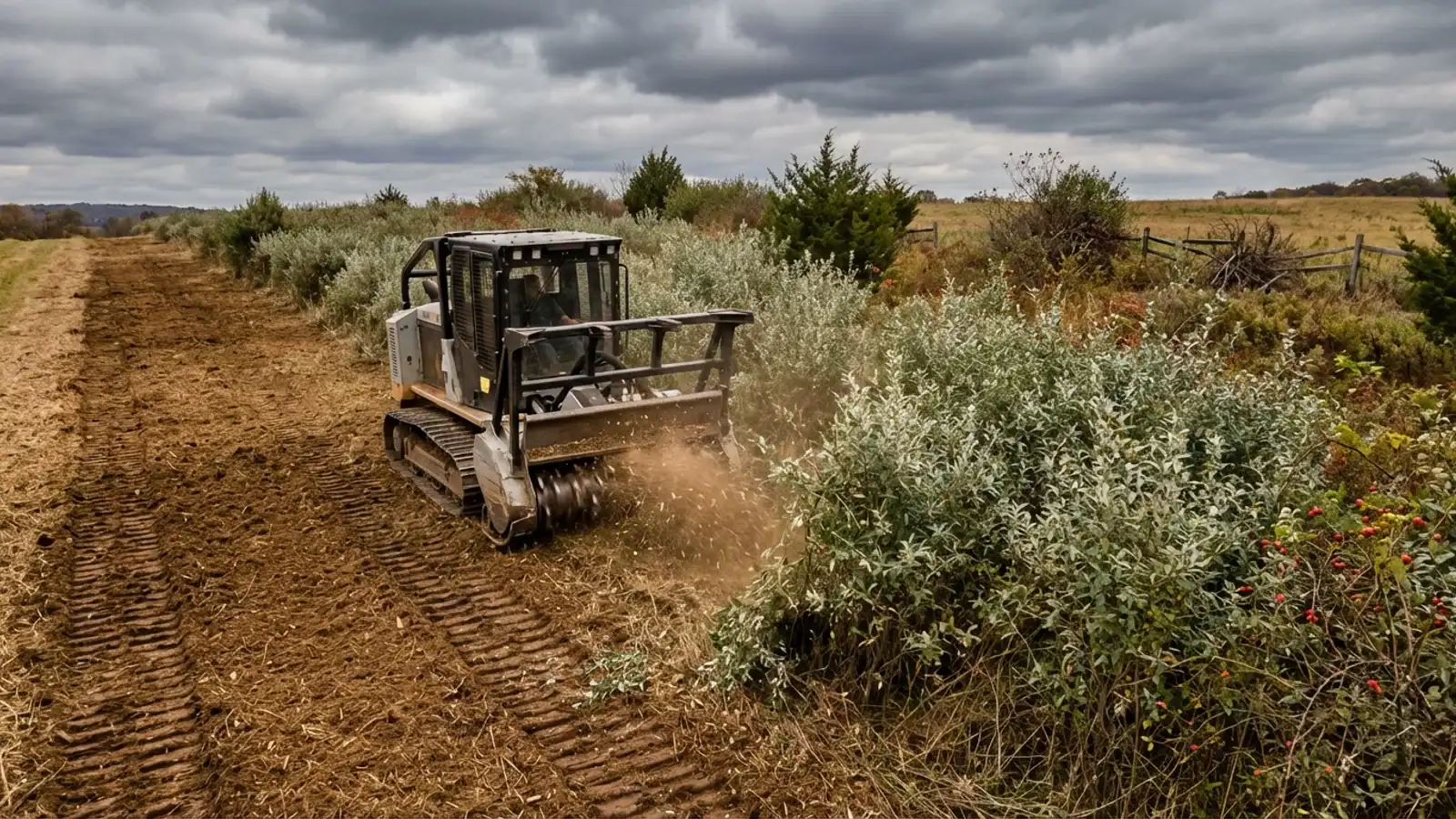
Delaware Township's landscape doesn't look like it needs industrial equipment — until you try to walk through a pasture that's been fallow for eight years. The autumn olive and multiflora rose that colonize abandoned fields in this part of Hunterdon County grow dense enough to stop a tractor, and a bush hog can't handle anything with a stem thicker than about two inches. Forestry mulching bridges the gap. A single tracked machine grinds the cedar, the autumn olive, the rose thickets, and the sapling regrowth down to ground level and converts all of it into a mulch layer that decomposes into the soil over the following season. For a township where most of the clearing work is agricultural reclamation rather than development, this is the method that matches the land.
Why Forestry Mulching Works in Delaware Township
The clearing challenges in Delaware Township are more about volume and vegetation type than terrain. The terrain is rolling but not extreme — nothing like the steep hillsides of High Bridge or the rocky ridges in Oxford. What Delaware Township has is acreage. Five-acre fallow fields. Ten-acre woodlots. Quarter-mile fence lines buried under decades of rose and vine. These aren't surgical half-acre backyard jobs — they're production clearing that needs a machine designed to eat brush all day.
Forestry mulching is the right fit here because it handles the full spectrum of what's growing on Delaware Township's fallow fields. Autumn olive — the dominant invasive on former agricultural ground — produces woody stems three to five inches thick within a decade of colonizing a field. A brush hog bounces off those stems. A forestry mulcher grinds them to ground level. Red cedar encroaches from field edges and seed-dropped from bird perches, creating scattered stands that a standard mower can't navigate around. The mulcher takes everything in a single pass and leaves a uniform surface.
The mulch layer matters on Delaware Township's clay-heavy valley soils. These soils compact easily and erode when exposed. The mulch acts as a protective layer that keeps the soil structure intact while the organic material decomposes and enriches the topsoil underneath. For properties being reclaimed for hay or grazing, this decomposed mulch layer creates better seeding conditions than bare soil.
What We Typically Mulch in Delaware Township
Autumn olive is the species that defines fallow-field clearing in Delaware Township. Originally planted as a conservation species decades ago, it's now classified as invasive and spreads aggressively through bird-dispersed seeds. A field left fallow for five years will have scattered autumn olive three to six feet tall. A field left for ten years will have a closed canopy of autumn olive eight to twelve feet tall with trunks up to five inches in diameter, interspersed with multiflora rose and wild grape vine.
Multiflora rose fills the understory everywhere autumn olive doesn't dominate. It's particularly dense along fence lines, stone rows, and the edges where field meets forest. The arching, thorny canes create impenetrable thickets that reach six to eight feet tall and root wherever a cane tip touches the ground.
Red cedar and Virginia pine are the early succession conifers that colonize abandoned fields on the drier ridgetop soils. They grow in dense clusters — tight enough that the interior branches die and the stand becomes a fire hazard in dry conditions. On a single property, you may see autumn olive in the valley bottom, multiflora rose along the fence lines, and cedar clusters on the ridgetop — three different vegetation types that the mulcher handles without switching equipment.
Along the streams and drainages that feed toward the Delaware River, Japanese knotweed holds the banks. It's less of a presence here than in true river-corridor towns like Clinton, but any watercourse in this part of New Jersey has knotweed somewhere along its length.
Equipment & Approach for Delaware Township Terrain
Delaware Township's rolling terrain and large parcels are ideal for full-size forestry mulching equipment running at production speed. The open field conditions on most reclamation jobs allow the mulcher to work in long passes across the property rather than the tight, maneuvered cuts required on suburban lots. This translates to faster completion and lower per-acre cost than hill-country or tight-access work.
For fence line clearing, the operator follows the fence row at a walking pace, clearing five to eight feet of growth on each side while working around the posts and wire. On properties with long fence runs — a thousand linear feet or more — this can be a full day's work.
Access is rarely an issue in Delaware Township. Most properties have wide farm gates, gravel lanes, or open field frontage that accepts equipment without modification. The exception is properties set back on shared lanes off the narrow township roads where passing width requires coordination.
Common Questions
How much does forestry mulching cost per acre in Delaware Township?
Fallow-field reclamation typically runs $1,500–$3,000 per acre depending on density. Get a free estimate for your Delaware Township property.
Is forestry mulching better than bush hogging for reclaiming fields in Delaware Township?
For woody growth older than about 4 years, forestry mulching is the only single-pass option. Bush hogs can’t cut through autumn olive and cedar stems. Learn how forestry mulching works.
What happens to the mulch on reclaimed farmland in Delaware Township?
The mulch decomposes over 6–18 months, adding organic matter to the soil. Seed germinates through the mulch layer. Learn about our pasture reclamation process.
Can you mulch around preserved farmland fencing and stone rows?
Yes — we clear right up to stone rows, fence posts, and historic features without contacting them. Learn about our fence line clearing service.
How long does it take to mulch a ten-acre fallow field in Delaware Township?
A 10-acre field takes roughly 3–5 days with moderate growth. We provide detailed timelines with every large-acreage quote.
Can you clear near streams in Delaware Township that feed the Delaware River?
We work near streams, but NJ DEP riparian buffers apply. Forestry mulching is one of the safest near-stream methods because it doesn’t disturb soil. We identify buffer zones during the site visit.
Fallow fields in Delaware Township don't clear themselves.
Autumn olive, cedar, multiflora rose — we take it all back to clean ground. Get a free estimate.
Or call (908) 774-9235.