

Home / Forestry Mulching / Alexandria Township, New Jersey
Forestry Mulching in Alexandria Township, New Jersey
Alexandria's agricultural land doesn't need to be brushy. These are some of the deepest, most productive soils in Hunterdon County — silt loam that grew hay and row crops for generations. The brush that's taken over isn't the land's destiny. It's just what happens when nobody mows for a decade. Forestry mulching reverses that succession faster and cheaper than any other method. A full-size mulcher processes one to three acres per day of autumn olive, cedar, and sapling growth, grinds it all at ground level, and leaves the topsoil untouched underneath a mulch layer that decomposes back into the very soil the brush was stealing nutrients from. On Alexandria's scale — ten, twenty, thirty-acre fields — there's simply no alternative that makes economic sense.
Why Forestry Mulching Works in Alexandria
The soil preservation argument is strongest in Alexandria because the soil is the asset. These deep silt-loam fields represent decades of agricultural soil development — organic matter, microbial communities, drainage structure. A bulldozer would destroy it in an afternoon by pushing the topsoil into windrows and exposing compacted subsoil that would need years of amendment before it could grow anything productive. Forestry mulching leaves every inch of topsoil in place. The mulch layer breaks down over twelve to eighteen months and adds organic material back to the soil. Fields cleared by mulching test richer than the surrounding uncleared ground within two growing seasons because the decomposed mulch acts as a slow-release amendment.
The gentle terrain in Alexandria lets the full-size mulcher operate at peak efficiency. Unlike the rocky slopes of Lebanon Township or the tight wooded lots of Bernardsville, Alexandria's rolling fields allow the operator to run long, straight passes at consistent speed. This maximizes production rate and minimizes per-acre cost — which matters when you're clearing twenty acres instead of two.
The absence of Highlands restrictions simplifies everything. There's no overlay zoning, no applicability determinations, no 90-day DEP review cycles. You call, we walk the property, we give you a price, and we schedule the work. On agricultural land that should be producing hay instead of autumn olive, that streamlined process gets the land back into use faster.
What We Typically Mulch in Alexandria
Autumn olive accounts for the majority of what we grind in Alexandria — possibly seventy to eighty percent by volume on the abandoned agricultural fields. It's a nitrogen-fixing shrub that thrives in the well-drained upland soils, grows eight to fifteen feet tall, and produces thousands of berries per plant that birds distribute across every open acre in the township. A field that was mowed ten years ago can be solid autumn olive from edge to edge — not scattered plants, but a continuous canopy of overlapping shrubs.
Mulching autumn olive at ground level grinds through the root crown and kills a high percentage of younger plants outright. Established plants with extensive root systems may resprout, but the regrowth is weakened and a single round of spot herbicide treatment typically finishes the job. For fields intended for hay or pasture reestablishment, we recommend mowing or brush-hogging any resprouts in the first growing season before they get tall enough to shade out the new grass seedlings.
Multiflora rose fills the hedgerows between fields and lines the township roads. On Alexandria's older farms, these hedgerows have been accumulating rose, elderberry, wild grape, and tree saplings for decades. A hedgerow that was six feet wide twenty years ago is now thirty to forty feet of impenetrable brush consuming the margins of two adjacent fields.
Red cedar takes the drier hilltops where the soil is thinner and the autumn olive hasn't dominated. Cedar stands on hilltops can be remarkably dense — the shallow, spreading root systems interlock and the evergreen canopy shades out everything beneath. Cedars mulch quickly and the kill rate is essentially one hundred percent because the species doesn't resprout from roots.
Equipment and Approach for Alexandria Terrain
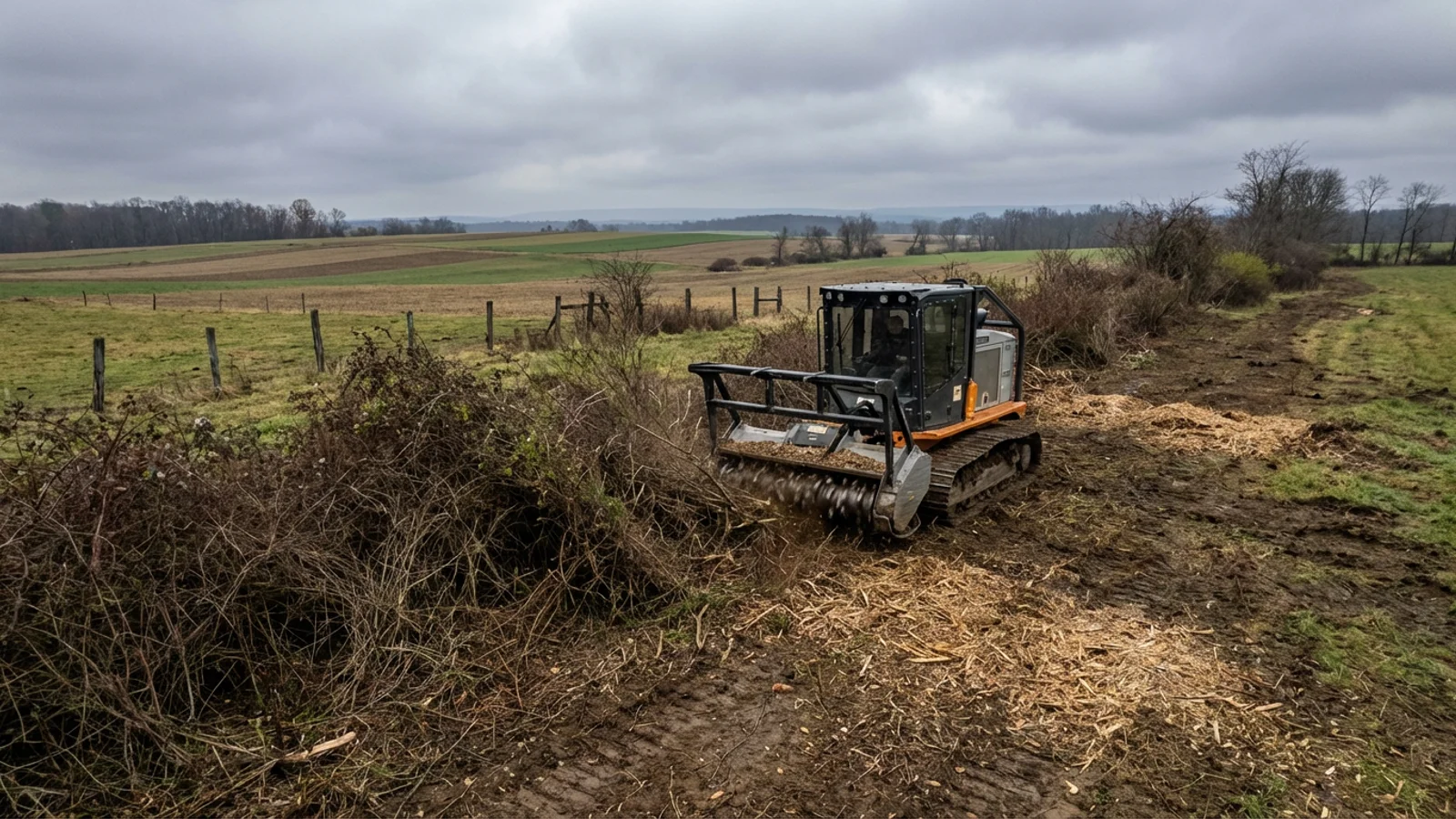
Full-size tracked forestry mulcher, running long parallel passes across open fields. This is the most efficient configuration for the work and the terrain. The operator starts at one edge of the field and works systematically across, processing overlapping rows of autumn olive, cedar, and sapling growth. On gentle Alexandria slopes, the machine maintains a consistent speed and the production rate peaks at two to three acres per day in moderate brush.
For hedgerow clearing, the operator approaches the hedgerow from the field side and grinds inward, reducing the hedgerow width from its expanded state back to a defined edge. On longer hedgerows, the operator works the length in a single pass per side, clearing ten to fifteen feet of encroachment on each pass.
On the Musconetcong corridor, where the terrain drops toward the river and the vegetation shifts to knotweed and phragmites, the operator works more carefully — the soils are softer, the buffer restrictions tighter, and the invasive species require a different follow-up strategy. We schedule river-corridor work during dry conditions to keep the equipment on firm ground.
Common Questions
How much does forestry mulching cost per acre in Alexandria, NJ?
Agricultural mulching runs $2,000 to $4,000 per acre in moderate brush. Get a free estimate for your Alexandria property.
How fast can you clear a large agricultural field in Alexandria?
Two to three acres per day in moderate brush. A twenty-acre field takes roughly seven to ten days. We include detailed timelines.
Will forestry mulching preserve the topsoil on my Alexandria farmland?
Yes. The mulch decomposes and adds organic material back to the soil. Cleared fields test richer than uncleared ground within two seasons. Learn about our pasture reclamation approach.
Does forestry mulching kill autumn olive or will it grow back?
Mulching kills a high percentage by grinding the root crown. Established plants may resprout. One round of spot herbicide finishes the job. Learn about our invasive species approach.
What should I do after the field is cleared in Alexandria?
For hay, overseed after mulch decomposes. For pasture, seed through the mulch sooner. For meadow, broadcast native seed in fall. Mow resprouts in the first season regardless. See our full reclamation process.
Can you clear the hedgerows between fields on my Alexandria farm?
Yes. We grind hedgerows back from the field side to a manageable width, recovering acreage along every edge. Learn about our hedgerow and fence line clearing.
Alexandria's fields were meant to produce — not feed autumn olive.
Get a free estimate for agricultural field reclamation. We'll tell you the cost per acre and the timeline.
Or call (908) 774-9235.