

Home / Forestry Mulching / Clinton, New Jersey
Forestry Mulching in Clinton, New Jersey
Clinton's landscape runs from tight quarter-acre lots along the South Branch Raritan to open five-acre parcels on the rolling hills of Clinton Township. Both ends of that spectrum end up overgrown for the same reason — brush grows faster than people deal with it. Forestry mulching is the most practical way to take it back because the equipment handles everything from knotweed-choked riverbanks to sapling-filled fields in a single pass, without hauling, burning, or stripping the soil.
If you've driven past your property thinking "I really need to deal with that" for two or three seasons running, one day with a mulcher will fix what years of neglect created.
Why Forestry Mulching Works in Clinton
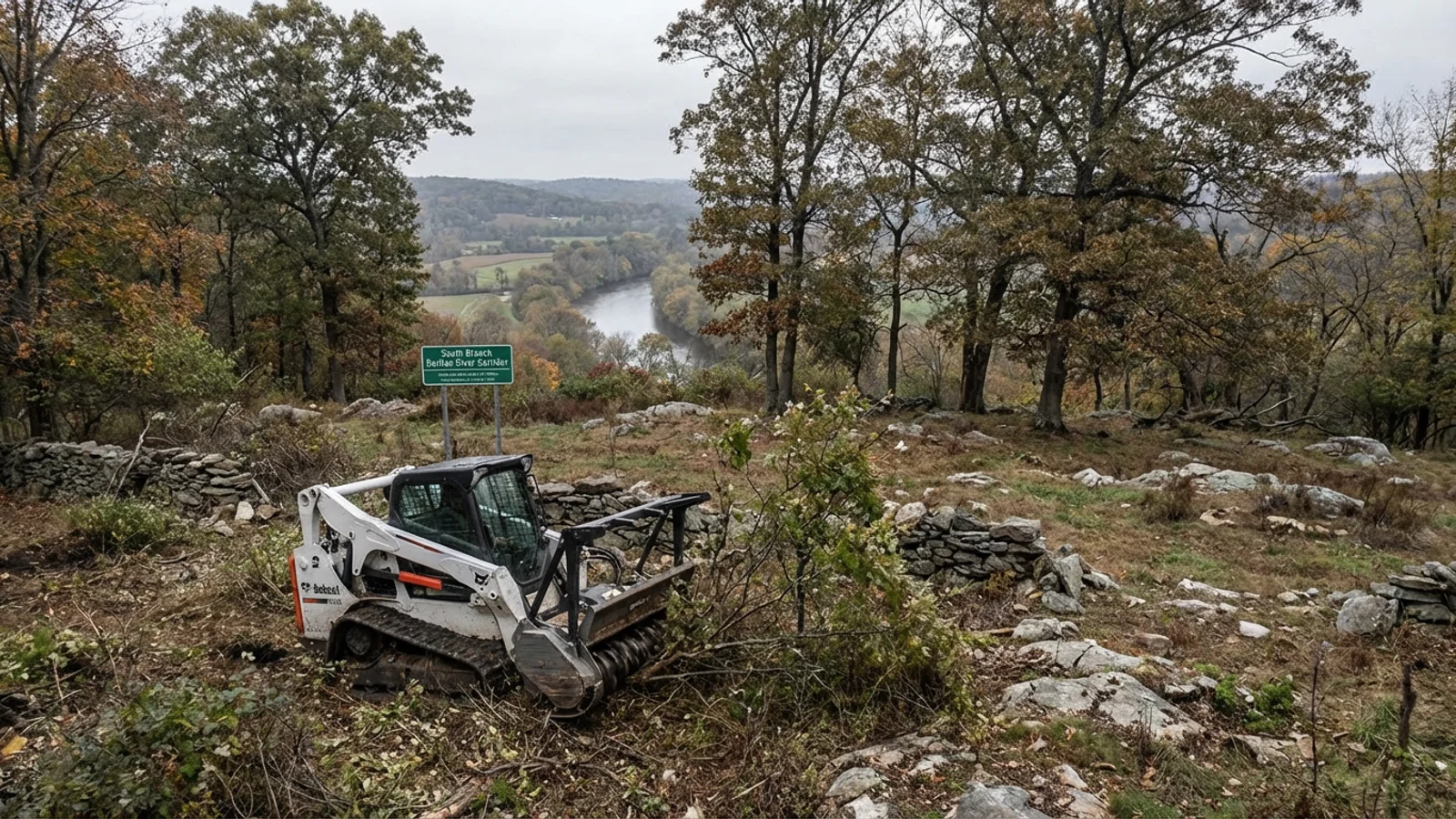
Clinton's terrain is a mix of flat riverside parcels and moderately sloped hillsides above the South Branch valley. Forestry mulching handles both well. On the flat ground near the river, the mulcher grinds invasive knotweed and vine overgrowth at soil level and leaves a clean mulch layer that suppresses regrowth and prevents sediment from washing into the waterway during storms. On the hillsides above town, tracked equipment stays stable on grades that would bog down a mower or skid steer, and the mulch left behind locks the slope against erosion.
Bulldozing doesn't make sense for most Clinton properties. The lots are too established — stone walls, mature trees worth keeping, septic systems, and neighboring properties inches away. A bulldozer would tear through all of it. Forestry mulching is precise. We work around what matters and grind what doesn't.
Hand clearing is the other common alternative, but it's painfully slow and expensive for anything beyond a small garden bed. A crew with chainsaws and a chipper might spend three days on what a mulcher finishes in four hours — and they leave a pile of chips you still need to deal with. The mulcher processes everything in place.
What We Typically Mulch in Clinton
Japanese knotweed is the signature problem along the South Branch Raritan and its tributaries. It dominates riverbank properties, grows through cracks in stone walls, and pushes into maintained yards every season. Mulching knocks it back hard, though repeat treatment is usually needed for full eradication because the root system stores enough energy to regrow from fragments.
Multiflora rose fills the understory on wooded parcels throughout Clinton Township. It's thorny, dense, and forms impenetrable thickets that block foot traffic and bury fence lines. The mulcher grinds it at ground level — thorns and all.
Oriental bittersweet is the vine that's pulling down trees along property borders and in neglected woodlots. It wraps around trunks, climbs into the canopy, and shades out the host tree. Mulching clears the ground-level growth and frees the trees that are still viable.
Volunteer saplings — red maple, ash, black cherry, and ailanthus (tree of heaven) — fill in any open ground within a few years if it's not maintained. Fields that were mowed five years ago can have head-high saplings today. The mulcher takes them down in a single pass.
Equipment and Approach for Clinton Terrain
For standard Clinton lots — relatively flat, good driveway access, moderate brush — we bring a full-size tracked forestry mulcher that processes vegetation quickly and leaves a clean, even mulch layer. For tighter borough lots where the driveway is narrow or the work area is hemmed in by structures and fences, we use a compact tracked machine that fits through a standard residential gate and works in spaces a larger unit can't access.
On sloped parcels above the river valley, the tracked undercarriage is essential. It distributes the machine's weight across a wide footprint, which prevents the rutting and soil compaction that wheeled equipment would cause. The mulch layer left on slopes is typically two to four inches deep — enough to hold the soil in place while native vegetation re-establishes underneath.
Common Questions
How much does forestry mulching cost in Clinton, NJ?
For typical Clinton properties, forestry mulching runs between $2,500 and $6,500 depending on acreage, brush density, and slope. A quarter-acre borough lot with moderate overgrowth is on the lower end. A three-to-five-acre township parcel with dense saplings and invasive brush runs higher. We quote by the project, not by the hour. Request your free estimate.
What size trees can you mulch in Clinton?
Our equipment handles trees up to six to eight inches in diameter in a single pass. That covers saplings, volunteer trees, and most of the woody growth that fills in on neglected Clinton properties. For larger trees, we can coordinate with a tree service or work around them selectively.
Will forestry mulching work on the slopes above the South Branch in Clinton?
Yes. Our tracked equipment is built for moderate slopes and stays stable on the grades common above the South Branch Raritan valley. The mulch layer left behind is critical on these slopes — it prevents erosion that would otherwise wash exposed soil into the river corridor during heavy rain.
Is forestry mulching better than bulldozing for Clinton properties?
For most Clinton properties, yes. Bulldozing strips topsoil, damages root systems of trees you want to keep, and creates bare ground that erodes quickly — especially on slopes near the river. Forestry mulching preserves the soil, leaves a protective mulch layer, and allows selective clearing around mature trees, stone walls, and structures. Read our full comparison of forestry mulching vs. bulldozing.
What happens to the mulch after you're done?
The mulch stays on the ground where it was created. It typically settles to a layer two to four inches deep, depending on how dense the vegetation was. Over the following twelve to eighteen months, it breaks down naturally and enriches the soil. In the meantime, it suppresses weed regrowth and prevents erosion — both of which matter on Clinton’s sloped and river-adjacent properties.
Can you mulch around the stone walls on my Clinton property?
Yes. Selective clearing is one of the biggest advantages of forestry mulching. We can work right up to the edge of stone walls, mature trees, and other features you want to keep without damaging them. Just walk us through what stays and what goes before we start.
Done watching the brush take over your Clinton property?
Get a free estimate — one visit, one quote, and we'll tell you exactly what the job involves.
Or call (908) 774-9235.