

Home / Forestry Mulching / High Bridge, New Jersey
Forestry Mulching in High Bridge, New Jersey
High Bridge is one of the steepest residential areas in Hunterdon County — a small borough stacked into the hills above the South Branch Raritan where standard clearing methods either can't reach or would leave the hillside stripped and eroding. Forestry mulching solves both problems. Tracked equipment grinds brush and saplings at ground level without tearing up the slope, and the mulch left behind is what keeps the soil in place. On terrain like High Bridge's, that mulch layer isn't optional — it's the difference between a cleared hillside that stays stable and one that washes into your basement in the next storm.
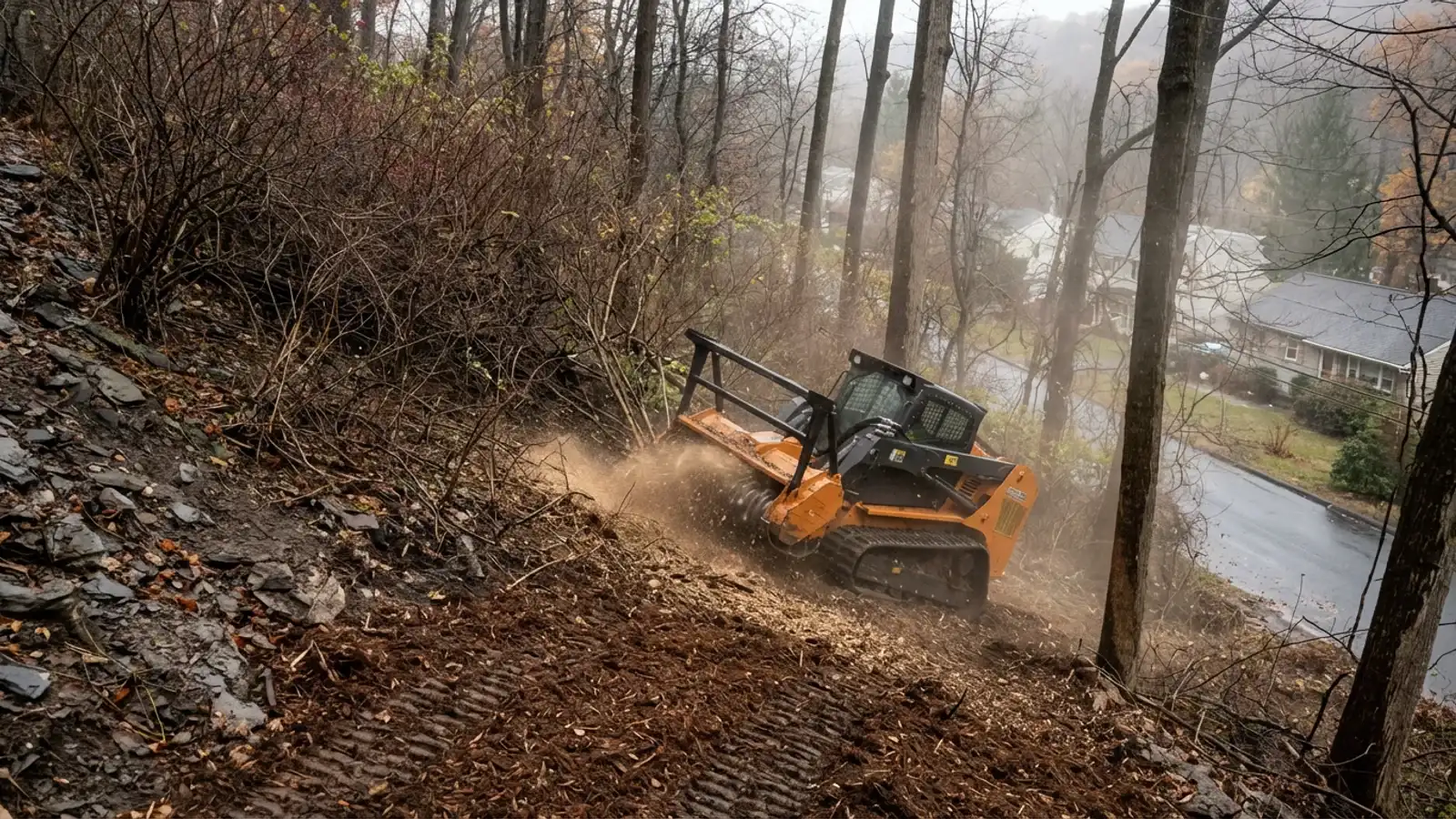
Why Forestry Mulching Works in High Bridge
The grades on High Bridge properties — routinely thirty percent, sometimes steeper — rule out every clearing method except forestry mulching with tracked equipment. Wheeled machines lose traction. Brush hogging can't operate on slopes. Hand crews with chainsaws can cut brush, but they can't grind it in place — they'd need to haul every piece off the hill, which means dragging it across slopes steep enough to lose footing. Bulldozing would strip the thin soil layer to bedrock and cause catastrophic erosion.
A tracked forestry mulcher stays planted on these grades because the steel tracks spread the machine's weight across a wide footprint, gripping the surface without concentrating pressure. The machine processes everything in a single pass — brush, saplings, vines, small trees — and converts it into a ground-level mulch layer that sits on the surface and knits together. On a steep hillside, that layer does three things: it absorbs rainfall before it can build velocity as runoff, it anchors the soil beneath it, and it suppresses regrowth by blocking light to the root crowns of the species that were just removed.
The Highlands Preservation Area designation over most of High Bridge makes erosion-safe clearing methods more than just good practice — it's the approach least likely to trigger environmental review. Forestry mulching doesn't expose bare soil, doesn't require hauling through sensitive areas, and doesn't change the grade of the land.
What We Typically Mulch in High Bridge
The hillsides above High Bridge's center are a textbook example of what happens to residential lots in wooded boroughs over twenty to thirty years of benign neglect. The understory fills in with multiflora rose — the thorny, arching thickets that create impenetrable walls within five years of taking hold. Japanese barberry fills the gaps underneath the rose, forming a low, dense carpet that nothing else can grow through. Together, they lock the hillside into a permanent state of unusable undergrowth.
Along the South Branch and the Columbia Trail corridor at the base of town, Japanese knotweed dominates. The bamboo-like stalks reach eight to ten feet tall by midsummer and form dense monocultures that crowd out every native species. Knotweed's root system — technically a rhizome network — can extend fifteen feet from the visible stand, which means the problem is always bigger than it looks from above ground.
On the drier upper slopes and ridgetops, the growth pattern shifts. Red cedar and Virginia pine establish on former open ground and create dense stands within a decade. Mixed in with them are black cherry saplings, gray birch, and sassafras — all fast colonizers of disturbed or abandoned residential lots.
Equipment & Approach for High Bridge Terrain
High Bridge jobs use our low-ground-pressure tracked mulcher configured for slope work. The machine's center of gravity stays low, and the operator works across the grade — traversing the hillside rather than driving straight up or down — to maintain stability and control.
Access planning matters more in High Bridge than in most of our service area. Many lots are reached through narrow gaps between houses, across shared driveways, or through backyard gates that were never designed for equipment wider than a lawn mower. We assess access during the estimate and bring the right-sized machine for the available entry point. Where full-size equipment can't reach, we use a compact tracked unit that fits through a standard gate opening.
Common Questions
How much does forestry mulching cost in High Bridge, NJ?
Most jobs run $2,500–$6,000 depending on slope and density. Get a free estimate for your High Bridge property.
What size trees can you mulch on High Bridge's hillsides?
We handle trees up to 6–8 inches in diameter. That covers the saplings, small trees, and dense brush on most hillside lots here.
Will forestry mulching work on a forty-percent grade?
Yes — our tracked equipment handles slopes up to 45%. Learn about our hillside clearing capabilities.
Does the mulch prevent erosion on High Bridge's steep lots?
Yes — the mulch absorbs rainfall, slows runoff, and anchors the soil. On High Bridge’s steep grades, it’s the only clearing method that improves erosion resistance while clearing.
Can you mulch along the Columbia Trail in High Bridge?
Yes — we clear properties bordering the Columbia Trail regularly. We clear the private-property side to restore space and sight lines without affecting trail drainage.
How do I get equipment to the back of my High Bridge lot?
We assess access during the estimate. Our compact mulcher fits through openings as narrow as 4 feet. Schedule a free site visit.
High Bridge hillside that needs clearing? We're built for it.
Tracked equipment, zero erosion, fixed pricing. Call for a free estimate.
Or call (908) 774-9235.