

Home / Forestry Mulching / Washington Township, Warren County, NJ
Forestry Mulching in Washington Township, Warren County, NJ
Washington Township's growth along the Route 31 corridor means cleared land is in demand — and so is a fast, clean way to get from overgrown to usable. Forestry mulching is the method that fits this township best because it handles the full range of what grows here: the multiflora rose thickets on rural fence lines, the autumn olive spreading across abandoned pastures, the knotweed creeping up from the Musconetcong, and the cedar and sapling regrowth on lots that haven't been touched since they were subdivided. One machine, one pass, no hauling, no burning.
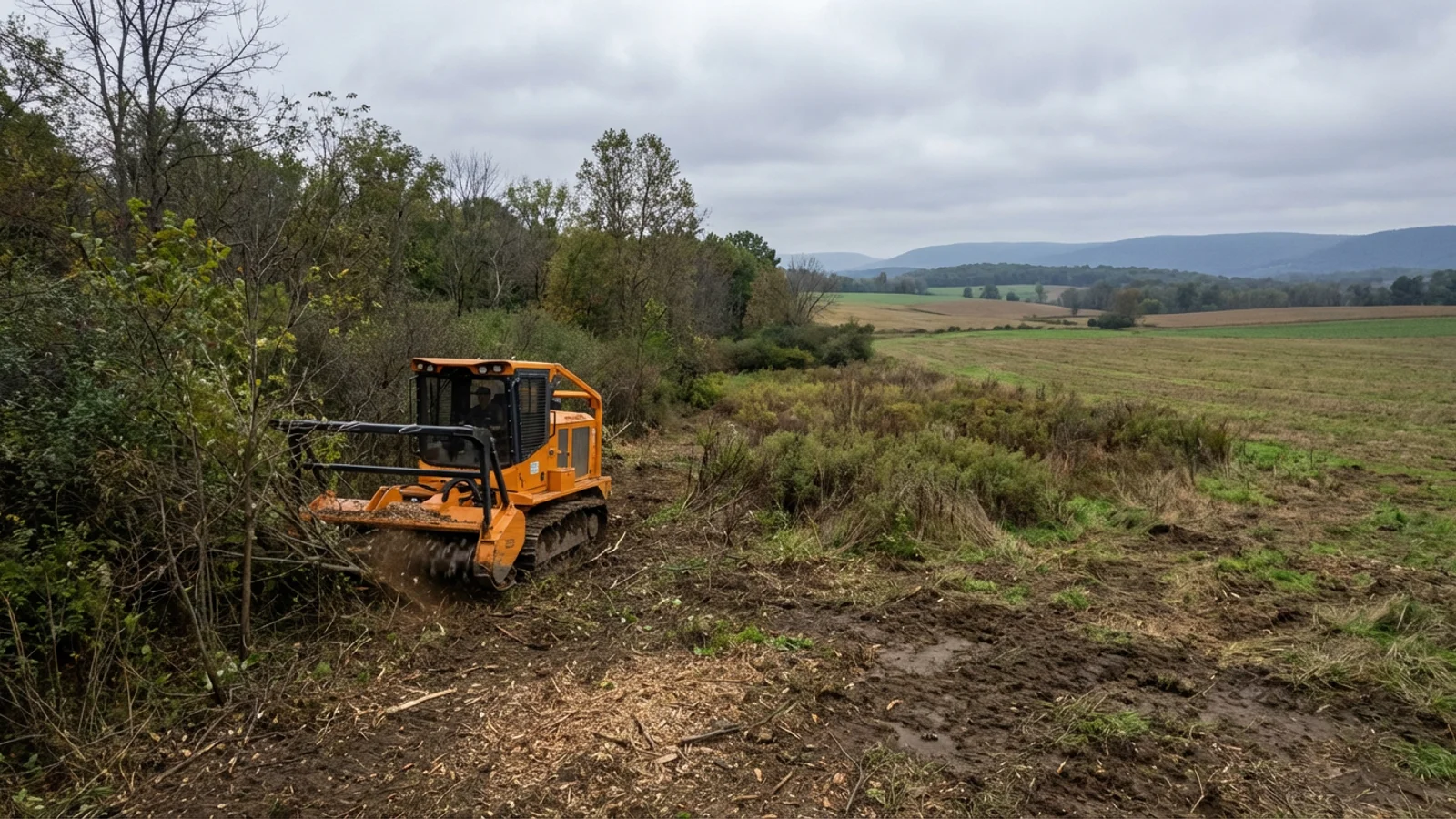
Why Forestry Mulching Works in Washington Township
The rolling terrain in Washington Township creates moderate slopes that are manageable for tracked mulching equipment but problematic for bulldozers. A bulldozer on these hillsides would blade the topsoil downhill, exposing the clay-shale subsoil underneath — which compacts into a surface that sheds water instead of absorbing it. The result is erosion gullies and standing water where you wanted cleared ground.
Forestry mulching avoids that entirely. The machine grinds everything at or just below ground level and leaves the root structure and topsoil intact. The mulch layer settles onto the surface and acts as a natural erosion blanket. On Washington Township's slopes, this is the difference between cleared land that stabilizes within a few weeks and cleared land that washes out in the first thunderstorm.
For construction-related clearing, mulching is also faster than the alternatives. A lot that would take a chainsaw crew three to four days to cut, pile, and haul is cleared in a single day by a mulcher. When a builder is waiting to break ground, that time savings matters.
What We Typically Mulch in Washington Township
On upland parcels — which describes most of the township — multiflora rose is the constant. It fills every fence row, every wood edge, every understory gap. The thorns are vicious and the growth is relentless. Autumn olive has colonized the former agricultural fields, especially in the transitional areas where active farmland meets residential development. It fruits in fall, birds spread the seeds everywhere, and within a few years a clean field becomes a chest-high thicket of silver-leafed shrubs.
Along the Musconetcong River corridor on the township's northern boundary, Japanese knotweed forms dense monocultures on the streambanks and adjacent low ground. It's a perennial problem — mulching removes the above-ground biomass, but the root system is deep and persistent. We recommend mulching followed by targeted herbicide treatment for lasting control.
Tree of heaven is increasingly visible along Route 31 and the township's secondary roads. It's an aggressive colonizer of disturbed soils and produces a chemical in its roots that inhibits the growth of competing plants. It's also the preferred host of the spotted lanternfly, which has been expanding across Warren County. Removing tree of heaven reduces lanternfly habitat and limits their spread.
Equipment and Approach for Washington Township Terrain
Most Washington Township properties are well-suited to a full-size tracked forestry mulcher. The rolling terrain is moderate enough for conventional tracked equipment, access is good from Route 31 and the township road network, and lot sizes justify bringing the larger machine for productivity.
For tighter suburban lots near Washington Borough, we scale down to a compact unit that maneuvers between houses, fences, and landscaping. On river-adjacent properties along the Musconetcong, we plan the work to stay within NJ DEP buffer limits and orient the mulching pattern so that processed material doesn't end up in the waterway. The mulch layer actually helps — it absorbs rainfall and reduces sediment transport compared to bare ground.
Common Questions
How much does forestry mulching cost in Washington Township, Warren County?
Most forestry mulching projects in Washington Township range from $2,500 to $7,000. Get a free estimate for your property.
How long does forestry mulching take on a Washington Township property?
A typical one-to-three-acre residential lot takes one day. Larger rural parcels may take one to two days. We provide a timeline estimate with your quote.
Will forestry mulching stop autumn olive from growing back in my field?
Mulching dramatically slows autumn olive regrowth because it grinds the plant at and below the root crown. For heavy infestations, we recommend mulching followed by spot herbicide treatment within the first growing season. Learn about our invasive species removal approach.
Can forestry mulching handle tree of heaven in Washington Township?
Yes, but tree of heaven requires extra care. Cutting or mulching it without herbicide treatment causes aggressive root suckering. We mulch the above-ground growth and recommend herbicide application to kill the root system. Read our guide to tree of heaven removal in NJ.
Is forestry mulching safe near the Musconetcong River?
Yes, with proper planning. We assess NJ DEP riparian buffer requirements during the site visit and design the clearing plan accordingly. Forestry mulching is actually one of the safest methods for river-adjacent clearing because the mulch layer prevents sediment runoff.
What's the difference between forestry mulching and brush hogging for Washington Township fields?
Brush hogging works for tall grass and light weeds. Once you’re dealing with woody stems, a brush hog just mows the tops off and they regrow. Forestry mulching grinds woody material at and below ground level, including the root crown, which produces lasting results.
Washington Township land doesn't clear itself.
One call, one visit, one quote. Let's get your property sorted out.
Or call (908) 774-9235.