

Home / Forestry Mulching / Hackettstown, New Jersey
Forestry Mulching in Hackettstown, New Jersey
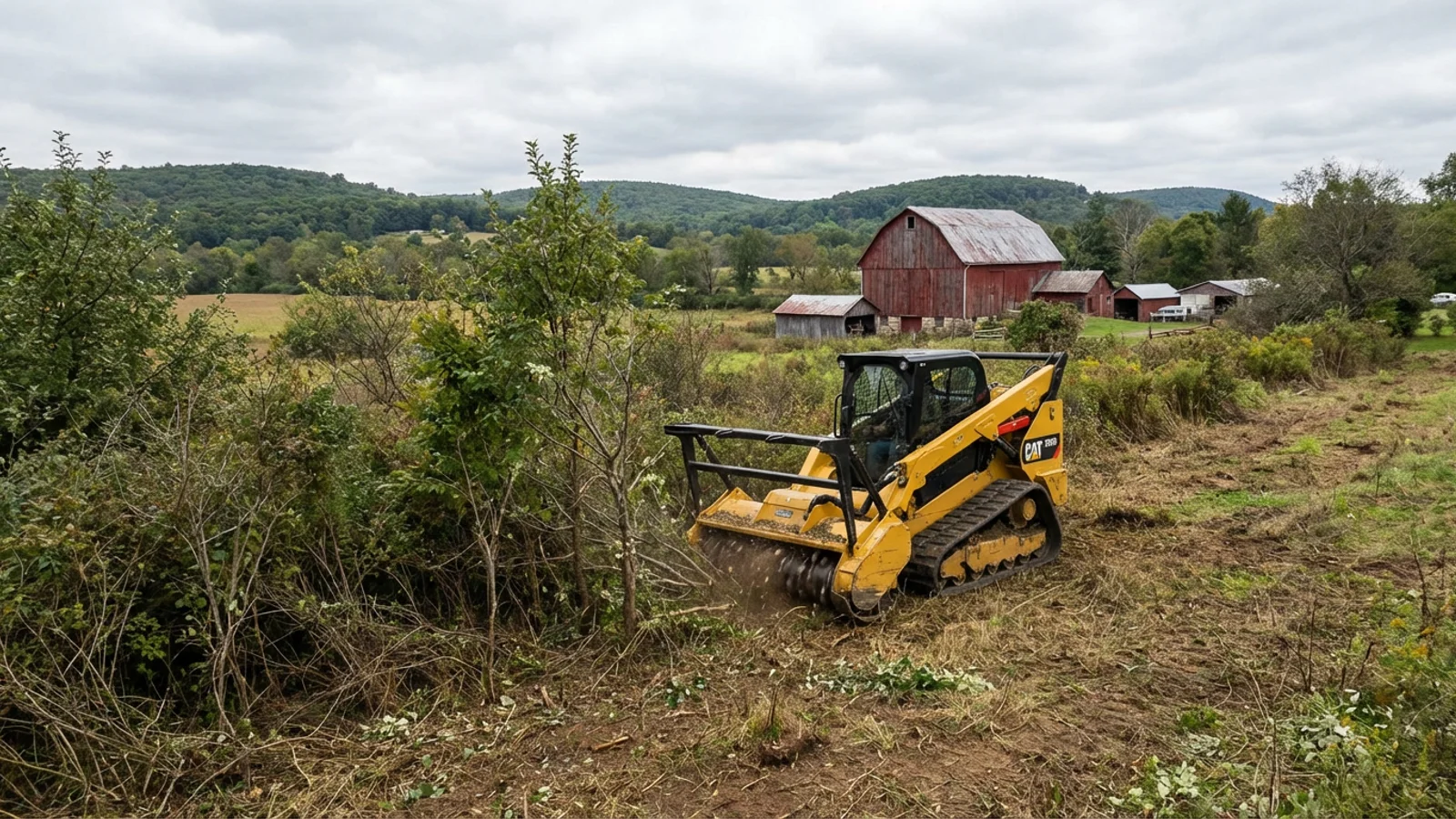
Hackettstown's mix of river corridor properties, in-town residential lots, and outlying rural acreage means clearing needs here range from tight backyard jobs to multi-acre field reclamation. Forestry mulching handles the full range. The machine grinds brush, saplings, knotweed, and invasive shrubs into mulch right where they stand — no chainsaw crews, no chipper truck, no dump runs. A riverbank choked with knotweed and a five-acre field full of autumn olive both get the same treatment: one machine, one pass, clean ground.
Why Forestry Mulching Works in Hackettstown
The Musconetcong River corridor is the reason forestry mulching makes more sense in Hackettstown than any other clearing method. Properties near the river need to minimize soil disturbance — bare ground along a Category One waterway means sediment washing into the river during every rain event, which triggers regulatory problems and ecological damage. Forestry mulching eliminates vegetation without exposing soil. The mulch layer acts as an instant erosion blanket, absorbing rainfall and keeping sediment in place. Bulldozing the same riverbank would create exactly the kind of disturbance that NJ DEP rules are designed to prevent.
On the upland properties away from the river, the advantage shifts to speed and economy. Hackettstown's outlying parcels are large enough that hand clearing or chainsaw-and-chipper work becomes prohibitively expensive. A mulcher processes an acre of dense autumn olive and multiflora rose in a few hours — work that a hand crew would take a week to finish. The property owner gets usable ground by the end of the day rather than the end of the month.
For in-town residential lots, the compact mulcher provides the precision needed on smaller properties. It works in enclosed backyards, between houses, and around landscaping features without the disruption that a bulldozer or large clearing crew would create in a neighborhood setting.
What We Typically Mulch in Hackettstown
Japanese knotweed is the headline species. It dominates the Musconetcong riverbanks and has pushed deep into adjacent properties on the floodplain. Knotweed grows through asphalt, concrete, and stone walls, and a single root fragment can establish a new colony. Mulching removes all above-ground biomass and grinds the root crowns at soil level. For lasting control, follow-up herbicide treatment is essential — knotweed's deep rhizome system stores enough energy to regrow from fragments that the mulcher can't reach.
Phragmites fills the wet, low-lying areas along the Musconetcong and in the stormwater basins scattered around town. It grows ten to twelve feet tall and forms dense monocultures that crowd out native plants and block drainage. Mulching cuts it to ground level, but like knotweed, phragmites regenerates from its root system and typically needs herbicide follow-up for complete control.
On the upland lots and rural parcels, autumn olive is the primary colonizer of abandoned fields. It grows fast, fruits heavily, and the berry clusters feed flocks of birds that distribute the seeds across every open acre in the township. Multiflora rose fills the fence rows and wood edges with its signature wall of thorns. Both grind cleanly and a high percentage of plants are killed when the mulcher processes through the root crown.
Tree of heaven is concentrated along Route 46 and Route 517 but spreads aggressively from road shoulders onto adjacent private land. As with every site where tree of heaven is present, we recommend herbicide treatment concurrent with mulching to prevent the explosion of root suckers that cutting alone triggers.
Equipment and Approach for Hackettstown Terrain
The Musconetcong valley floor in central Hackettstown is flat and accessible — standard tracked mulching equipment works well here. The primary consideration is moisture: the valley soils stay wet longer after rain than the upland areas, so we schedule river-corridor work during dry periods to avoid rutting soft ground.
On the hillsides above town — toward Mansfield, Independence, and Allamuchy — the terrain steepens enough that tracked equipment is necessary. Wheeled equipment would lose traction on the shale-derived clay soils common on these slopes. The mulch layer left on hillsides is especially important because it prevents the surface erosion that exposed clay is prone to during heavy rain.
For in-town lots with tight access — narrow driveways, rear-only access through a side yard, enclosed backyards — the compact tracked mulcher fits where a full-size machine can't. It's slower per acre but essential for the work environment.
Common Questions
How much does forestry mulching cost in Hackettstown, NJ?
Forestry mulching in Hackettstown ranges from $2,000 to $7,000. Get a free estimate for your property.
Does forestry mulching actually kill Japanese knotweed?
Mulching kills above-ground growth and grinds root crowns. But knotweed’s deep rhizomes can regrow. For lasting results, combine mulching with herbicide treatment. Read our full knotweed removal guide.
Can you forestry mulch near the Musconetcong River in Hackettstown?
Yes, within buffer limits. The Musconetcong’s Category One status means a 300-foot buffer zone. Forestry mulching is ideal for river-adjacent work because the mulch prevents sediment runoff. We assess buffer requirements during the site visit.
How long does forestry mulching take on a Hackettstown property?
In-town lots take one day. Larger parcels take one to two days. River-corridor properties with dense knotweed may take longer due to buffer zone care.
What happens to the mulch on my Hackettstown property after you're done?
The mulch stays in place — two to four inches deep — and decomposes naturally over 12–18 months. On river-adjacent properties, it prevents sediment runoff. On hillsides, it stabilizes the slope.
Is forestry mulching better than burning for clearing in Hackettstown?
Yes. Burning requires permits, creates air quality issues, and doesn’t address root systems. Forestry mulching requires no burn permit, processes root crowns, and leaves a useful mulch layer. There’s no scenario in Hackettstown where burning is a better option.
Knotweed on the river? Brush on the hill? We handle both.
Get a free estimate for your Hackettstown property — one call and we'll figure out the right approach.
Or call (908) 774-9235.