

Home / Forestry Mulching / Oxford Township, New Jersey
Forestry Mulching in Oxford Township, New Jersey
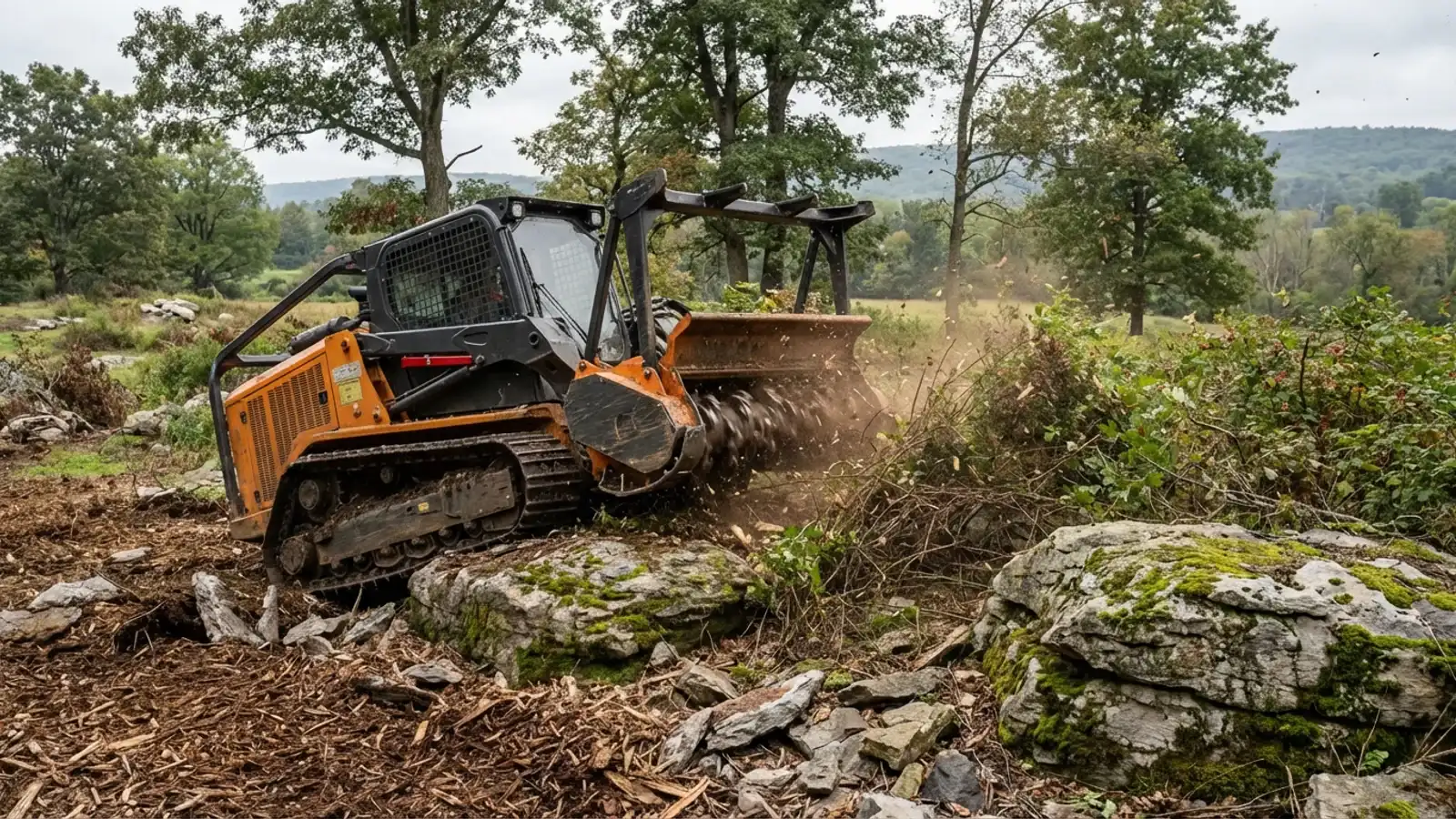
Oxford Township sits on some of the hardest ground in Warren County — Cambrian limestone, dolomite ledge, and glacial boulders scattered through every field and woodlot. Most clearing methods struggle here. Bulldozing catches on subsurface rock and tears up the thin topsoil layer that took centuries to form. Hand clearing works but costs a fortune in labor hours on properties that run ten acres or more. Forestry mulching handles Oxford's rock-country conditions because the machine processes vegetation at ground level — above the rock — without digging, grading, or displacing soil. The cutting head grinds everything organic while the rock stays where it's been sitting since the last ice age.
Why Forestry Mulching Works in Oxford Township
The fundamental advantage of forestry mulching on Oxford's rocky terrain is that the machine works above the soil surface. A bulldozer blade has to penetrate the ground to push material — and on Oxford's limestone-and-boulder substrate, that blade catches on subsurface ledge, displaces the thin topsoil, and exposes raw rock that nothing will grow on again without years of soil rebuilding. Forestry mulching avoids all of that. The cutting head spins at the surface, grinding vegetation to mulch while the soil and rock structure underneath stays intact.
This matters because Oxford's topsoil is thin and irreplaceable on a human timescale. The ridgetop properties have six to twelve inches of soil over fractured bedrock. Scrape that off with a dozer and you're left with a limestone pavement. The mulch layer from forestry mulching actually adds to the soil — it decomposes into organic material that enriches the thin topsoil over six to eighteen months.
On Oxford's rocky ground, the mulcher operates at reduced speed compared to clean-soil properties. The operator reads the terrain ahead of the machine, watching for exposed outcrops and surface boulders that require routing around. The teeth on the cutting head are carbide-tipped and designed to handle occasional rock contact, but sustained grinding against limestone wears them down faster than brush alone. We factor this wear into Oxford pricing and bring spare teeth on every job.
What We Typically Mulch in Oxford Township
The ridgetop properties in Oxford grow a distinctive mix of drought-tolerant species. Chestnut oak, shagbark hickory, and red cedar dominate the overstory on thin, rocky soils. The understory is sparser than on richer ground but still problematic — Japanese barberry carpets the forest floor in dense patches, multiflora rose invades wherever there's enough soil depth for its roots, and garlic mustard fills the gaps every spring.
In the valleys between Oxford's ridges, the vegetation is more aggressive. Autumn olive and multiflora rose dominate abandoned fields. Young hardwoods — red maple, tulip poplar, sweet gum — establish quickly on the deeper valley soils and can reach six to eight inches in diameter within fifteen years of a field going fallow. Wild grape vine and Virginia creeper drape over everything, creating a layered tangle that's nearly impossible to walk through.
Along the Pequest River corridor and the smaller streams that cut through the township, Japanese knotweed colonizes the riparian zones. The knotweed stands are typically narrower here than in major river corridors but still need management to prevent them from spreading into adjacent cleared areas.
Eastern red cedar is the signature encroachment species on Oxford's former agricultural ground. It colonizes rocky, well-drained soils faster than any other tree in this part of New Jersey and can create dense, impenetrable stands within fifteen years. The dense shade under cedar stands kills grass and ground cover, creating bare soil that erodes on slopes.
Equipment & Approach for Oxford Township Terrain
Every Oxford job starts with a more thorough site assessment than most properties require. We walk the parcel specifically to map rock conditions — where ledge is exposed, where boulders cluster, where the soil is deep enough for normal operation. This assessment prevents surprises during clearing and allows us to quote accurately.
On properties with scattered surface rock, the mulcher works at roughly seventy percent of the speed it would run on clean ground. The operator keeps the cutting head at a slightly higher elevation to avoid direct rock contact and navigates around exposed outcrops rather than trying to clear over them. On properties with extensive ledge exposure, some areas may need hand-clearing of vegetation from the rock faces — the mulcher handles everything around and between the outcrops.
We bring a full set of replacement teeth on every Oxford job. The carbide tips handle occasional rock contact, but Oxford's limestone chews through them faster than soft-ground properties do. Planning for tooth changes avoids downtime during the job.
Common Questions
How much does forestry mulching cost in Oxford Township, NJ?
Oxford runs 10–30% higher per acre than clean-soil properties due to rocky conditions. Get a free estimate with accurate rock-terrain pricing.
Will the mulcher damage the rock on my Oxford property?
No — the mulcher works above the soil surface and navigates around rock. Your outcrops and boulders stay exactly as they are.
Does rocky terrain damage your equipment?
The carbide teeth handle rock contact but wear faster here. We bring replacement teeth on every Oxford job and factor wear into pricing.
How long does forestry mulching take on rocky ground in Oxford?
Rocky terrain adds roughly 30% to clearing time. A 5-acre job that takes 3 days on flat ground might take 4–5 days here. We build this into every quote.
Can you mulch cedar stands on rocky ridgetop soil in Oxford?
Yes — cedar clearing on rocky ridgetops is one of our most common Oxford jobs. Learn how forestry mulching handles cedar stands.
Is Oxford Township in the Highlands?
No — Oxford is outside both Highlands zones. No Highlands overlay on clearing projects here.
Rocky ground doesn't scare our equipment.
We know Oxford's limestone terrain. Get a free estimate from a crew that clears stone-belt properties every week.
Or call (908) 774-9235.