

Home / Field Notes — Land Clearing Knowledge Base / Callery Pear Removal in New Jersey
Callery Pear Removal in New Jersey
Published April 1, 2026 by Brush Busters • Last reviewed April 1, 2026
You know the tree even if you don’t know the name. The Bradford pear — the ubiquitous white-blooming ornamental planted in every NJ shopping center parking lot and suburban development from the 1960s through the 2000s — is a cultivar of Callery pear (Pyrus calleryana). The ornamental cultivars were supposed to be sterile. They’re not. Cross-pollination between different cultivars produces viable seeds that birds spread across the landscape, and the resulting wild Callery pear trees are now one of the fastest-spreading invasive trees in the eastern United States.
In New Jersey, wild Callery pear is colonizing field edges, roadsides, disturbed areas, and the borders of suburban development throughout our service area. It’s most visible in April when the clouds of white blossoms appear along every highway corridor and field margin — and if you’re noticing more of them every year, you’re not imagining it.
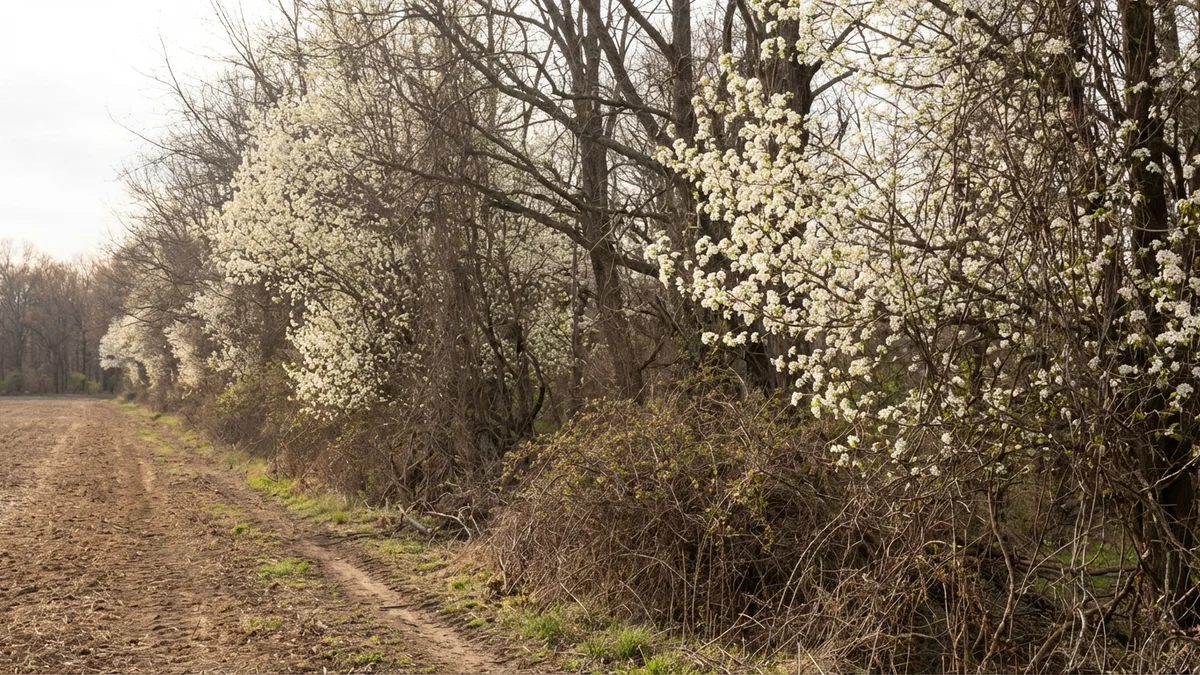
Identification
Spring flowers: Masses of white flowers in early April — before most native trees leaf out. The blooms are the easiest identifier and the reason everyone recognizes this tree. The smell is distinctive and unpleasant — often described as rotting fish.
Leaves: Glossy, dark green, oval with fine-toothed (crenate) edges. Two to three inches. Fall color is typically red to purple — one of the ornamental features that made it popular in landscaping.
Fruit: Small, round, hard berries about half an inch in diameter. Brown when ripe. Birds eat them and deposit seeds.
Form: Wild Callery pear (as opposed to the grafted ornamental cultivars) grows as a thorny, multi-stemmed, densely branched tree reaching 30–50 feet. The thorns on wild specimens are formidable — one to three inches, sharp enough to puncture a tire. Ornamental cultivars (Bradford, Cleveland Select, etc.) are single-trunked without thorns.
Where it grows: Field edges, highway medians, abandoned lots, suburban fringes, old parking lot borders. Anywhere a bird sat with a belly full of berries. It tolerates poor soil, compacted ground, salt spray, and drought. It’s incredibly tough, which is why it was planted everywhere — and why it’s now everywhere it was never intended to be.
Why it's a problem
Aggressive colonization. Wild Callery pear establishes on disturbed and fallow ground faster than most native trees. In NJ’s agricultural-to-suburban transition zones, it’s colonizing field edges and abandoned lots at an accelerating pace. A field left fallow for five to ten years in central NJ will have Callery pear among the first woody colonizers.
Displacement of native trees. In field-edge and early-succession habitats, Callery pear displaces native species that would normally fill those niches — native dogwood, serviceberry, hawthorn, and young oaks and maples. The thorny, dense growth form shades out competition.
Thorns. Wild Callery pear thorns are a legitimate safety hazard. They puncture tires, boots, and skin. Dense Callery pear thickets on field edges are essentially impassable without clearing equipment.
Structural weakness. The ornamental cultivars (Bradford pear especially) are notorious for splitting at the branch crotches during storms, ice, and snow. If you still have ornamental Bradford pears on your property, they’re likely approaching the age where structural failure becomes a regular occurrence.
NJ regulatory status. New Jersey has moved toward restricting Callery pear sales and planting. The tree is recognized as invasive by the NJ Invasive Species Strike Team. Check current NJ Department of Agriculture guidance for sales and planting restrictions.
Removal approach
Forestry mulching handles wild Callery pear up to about eight inches in trunk diameter — which covers the vast majority of wild specimens under fifteen years old. The mulcher grinds the thorny stems and all associated growth at ground level. The mulch covers the root zone and suppresses regrowth.
For larger specimens (over eight inches), selective chainsaw removal followed by stump treatment brings the tree down. The remaining brush and smaller stems are then mulched.
Herbicide is strongly recommended on Callery pear. The species resprouts from roots and stump tissue. Apply triclopyr or glyphosate to cut stumps immediately after cutting. Without treatment, the stump sends up multiple vigorous sprouts that create a thornier, denser thicket than the original tree.
Seed bank management. Birds continue depositing Callery pear seeds from adjacent source trees. Annual monitoring and removal of new seedlings (easy when small — just pull them) prevents reestablishment. This is particularly important on cleared field edges where new seeds arrive every season.
Costs
Callery pear removal is typically part of broader field-edge clearing, fence-line work, or lot clearing. As part of a standard clearing project, there’s no additional charge. For targeted removal of scattered Callery pear trees on an otherwise maintained property, expect $200–$500 per tree depending on size, plus herbicide treatment.
On field-edge clearing projects where Callery pear is the dominant invasive, per-acre costs run $1,500 to $3,500 depending on stem density and tree size.
Common Questions
Is Callery pear the same as Bradford pear?
Bradford is a cultivar of Callery pear — the ornamental version. The wild invasive form grows from bird-spread seeds and is thorny, multi-stemmed, and aggressive. Both are the same species.
Can forestry mulching remove Callery pear?
Yes, up to ~8-inch trunks. Larger trees need chainsaw first. Herbicide on stumps is essential — without it, the tree resprouts worse. Learn about forestry mulching.
Will Callery pear grow back after removal?
Without herbicide — aggressively. Treat stumps immediately with triclopyr or glyphosate. One treatment prevents the dense, thorny regrowth that’s worse than the original.
Is Callery pear banned in NJ?
NJ has moved toward restricting sales and planting. It’s listed as invasive by the NJ Invasive Species Strike Team. Removal is recommended but not currently required for existing trees.
How do I identify wild Callery pear?
White April blooms (with a fishy smell), glossy oval leaves, hard brown berries, and 1–3 inch thorns. Wild form is multi-stemmed and thorny, unlike the ornamental cultivars.
Are the thorns dangerous?
Yes — 1–3 inches long, strong enough to puncture tires and boots. Dense thickets are impassable and dangerous. The mulcher grinds thorns and all.
Related Services
Invasive Species Removal
Japanese knotweed, multiflora rose, mile-a-minute vine, and other NJ invasives eliminated at ground level.
Want the full New Jersey land clearing playbook?
This article covers one piece of the puzzle. The complete guide ties together methods, costs, permits, terrain, and contractor selection in one place.
Callery pear is spreading across your field edge. We stop it.
Thorns, resprouts, and all. One pass with follow-up treatment eliminates it.
Or call (908) 774-9235.