

Home / Field Notes — Land Clearing Knowledge Base / Phragmites Removal in New Jersey
Phragmites Removal in New Jersey
Published April 4, 2026 by Brush Busters • Last reviewed April 4, 2026
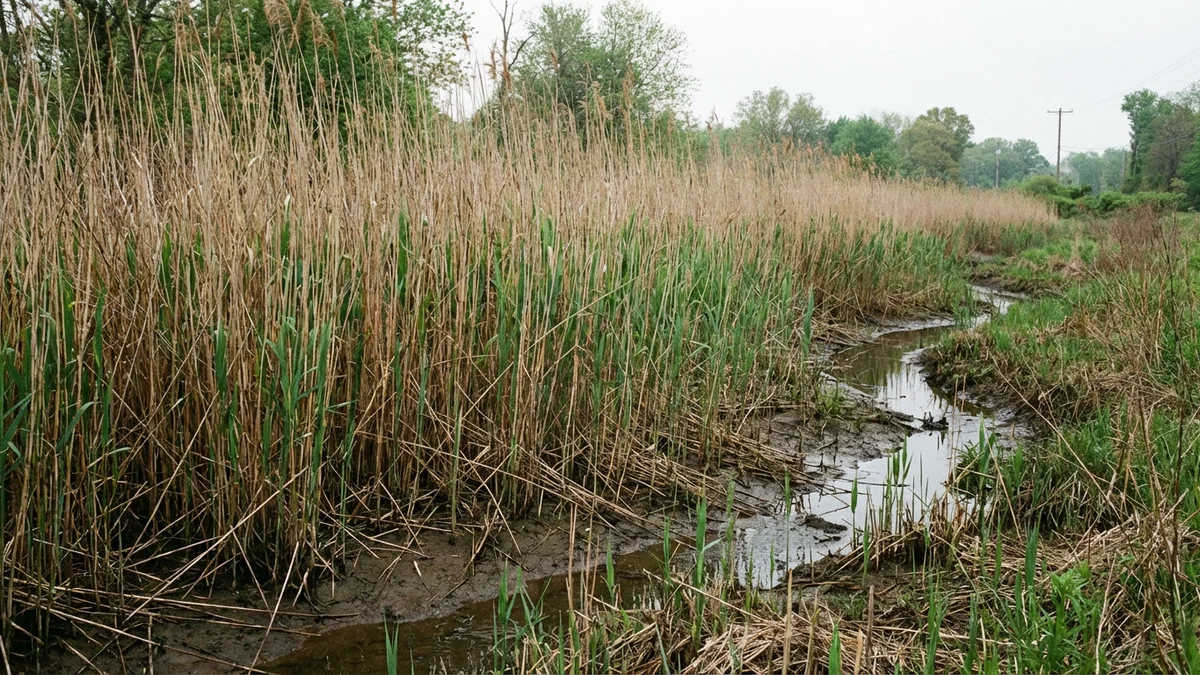
Phragmites australis — the non-native common reed — is one of the most visible invasive plants in New Jersey. The tall, dense stands (reaching 12–15 feet) line highway medians, fill drainage ditches, and colonize every wet area on properties throughout our service area. Along the margins of Budd Lake in Mount Olive, in the wet areas near Hackettstown, and around farm ponds and drainage channels throughout Warren County, phragmites crowds out native wetland vegetation, blocks views, impedes drainage, and creates a fire hazard in winter when the dried stalks accumulate.
Phragmites removal is more complicated than most invasive species because the plant grows in wet areas where equipment access is limited and NJ DEP regulations apply. Here’s what works, what doesn’t, and what you need to know.
Identification
Non-native phragmites is easy to identify by its sheer size and density. It’s the tall reed forming monotonous walls of identical stems along roads, ditches, and wet areas.
Height: 8–15 feet. The tallest common plant in NJ wetlands.
Stems: Stiff, bamboo-like, hollow. Previous year’s dead stalks remain standing through winter — the familiar brown walls along NJ highways.
Leaves: Blue-green, 1–2 inches wide, up to 2 feet long, extending from the stem at 45-degree angles.
Flower/seed head: Large, feathery, purplish-brown plumes at the top of stems in late summer, turning silvery-gray in fall. These are conspicuous and visible from a distance.
Native vs. non-native: NJ has a native phragmites subspecies (Phragmites australis subsp. americanus) that’s much less aggressive and grows in scattered, smaller patches. The non-native subspecies (subsp. australis) forms dense monocultures. The non-native has a bluer-green stem color, denser growth pattern, and rougher stem texture. Most large phragmites stands in NJ are the non-native variety.
Root system: The reason phragmites is so difficult to eliminate. The rhizome network extends 6+ feet deep and spreads horizontally 10+ feet per year. A single rhizome fragment can regenerate the entire stand.
Why it's a problem
Native plant displacement. Phragmites outcompetes and displaces native wetland plants — cattails, sedges, rushes, native grasses — that provide food and habitat for wildlife. A phragmites monoculture has dramatically lower biodiversity than a healthy native wetland.
View obstruction. On properties near ponds, lakes, and low-lying areas, phragmites walls block water views, reduce property enjoyment, and can lower property values.
Drainage interference. Dense phragmites stands in drainage channels slow water flow, trap sediment, and can cause localized flooding. Municipal and HOA drainage maintenance often involves phragmites clearing.
Fire hazard. Dead phragmites stalks are highly combustible. Dense stands of dried phragmites near structures or along road margins pose a wildfire ignition risk, particularly in dry winter and early spring conditions.
Removal methods
Phragmites removal is a multi-step, multi-year process. No single treatment eliminates an established stand.
Step 1: Mechanical clearing (forestry mulching or mowing). The mulcher or mower cuts the above-ground stalks to ground level. This doesn’t kill the rhizome system, but it removes the standing biomass and makes the site accessible for herbicide treatment. Forestry mulching handles phragmites on firm ground — the stalks are hollow and mulch easily. On saturated or standing-water ground, the machine can’t operate and hand cutting or specialized wetland equipment is needed.
Step 2: Herbicide treatment. Glyphosate (aquatic-approved formulation) is the standard herbicide for phragmites. It’s applied to regrowth after mechanical clearing, or as a foliar spray on standing phragmites in late summer (August-September) when the plant is actively translocating to its rhizome system. Timing is critical — too early and the herbicide doesn’t reach the roots. Aquatic-approved glyphosate is required because phragmites grows in and near water.
Step 3: Follow-up for 2–3 years. The rhizome system is resilient. Expect regrowth from surviving rhizome fragments for two to three years. Each year of treatment weakens the rhizome system further. By year three, most stands are eliminated or reduced to scattered, weak growth.
Important: If the phragmites stand is in a mapped wetland or within a riparian buffer zone, NJ DEP permitting may be required for removal activities — particularly herbicide application in or near waterways. Consult with NJ DEP or a licensed applicator familiar with wetland regulations before beginning treatment.
Costs
| Component | Cost range |
|---|---|
| Mechanical clearing (firm ground, forestry mulcher) | $1,500–$3,500/acre |
| Herbicide treatment (licensed applicator, aquatic glyphosate) | $500–$1,500/acre per application |
| Annual follow-up (2–3 years) | $300–$800/year |
| Total for complete elimination | $3,000–$7,000/acre over 3 years |
Small stands (under a quarter acre) around drainage channels, pond edges, or property margins are priced as minimum-charge jobs rather than per-acre.
Common Questions
Can forestry mulching remove phragmites?
It removes above-ground stalks on firm ground. Herbicide is needed to kill the rhizome system. Mulching makes the site accessible for treatment. Learn about forestry mulching.
How long does it take to eliminate phragmites?
Two to three years of clearing plus herbicide. The rhizome system is resilient but weakens with each treatment cycle.
Do I need NJ DEP approval to remove phragmites?
In mapped wetlands or buffer zones, possibly. In upland areas (ditches, field edges), less likely. Consult NJ DEP or a licensed applicator for wetland-area removal.
Will phragmites grow back if I just mow it?
Yes — the rhizome sends up new shoots within weeks. Mowing alone maintains but doesn’t eliminate. Herbicide follow-up is needed for actual elimination.
Is phragmites a fire hazard?
Yes — dead stalks are highly combustible and burn rapidly. Clear dead stands near structures before spring to reduce fire risk.
How much does phragmites removal cost?
Complete elimination: $3,000–$7,000/acre over 3 years. Initial clearing alone: $1,500–$3,500/acre. Get a free estimate.
Can I replace phragmites with native plants?
Yes, and it’s recommended. Native cattails, sedges, and grasses compete with regrowth and restore wetland function. Without replanting, the area is vulnerable to reinvasion.
Is there a native phragmites in NJ?
Yes — Phragmites australis subsp. americanus is native with smoother, reddish stems and sparser growth. It doesn’t form dense monocultures. Most large stands are the non-native variety.
Related Services
Invasive Species Removal
Japanese knotweed, multiflora rose, mile-a-minute vine, and other NJ invasives eliminated at ground level.
Relevant City Pages
These city pages are a good fit if you want to compare the article advice with the kind of properties we see on the ground.
Want the full New Jersey land clearing playbook?
This article covers one piece of the puzzle. The complete guide ties together methods, costs, permits, terrain, and contractor selection in one place.
Phragmites blocking your views and clogging your drainage?
We clear the stalks, your applicator treats the roots. Multi-year elimination that works.
Or call (908) 774-9235.