
Home / Field Notes — Land Clearing Knowledge Base / Equipment Spotlight: What We Run and Why It Matters for Your Property
Equipment Spotlight: What We Run and Why It Matters for Your Property
Published April 5, 2026 by Brush Busters • Last reviewed April 5, 2026
The machine determines the result. A skid steer with a mulching attachment and a purpose-built tracked forestry mulcher both “mulch” — the way a kitchen knife and a chainsaw both “cut.” The output quality, speed, and capability are in different categories entirely. This page explains what we run, why we chose it, and what it means for the work we do on your property.
The tracked forestry mulcher
Our primary machine is a purpose-built tracked forestry mulcher — not a skid steer with an attachment, not a tractor-mounted head, but a machine designed from the ground up for one job: grinding vegetation into mulch.
Why tracked? Tracks distribute the machine’s weight over a large footprint, reducing ground pressure. On NJ’s clay soils and wet-prone valley floors, this means less rutting than wheeled equipment. Tracks also provide traction on slopes — our machine handles grades up to 45%, which covers the steepest terrain in our service area (the Watchung ridge, the Highlands slopes, and the bluffs along the Delaware River corridor).
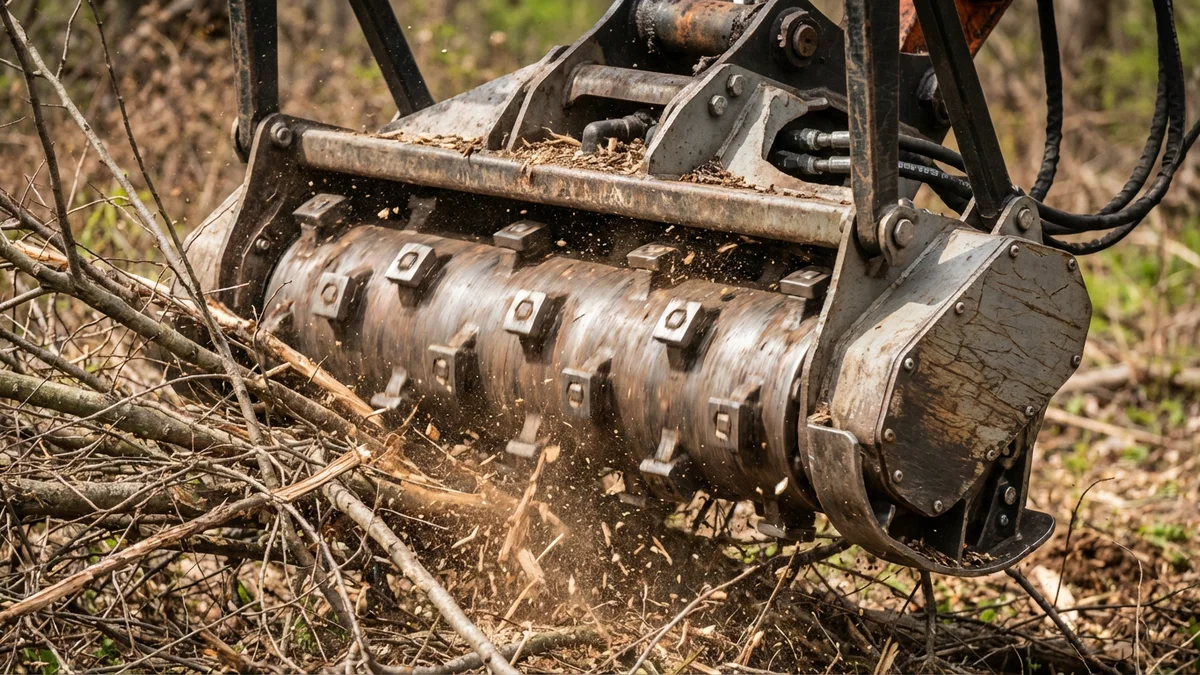
The cutting head. The heart of the machine is a high-speed rotary drum fitted with carbide-tipped teeth. The drum spins at high RPM, and each tooth chips into the vegetation in rapid succession. The teeth process brush, saplings, and small trees up to about eight inches in diameter, converting them into uniform mulch in a single pass. The mulch drops to the ground directly beneath the cutting head.
Cutting head types matter. There are two main tooth designs — fixed teeth and swinging hammers. Fixed teeth (what we run) produce a finer, more uniform mulch and handle woody material more efficiently. Swinging hammers are more forgiving on rocky ground (they deflect rather than chip rock) but produce coarser, less uniform mulch. We chose fixed teeth for mulch quality and went with carbide tips for longevity on NJ’s rocky terrain.
The cab. The operator works inside a fully enclosed, climate-controlled cab with ROPS (rollover protection), FOPS (falling object protection), and polycarbonate windows rated for debris impact. This means the operator is protected from thorns, poison ivy, flying debris, giant hogweed sap, and any other hazard in the vegetation. It’s safer than any other clearing method.
The compact machine
For suburban properties with tight access — side yards, narrow gates, established landscaping to navigate around — we deploy a compact tracked mulcher. This machine fits through openings as narrow as four feet while maintaining the same cutting-head technology as the full-size unit.
The compact machine is slower in open-field production (it has less horsepower and a narrower cutting head) but essential for properties where the full-size machine can’t access the work area. On a suburban backyard in Bridgewater or Hillsborough where the access route runs between the house and the fence, the compact machine is the only equipment that fits.
What this means for your property
Mulch quality. A purpose-built mulcher with fixed carbide teeth produces fine, uniform mulch that decomposes evenly and looks clean. A skid steer with a mulching attachment produces coarser, more uneven material because the cutting head is smaller, slower, and less precisely engineered. If you’re comparing quotes, ask what machine the contractor runs — the equipment directly affects the finished result.
Production speed. A full-size tracked mulcher covers one to three acres per day depending on vegetation density. A skid steer with an attachment covers roughly half to one acre per day on the same vegetation. Faster production means lower per-acre cost and shorter time on your property.
Slope capability. Tracks on a low-center-of-gravity machine handle slopes that no wheeled or tractor-mounted equipment can access. On hillside clearing projects, this is the difference between “we can do it” and “we can’t get there.”
Ground impact. The track footprint distributes weight across a large area. On firm ground, the machine leaves minimal impression. On softer ground, the tracks leave a flat, even compression — not the deep ruts that wheeled equipment creates. On frozen winter ground, the tracks leave no impression at all.
Common Questions
What's the difference between a forestry mulcher and a skid steer with a mulching attachment?
Purpose-built mulchers are more powerful, faster, finer-mulching, and handle steeper terrain. Skid steer attachments are lighter-duty and produce coarser results. Ask any contractor what machine they run.
How big of a tree can the mulcher handle?
Up to ~8 inches. 8–10 inches depends on species. Above 10 → arborist first, then we handle everything else.
Can the machine fit through a gate or side yard?
Compact machine: 4-foot openings. Full-size: 8 feet. We assess access at every estimate and bring the right machine.
Does the machine damage the ground?
Minimal on firm/frozen ground. On soft soil, we assess conditions and schedule accordingly. Ground-protection mats are used on suburban lawn access when needed.
How loud is the machine?
Similar to a wood chipper (~90-100 dB). From 100 feet away, comparable to a lawn mower. We advise neighbors before the work date.
What happens when the machine hits rock?
Carbide teeth deflect off rock — no machine damage. Rocky terrain adds 30–50% time due to slower operation. We factor this into the quote.
Related Services
Forestry Mulching
We grind brush, saplings, and small trees into mulch on the spot – no hauling, no burn piles, no mess.
Hillside Clearing
Steep terrain and rocky slopes cleared safely with tracked, low-ground-pressure equipment.
Want the full New Jersey land clearing playbook?
This article covers one piece of the puzzle. The complete guide ties together methods, costs, permits, terrain, and contractor selection in one place.
The right machine for the job. Every time.
Purpose-built mulchers, not adapted skid steers. Ask us what we run and why.
Or call (908) 774-9235.