

Home / Field Notes — Land Clearing Knowledge Base / Best Time to Clear Land in New Jersey: Seasonal Guide
Best Time to Clear Land in New Jersey: Seasonal Guide
Published March 15, 2026 by Brush Busters • Last reviewed March 15, 2026
People often ask for the best time of year to clear land in New Jersey as if there is one perfect answer that fits every property. There is not. What works best depends on the ground, the vegetation, the access, and what you need the land ready for next. A great clearing window for a wooded hillside is not always the same as the best window for an overgrown backyard or a future building lot.
Still, timing matters. New Jersey’s seasons affect soil moisture, vegetation density, scheduling, and even how clearly you can read the site. If you understand what each season gives you and what it takes away, you can make a much better decision about when to move.
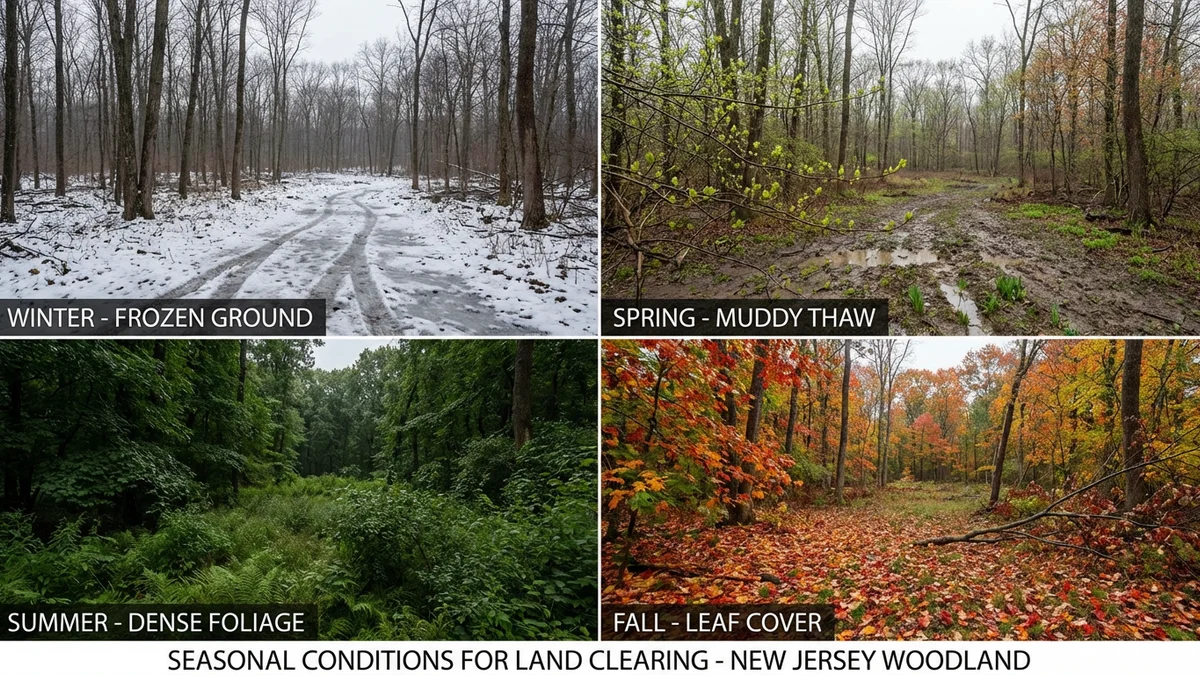
Winter can be one of the best times to clear land
A lot of owners assume winter is a bad time because they picture frozen weather shutting everything down. In reality, winter is often one of the best seasons for clearing in New Jersey. Vegetation is dormant, leaves are down, and many properties are easier to read. You can see through woods better, identify boundaries more easily, and understand the terrain without summer growth hiding everything.
Ground conditions can also work in your favor. On the right site, colder weather and firmer ground reduce disturbance, especially on properties that stay soft or spongy in wet months. That can be a real advantage on rural or semi-rural parcels in Sussex County and Warren County where access roads and slopes are a bigger part of the project.
Winter also tends to open up scheduling. That does not mean every contractor is sitting idle, but it does mean some owners can get work done faster than they could during packed spring demand. If the site is ready and weather cooperates, winter can be a very efficient time to move.
Winter is not perfect for every site
There are still limits. Snow cover can hide fine details. Repeated freeze-thaw cycles can make some ground slick or less predictable. Very wet areas do not magically stop being wet just because the calendar says January. If the access road is steep, icy, or poorly drained, winter can create its own challenges.
The bigger point is that winter should be judged by actual site conditions, not assumptions. On a lot of properties, especially wooded and overgrown ones, it is a strength season for clearing, not a weak one.
Spring is where people need the most caution
Spring feels like the natural time to start outdoor work, and for many owners that is true. But it is also the season that can fool people. New Jersey spring often means saturated ground, soft shoulders, and fast vegetation growth. If you wait until the site is exploding with new green growth, the job may be harder to assess and messier to access than it would have been a few months earlier.
Spring can still be the right time, especially if the property needs to be ready for a summer project or active use. But it is the season where ground conditions need the closest attention. A site that looks dry at the entrance can still be soft farther in. Low areas may stay wet much longer than owners expect. If the property borders wetlands or drainage features, spring can make those realities more obvious.
It is also the season when owners tend to call all at once. Everyone looks outside, sees the overgrowth, and decides it is time. So even when spring works, it is smart to start the conversation earlier rather than waiting until you want the machine on-site next week.
Summer has pros and cons
Summer can be productive, especially if the site has dried out well and access is straightforward. Long daylight hours help. The owner can usually see how the clearing will affect sightlines, usable yard space, and overall appearance. If the goal is to reclaim a section of property during the season you actually use it, summer may feel like the obvious move.
But summer also has tradeoffs. Leaf-on conditions can hide boundaries and terrain. Dense canopy and full brush growth can make it harder to read the site before work starts. Heat can also affect pace and comfort, particularly on exposed or steep ground. Invasive growth is often at full strength, which can be good if the goal is to expose the whole problem, but it also means the site may be at its thickest and most tangled.
Summer is often fine for brush clearing and forestry mulching, especially on smaller residential jobs. It just is not automatically the easiest season simply because it is warm.
Fall is often the sweet spot
If you force most contractors to pick one broad season they like for many clearing jobs, fall usually ends up near the top. The ground often firms back up after the worst of spring softness. Temperatures are easier on people and equipment. Leaf drop begins improving visibility. And owners are often thinking ahead to winter access, next-year projects, or getting the property back under control before another full season of growth arrives.
Fall is especially useful for properties where the owner wants to start next year ahead instead of behind. Clearing in fall means the site heads into winter open and manageable instead of entering another dormant season still buried in brush. On a lot of New Jersey parcels, that makes the next spring much easier.
Fall also works well when the clearing is the first step before a builder, surveyor, or other trade needs access. Opening the site in fall can set up a smoother winter or early spring sequence for the next phase.
Different goals change the best timing
The right season is not just about weather. It is also about purpose. If the main goal is to reclaim a backyard for family use, you may care more about immediate usability than ideal production conditions. If the goal is to prep a lot for a future build, you may care more about sequencing with utilities, staking, and excavation. If the goal is to get hunting access open before the fall season, that changes the schedule too.
This is where land clearing projects differ from simple vegetation resets. If there is a build timeline involved, the best season for clearing may be the one that keeps the entire project moving, not the one that produces the prettiest stand-alone clearing conditions.
Invasive species can change the timing conversation
Some invasive plants respond differently depending on the season and whether the clearing is only mechanical or part of a longer treatment plan. A heavy knotweed or multiflora rose problem may still need follow-up work after the first clearing pass. So the best timing is not always just “when can the machine get there?” It may also be “when does this fit the next control step?”
That is why seasonal advice should stay practical. If you are clearing ordinary overgrowth, the timing decision may be simple. If you are dealing with invasive species, wet edges, or a bigger site-development plan, the sequence matters more.
New Jersey terrain makes timing local
Seasonal advice lands differently in different counties. A sloped property in western Morris County behaves differently than a smaller suburban lot in Essex. Rural parcels in Warren or Sussex often gain more from firm winter ground and leaf-off visibility. Suburban backyards may be flexible, but access and neighborhood constraints still matter.
That is another reason generic internet advice fails. “Best season” depends on local terrain and the condition of the site in front of you. New Jersey has enough variation that the county, slope, and surrounding land cover all matter.
So when should you actually do it?
If the site is dry enough, winter and fall are often the strongest overall seasons for clearing work in New Jersey. Spring can work, but it demands more caution around soft ground. Summer is absolutely viable, but it is not automatically easier just because the weather is warm. The best answer comes from matching the season to the land and the project goal.
If you need a simple rule, use this one: do not wait for the calendar to feel perfect. If the property is getting worse, the best time may be the first good window that matches the site conditions and your goal. Overgrowth rarely gets cheaper or simpler by sitting for another year.
That is especially true when the clearing is a setup step for something else. If the land needs to be usable, buildable, sellable, or maintainable by a certain point, backward planning matters more than seasonal theory.
The bottom line
There is no universal best month to clear land in New Jersey, but there are smart and not-so-smart windows for each property. Winter and fall often offer the cleanest conditions. Spring requires the most caution. Summer works well on the right site but comes with its own tradeoffs.
The important part is matching the season to the ground, not chasing a generic answer. If you are not sure what the right window is for your property, a site walk usually clears that up fast.
Common Questions
What is the best season to clear land in New Jersey?
Fall and winter are often the easiest seasons for many clearing jobs, but the best timing depends on your soil, slope, access, and project goal.
Can land be cleared in winter?
Yes. Winter can be excellent for clearing, especially when vegetation is dormant and the ground is firm enough to support equipment well.
Is spring a bad time to clear land?
Not always, but spring can bring soft ground, fast regrowth, and wetter site conditions that need more caution.
Does summer offer better visibility?
Summer can make access and site review easier in some ways, but thick leaf-on conditions can also hide terrain and obstacles.
Why is fall good for land clearing?
Fall often brings firmer ground, cooler working conditions, and good visibility as leaf cover starts dropping.
Can frozen ground help reduce damage?
Yes. When winter conditions are right, firmer or frozen ground can reduce disturbance on some sites.
Should I wait until brush is fully leafed out?
Not necessarily. Many clearing jobs move well before full leaf-out, and dormant-season work can make some properties easier to manage.
Do invasive species have a best clearing season?
Some invasive control plans benefit from specific follow-up timing, so the best season depends on the species and whether more than one treatment step is needed.
Is there a slow season for land clearing?
Winter can be a strong working season for clearing in New Jersey, not just an off-season, because site conditions often improve for certain types of work.
How far ahead should I schedule land clearing?
It is smart to start the conversation early, especially if you need the property ready for a build, sale, or seasonal use.
Related Services
Forestry Mulching
We grind brush, saplings, and small trees into mulch on the spot – no hauling, no burn piles, no mess.
Brush Clearing
Thick undergrowth, vines, and overgrown fence lines cleared down to clean, walkable ground.
Land Clearing / Lot Prep
Residential and small commercial lots cleared and prepped for building, grading, or landscaping.
Relevant City Pages
These city pages are a good fit if you want to compare the article advice with the kind of properties we see on the ground.
Related Articles
Forestry Mulching vs. Bulldozing: Which Is Right for Your NJ Property?
Forestry mulching vs. bulldozing for NJ properties: compare cost, speed, soil impact, and when each method makes sense.
See Forestry Mulching vs. Bulldozing: Which Is Right for Your NJ Property?
Land Clearing Cost Per Acre in New Jersey: Pricing Guide
New Jersey land clearing cost per acre explained: method, terrain, tree size, access, and how to compare quotes without getting burned.
See Land Clearing Cost Per Acre in New Jersey: Pricing Guide
Japanese Knotweed Removal in New Jersey: How to Actually Kill It
How to remove Japanese knotweed in New Jersey: identification, why it spreads, why cutting fails, and how mulching plus follow-up treatment works.
See Japanese Knotweed Removal in New Jersey: How to Actually Kill It
Want the full New Jersey land clearing playbook?
This article covers one piece of the puzzle. The complete guide ties together methods, costs, permits, terrain, and contractor selection in one place.
Want Help Sorting Out the Next Step?
If the article answered part of the question but you still need a site-specific answer, send us the address and a few photos.
Or call (908) 774-9235.