

Home / Field Notes — Land Clearing Knowledge Base / Mile-a-Minute Vine Removal in New Jersey
Mile-a-Minute Vine Removal in New Jersey
Published April 5, 2026 by Brush Busters • Last reviewed April 5, 2026
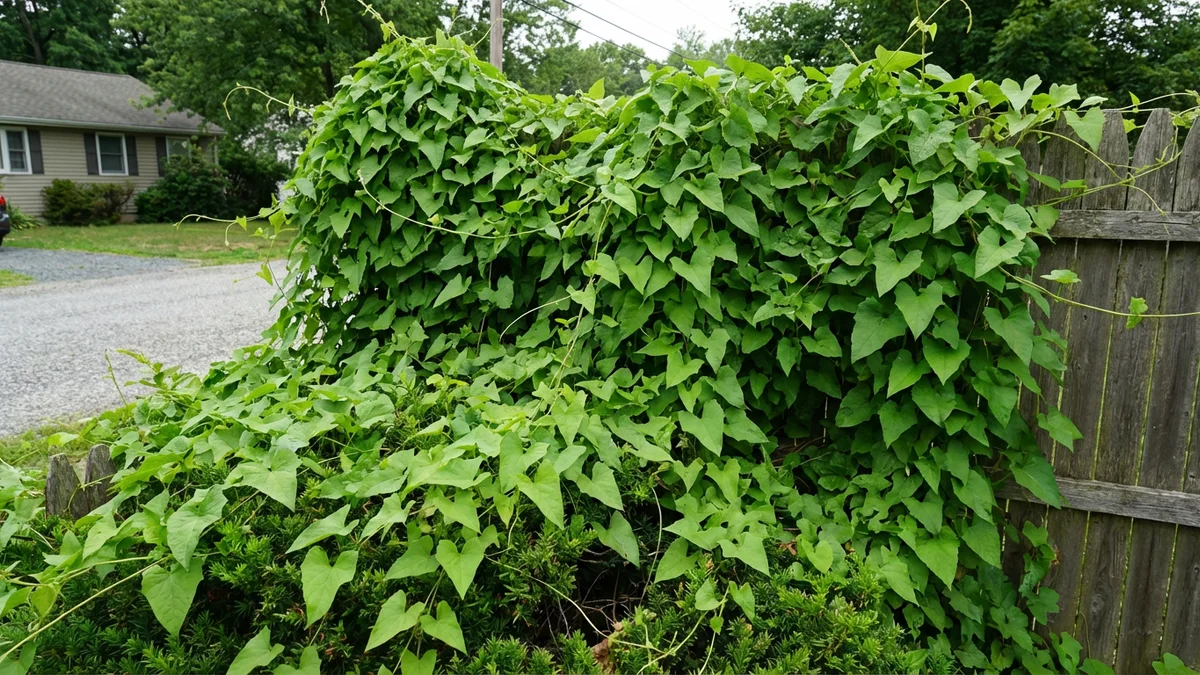
Mile-a-minute vine (Persicaria perfoliata, formerly Polygonum perfoliatum) is the fastest-growing invasive plant in New Jersey. The annual vine emerges from seed in spring, grows up to six inches per day during peak season, and can blanket a fence, a parked car, a shrub bed, or an entire clearing margin in a single growing season. By midsummer, infested areas look like they’ve been draped in a green tarp — the vine covers everything it touches with a mat of triangular leaves and barbed stems.
The good news: it’s an annual. It dies back completely in winter. The bad news: each plant produces hundreds of seeds that germinate the following spring, and the seed bank persists in the soil for five to seven years. Removal isn’t a one-and-done operation — it’s a multi-year commitment to exhausting the seed bank.
Mile-a-minute is most common in the suburban-to-rural transition zones of our service area — Flemington, Hillsborough, Branchburg, and disturbed edges along road corridors and construction sites. Anywhere soil has been recently disturbed provides ideal germination conditions.
Identification
Leaves: Distinctive triangular (equilateral triangle) shape — unlike any other common NJ vine. One to three inches on each side. Light green. This leaf shape is the instant identifier.
Stems: Thin, wiry, covered in recurved barbs (tiny hooks that point backward). The barbs help the vine climb by hooking onto adjacent vegetation and surfaces. The barbs also make hand removal unpleasant — they scratch skin and snag clothing.
Ocreae: Small, round, cup-shaped sheaths at each node that encircle the stem — a distinctive feature of the Persicaria genus. These look like tiny green saucers around the stem.
Fruit: Small, metallic blue berries in clusters. Each berry contains one seed. Birds eat the berries and spread the vine, but most spread is short-range through seed drop near the parent plant.
Growth rate: Up to six inches per day. A single plant can cover 25+ square feet in one growing season. Dense infestations create continuous mats over fences, shrubs, and low vegetation.
Removal approach
Because mile-a-minute is an annual, the removal strategy is fundamentally different from perennial invasives like barberry or bittersweet. You’re not trying to kill a root system — you’re trying to prevent seed production and exhaust the seed bank.
Year 1: Clear and prevent seeding. Forestry mulching removes all existing vegetation — the mile-a-minute along with whatever it’s growing on. Timing matters: clear BEFORE the vine produces mature seeds (before September). If the vine has already seeded, the seeds are now in the soil and you’re committed to a multi-year seed bank drawdown.
Year 2: Mow or mulch regrowth before it seeds. New plants germinate from the seed bank in spring. Mow or clear them before they flower (July-August). Every plant you prevent from seeding reduces next year’s germination.
Year 3 (and possibly year 4): Continue the same cycle. The seed bank diminishes with each year of prevented seeding. Most sites see minimal germination by year three if no plants have been allowed to set seed.
Herbicide option: Pre-emergent herbicides applied in early spring can prevent mile-a-minute seed germination. Post-emergent herbicides (glyphosate, triclopyr) kill established plants. Herbicide is most practical on small, defined infestations. On large clearing projects, the mulcher handles the mechanical removal and you manage regrowth with annual mowing.
Biological control: NJ DEP has released the mile-a-minute weevil (Rhinoncomimus latipes) — a host-specific insect that feeds on mile-a-minute foliage and reduces the vine’s vigor. The weevil is established in parts of NJ but doesn’t eliminate the vine on its own. It’s a supplementary control, not a replacement for mechanical removal.
Costs
Mile-a-minute removal is almost always part of a broader clearing job — the vine is mixed in with the other vegetation on the property. When we clear an overgrown lot or fence line that contains mile-a-minute, it comes off with everything else at the standard clearing price.
The additional cost is in follow-up: you’ll need one to two additional mowing passes per year for two to three years to exhaust the seed bank. If you can mow the cleared area yourself (a standard brush mower handles the annual regrowth), the follow-up cost is zero. If you hire mowing, expect $200–$500 per pass depending on area.
Common Questions
How do I identify mile-a-minute vine?
Triangular leaves on thin, barbed stems growing rapidly over everything it touches. The triangle leaf shape is unique in NJ. Small blue berries in late summer. Dies back in winter.
Will mile-a-minute come back after clearing?
Yes, from the seed bank. Annual mowing before the vine seeds (before September) depletes it over 2–3 years. Consistent management eliminates it.
How fast does mile-a-minute grow?
Up to 6 inches per day. A single plant covers 25+ square feet per season. The fastest-growing invasive in New Jersey.
When should I clear mile-a-minute?
Before September — before seed set. Clearing after seeds drop commits you to multi-year follow-up. The critical timing is preventing seed production each year.
Does the NJ mile-a-minute weevil help?
It reduces vine vigor but doesn’t eliminate it alone. It’s supplementary to mechanical removal, not a replacement. NJ DEP has released it in parts of the state.
Can I pull mile-a-minute by hand?
Small patches — yes, with gloves and long sleeves (the barbs scratch). Pull before September and bag the vines. Anything larger than garden scale needs mechanical clearing.
How much does mile-a-minute removal cost?
Initial clearing is included in the standard job price. Follow-up mowing for 2–3 years costs $200–$500/pass if hired, or free if you mow it yourself.
Where is mile-a-minute worst in NJ?
Suburban-rural transition zones — Flemington, Hillsborough, Branchburg, and disturbed soil along road corridors.
Related Services
Invasive Species Removal
Japanese knotweed, multiflora rose, mile-a-minute vine, and other NJ invasives eliminated at ground level.
Want the full New Jersey land clearing playbook?
This article covers one piece of the puzzle. The complete guide ties together methods, costs, permits, terrain, and contractor selection in one place.
Mile-a-minute is blanketing your property. Let's end it.
We clear the vine. You mow the regrowth. In two seasons, it's gone.
Or call (908) 774-9235.