

Home / Field Notes — Land Clearing Knowledge Base / Bamboo Removal in New Jersey
Bamboo Removal in New Jersey
Published April 2, 2026 by Brush Busters • Last reviewed April 2, 2026
Bamboo is the invasive that someone else planted. Running bamboo — the type that spreads — was installed as a privacy screen on a neighboring property ten or twenty years ago. Nobody told the bamboo to stay on that side of the property line. The rhizome network pushed under the fence, under the driveway, through the garden, and now your yard has a bamboo grove you never asked for and can’t seem to kill.
This scenario plays out on suburban properties throughout Somerset and Morris counties. Running bamboo (primarily Phyllostachys species) is one of the most difficult plants to eliminate once established because the rhizome system is massive, deep, and aggressively spreading.
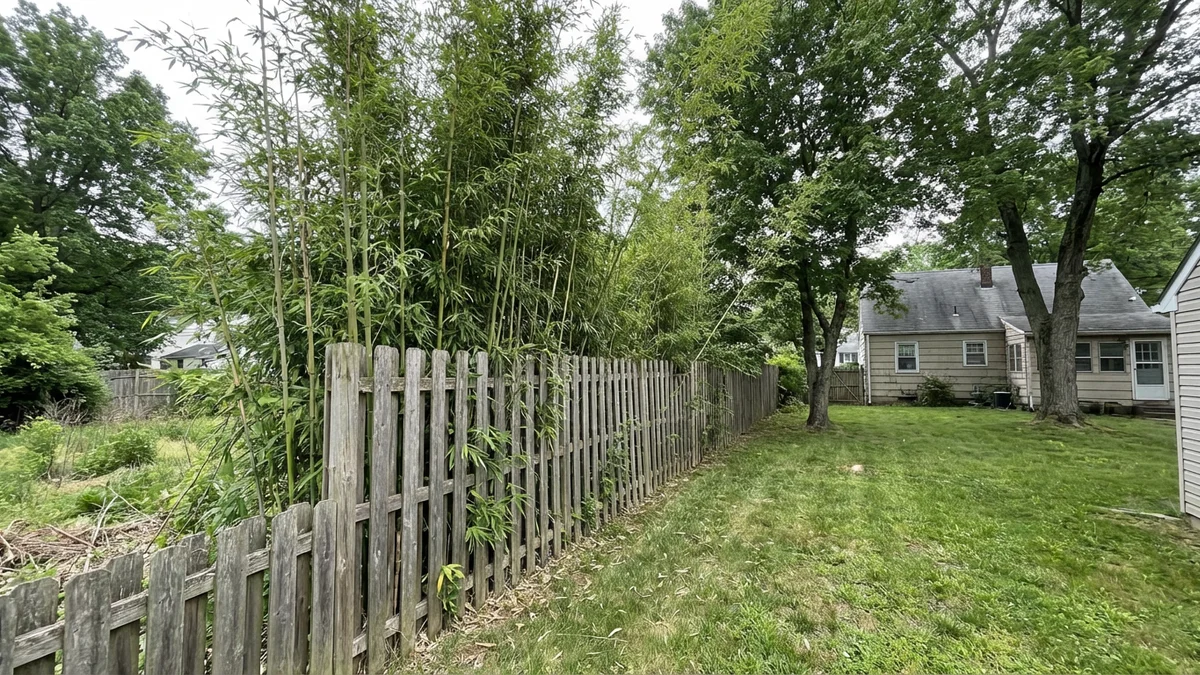
Running vs. clumping
Running bamboo (Phyllostachys, Pseudosasa, and other genera) spreads through underground rhizomes that extend 10–20+ feet per year. The rhizomes are woody, tough, and can push through cracks in asphalt and concrete. This is the type that invades neighboring properties and the type that generates removal calls.
Clumping bamboo (Bambusa, Fargesia) grows in tight clusters and expands only inches per year. It doesn’t invade neighboring properties. Clumping bamboo rarely needs removal — it stays where it’s planted.
If you’re dealing with bamboo invading from a neighbor or spreading across your property, it’s running bamboo.
Why bamboo is so hard to remove
The rhizome network is the entire problem. Running bamboo rhizomes run 6–18 inches deep, branch aggressively, and store massive amounts of energy. Cut the culms (the above-ground stems) and the rhizome network sends up new shoots within weeks — often more shoots than before because the plant redirects all its stored energy into regrowth.
A mature running bamboo grove on a quarter-acre suburban lot can have a rhizome network weighing several tons, extending 20+ feet beyond the visible culm boundary. This means the bamboo you see is not the bamboo you’re fighting — the underground system extends far beyond the visible stand.
Mowing, cutting, and hand-pulling don’t work. Each cut sends a regrowth signal to the rhizome. You can mow bamboo weekly for a season and it will still come back the next year from the untouched rhizome network.
Removal approach
Effective bamboo removal requires exhausting the rhizome’s energy reserves. There are two approaches, and the best programs combine both.
Mechanical removal + repeated cutting. Forestry mulching takes down the standing culms and grinds them to ground level in a single pass. The machine handles bamboo efficiently — the hollow culms shred easily. This initial clearing eliminates the above-ground biomass and opens the site.
Then: mow every regrowth shoot as soon as it appears. Each shoot that emerges and gets cut before it leafs out draws energy from the rhizome without returning any through photosynthesis. Repeated cutting — every two to four weeks during the growing season — starves the rhizome network over one to three growing seasons depending on the grove’s maturity.
Herbicide treatment. Glyphosate applied to cut culm stumps or to newly emerging shoot foliage is the most effective chemical approach. The “cut and treat” method — cut culms and immediately apply concentrated glyphosate into the hollow stem cavity — delivers herbicide directly to the rhizome system through the vascular connection.
Foliar herbicide on regrowth shoots (when leaves are fully expanded) provides a secondary treatment pathway. Multiple applications across one to two growing seasons are typical.
The combination approach (recommended): 1. Forestry mulch the entire stand in late fall/winter 2. Apply glyphosate to every cut culm stump within 30 minutes 3. Mow or treat every regrowth shoot throughout the following growing season (every 2–4 weeks) 4. Repeat Step 3 in year two if regrowth persists 5. By year two or three, the rhizome is exhausted
Rhizome barrier (for neighbor situations). If the bamboo originates on a neighbor’s property and you can’t control the source, install a rhizome barrier along the property line after clearing your side. A continuous barrier of 60-mil HDPE plastic, installed vertically to a depth of 30 inches, blocks rhizome spread. The barrier must be continuous — any gap, seam, or shallow section will be exploited.
NJ neighbor law and bamboo
NJ does not have a specific statewide bamboo ordinance, but general property law principles apply. A property owner is generally not liable for vegetation that naturally spreads to an adjacent property (the “common enemy” doctrine for vegetation). However, some NJ municipalities have enacted local ordinances specifically addressing invasive bamboo. Check your municipal code.
Regardless of legal liability, the practical reality is that bamboo originating from a neighbor’s property affects your property value, usability, and maintenance burden. Many successful resolutions involve a conversation between neighbors about shared management — the source property owner installs a rhizome barrier, and you clear the spread on your side.
Costs
| Component | Cost range |
|---|---|
| Initial forestry mulching of bamboo stand | $2,000–$5,000 (varies by area) |
| Herbicide treatment (licensed applicator) | $500–$1,500 per application |
| Ongoing regrowth management (mowing, 6–10 visits) | $1,000–$2,500/season |
| Rhizome barrier installation (per linear foot) | $15–$30/ft installed |
| Total for complete elimination (no barrier) | $4,000–$10,000 over 2 years |
| Total with rhizome barrier | $6,000–$15,000+ |
Bamboo removal is one of the most expensive invasive species removal projects per square foot because of the multi-year commitment required. The rhizome barrier, if needed, adds significant cost but is the only way to prevent re-invasion from an adjacent property.
Common Questions
Can forestry mulching remove bamboo?
It removes all culms in one pass, but doesn’t kill the rhizome. Follow-up mowing and/or herbicide over 1–2 seasons is essential. Learn about our invasive removal approach.
How long does it take to completely remove bamboo?
One to three years after initial clearing. The clearing takes one day. The follow-up commitment is what eliminates the rhizome.
Will bamboo come back after removal?
Without follow-up, yes. With repeated cutting and herbicide over 1–3 years, the rhizome exhausts and bamboo doesn’t return. A barrier prevents re-invasion from neighbors.
How much does bamboo removal cost?
$4,000–$10,000 over two years for complete elimination. Add $15–$30/ft for a rhizome barrier. Get a free assessment.
Is my neighbor responsible for bamboo spreading onto my property?
NJ has no statewide bamboo law, but some municipalities have local ordinances. The practical solution is shared management with the neighbor and a rhizome barrier. Check your municipal code.
Can I just mow bamboo to get rid of it?
It works IF you mow every shoot every 2–4 weeks for 1–3 seasons. Miss a few weeks and it recovers. Herbicide accelerates the process. One-time mowing guarantees worse regrowth.
Related Services
Invasive Species Removal
Japanese knotweed, multiflora rose, mile-a-minute vine, and other NJ invasives eliminated at ground level.
Helpful Resources
Homeowners
Want the full New Jersey land clearing playbook?
This article covers one piece of the puzzle. The complete guide ties together methods, costs, permits, terrain, and contractor selection in one place.
Bamboo doesn't respect property lines. We don't either.
We take down the stand. You manage the regrowth. In two seasons, it's history.
Or call (908) 774-9235.