

Home / Field Notes — Land Clearing Knowledge Base / Winter Land Clearing in New Jersey: The Frozen Ground Advantage
Winter Land Clearing in New Jersey: The Frozen Ground Advantage
Published April 8, 2026 by Brush Busters • Last reviewed April 8, 2026
Most property owners assume land clearing is a warm-weather activity. It’s not. Winter is arguably the best season for clearing land in New Jersey — and the contractors who know this stay busy from December through March while others sit idle.
The advantages are real and they stack: frozen ground supports heavy equipment without rutting, bare deciduous trees give the operator maximum visibility, dormant vegetation processes faster through the mulcher, invasive species aren’t actively growing or seeding, wildlife nesting restrictions don’t apply, and scheduling is easier because demand is lower. The only limitation is weather — snow and ice can delay work for a day or two, but they don’t cancel the season.
If you’re planning a spring construction project, a summer pool installation, or a fall property listing, winter is when the clearing should happen. Here’s why each advantage matters and how to plan for it.
Why frozen ground changes everything
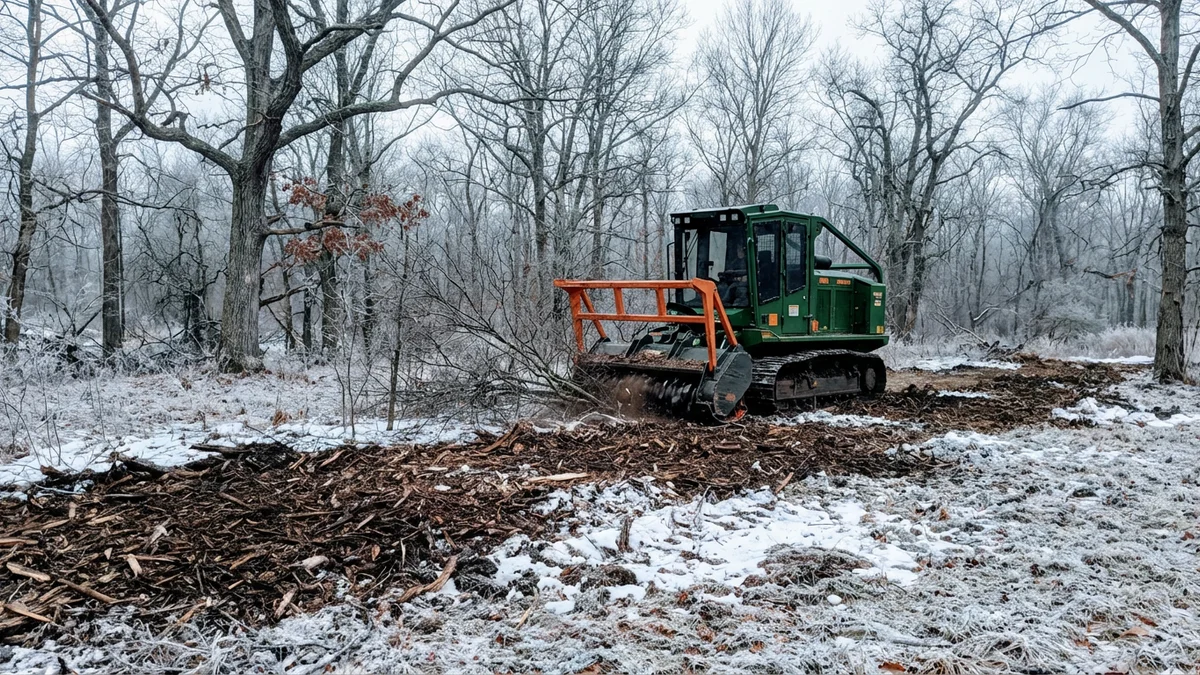
New Jersey’s soils are predominantly clay-based in the valley floors and thin over rock on the ridges. In warm, wet conditions — particularly spring — clay soils saturate and deform under heavy equipment. A 15,000-pound tracked mulcher on saturated clay creates ruts six to twelve inches deep that take months to recover. On residential properties, those ruts destroy lawn edges. On agricultural land, they compact the soil and reduce drainage capacity.
Frozen ground eliminates this problem entirely. When the top eight to twelve inches of soil are frozen, the surface is as firm as concrete. The machine’s tracks leave no impression. The mulch falls onto a hard surface that won’t be displaced by equipment weight. Properties that would be borderline inaccessible in April are ideal in January.
This matters most on the wet, clay-heavy soils found in the valley floors of Pohatcong, Mansfield, Readington, and the low-lying areas of Hillsborough and Branchburg. These are properties where we actively recommend winter clearing over any other season.
Visibility: the leaf-off advantage
When the leaves drop in November, the forest opens up. The operator can see the terrain — slopes, rock outcrops, old fences, property pins, wet areas — that are invisible under summer canopy. On a wooded lot in Bernardsville or Roxbury, the difference between summer and winter visibility is dramatic. In summer, the understory is a green wall. In winter, you can see 200 feet through the woods.
This visibility translates directly into better clearing results. The operator identifies obstacles, hazards, and trees to preserve from a greater distance. Equipment routing is more efficient because the terrain is visible rather than hidden. Cleanup is cleaner because you can see everything that’s been cleared and everything that remains.
For property owners, winter is also the best time to walk the property with the clearing crew. You can see the full scope of what needs to be cleared — and what you want to keep — without fighting through foliage. The estimate is more accurate because the crew can assess the vegetation density, stem size, and terrain conditions that are hidden under summer growth.
Dormant vegetation: faster and cleaner
Deciduous brush and invasive species in their dormant state process through the mulcher more efficiently than during the growing season. The stems are drier, the sap isn’t flowing, and there’s no heavy leaf mass adding volume and weight. The cutting head spins through dormant multiflora rose, barberry, and autumn olive stems with less resistance.
Dormant clearing also means the mulch is drier and lighter. It compacts more uniformly on the ground and decomposes at the expected rate when spring warmth arrives. Summer mulch — heavy with sap and green material — can mat and become anaerobic in thick layers.
For invasive species management, winter clearing has an additional benefit: you’re removing the plant at its lowest energy state. The root system has fewer stored reserves than in late summer or fall (when the plant is translocating energy downward for winter storage). This means root resprout vigor in spring is somewhat lower after winter clearing compared to clearing during the active growing season.
What winter clearing doesn't do well
Snow days. Significant snow cover (more than four to six inches) prevents clearing because the operator can’t see the ground surface, obstacles, or property markers. Light snow — a dusting to a few inches — doesn’t stop work; the machine clears through it. After a major snowfall, work resumes within a day or two of thaw.
Extreme cold. Below about 10°F, hydraulic fluid thickens and equipment needs longer warm-up time. Most clearing work proceeds normally down to the low 20s. Below that, some operations slow.
Identification challenges. Without leaves, some invasive species are harder to identify. Poison ivy climbing vines, porcelainberry, and mile-a-minute vine are all easier to spot in summer when foliage is present. Experienced operators identify dormant invasives by bark, growth form, and berry remnants — but flagging during a growing-season walk-through before winter clearing is helpful.
Septic and construction timing. If the cleared site is for a septic system, the perc test needs to happen when the ground is unfrozen (the soil evaluator digs test pits). Clearing in winter is fine, but the perc test waits until spring thaw. Similarly, construction on the cleared site can’t begin until the ground is workable.
None of these are dealbreakers. They’re scheduling considerations that are easy to plan around when you know they’re coming.
Winter clearing for spring projects
The most common reason to clear in winter is to have the site ready for a spring project. Here’s the timing for common project types:
Home building: Clear in December-February. The builder assesses the cleared site in March. Foundation work begins when the frost is out of the ground (typically April in central NJ). You’ve saved two to three months versus clearing in spring and waiting to start.
Pool installation: Clear in January-February. Pool contractor site visit in March. Excavation begins in April. Pool is in the ground by June-July instead of August-September.
Septic system: Clear in winter. Perc test as soon as the ground thaws (March-April). System design and permit through spring. Installation in late spring or summer.
Pasture reclamation: Clear in December-February. The mulch settles through winter. Seed or disc in April-May. First hay cut or grazing in late summer.
Property listing: Clear in January-February. The mulch weathers through winter into a natural-looking surface. Listing photos in April-May when the surrounding landscape greens up and the cleared areas contrast beautifully with the mulch.
Costs: winter vs. other seasons
Winter clearing costs are the same per-acre as any other season — the work is the same and the equipment is the same. The cost advantage is indirect:
Scheduling availability. Winter is the off-peak season for clearing. Lead times are shorter (one to two weeks versus three to four weeks in spring/fall). For time-sensitive projects, this flexibility has real value.
No re-clearing. A site cleared in October and left through winter needs no re-clearing in spring — the dormant season means no regrowth between clearing and use. A site cleared in June may need a touch-up mow in September if fast-growing annuals established during the summer.
Reduced site damage. Frozen ground means no lawn ruts, no compacted garden soil, no driveway damage from equipment tracking across soft ground. On suburban properties where the access route crosses lawn, this alone justifies winter timing.
Common Questions
Can you clear land in winter in New Jersey?
Yes — winter is one of the best seasons. Frozen ground, bare trees, dormant vegetation, and easier scheduling. Only deep snow or extreme cold cause delays. Schedule a winter clearing project.
Does frozen ground affect the clearing quality?
It improves quality — firm surface means no rutting, precise operation, and clean mulch placement. The mulch settles naturally when the ground thaws.
How cold is too cold for land clearing?
Down to the low 20s°F is normal. Below 10°F needs extended warm-up. Light snow is fine. Deep snow pauses work briefly. Most NJ winter days are workable.
Will snow damage the mulch left on the ground?
No — snow has no negative effect on mulch. Meltwater percolates through it like rainfall. The mulch performs its erosion and regrowth functions year-round.
Is winter clearing cheaper than summer?
Same per-acre price. The advantages are scheduling (shorter lead times), no ground damage from frozen access, and no regrowth between clearing and spring use.
When should I schedule winter clearing?
Reach out in October-November for December-February work. For spring construction deadlines, clear 8–10 weeks before the builder needs the site. Schedule now.
Can you identify invasive species in winter without leaves?
Yes — bark, growth form, and berries identify most species in winter. For harder-to-spot species, a fall walk-through before winter clearing helps.
What happens to the mulch over winter?
Mulch sits stable through winter, then begins decomposing in spring — perfect timing for spring seeding. It provides moisture retention and regrowth suppression for the new growth.
What is the cheapest time of year for tree removal?
Winter (December-February) is cheapest. Demand is lowest, contractors have more availability, and frozen ground means no lawn damage. Trees are dormant with less material to process. Read our full guide to winter clearing advantages.
Related Services
Forestry Mulching
We grind brush, saplings, and small trees into mulch on the spot – no hauling, no burn piles, no mess.
Relevant City Pages
These city pages are a good fit if you want to compare the article advice with the kind of properties we see on the ground.
Want the full New Jersey land clearing playbook?
This article covers one piece of the puzzle. The complete guide ties together methods, costs, permits, terrain, and contractor selection in one place.
Winter is the clearing season most people miss.
Frozen ground. No ruts. No regrowth. No waiting. Schedule your winter project now.
Or call (908) 774-9235.