
Home / Field Notes — Land Clearing Knowledge Base / Commercial Land Clearing in New Jersey: A Guide for Developers and Property Managers
Commercial Land Clearing in New Jersey: A Guide for Developers and Property Managers
Published April 8, 2026 by Brush Busters • Last reviewed April 8, 2026
Commercial land clearing is a different operation than residential backyard work. The acreage is larger, the timelines are tighter, the regulatory requirements are more complex, and the coordination involves multiple parties — developers, engineers, municipal planners, utility companies, and construction crews. A delay in clearing delays everything downstream: grading, foundations, utilities, and ultimately the certificate of occupancy or the lease date.
This guide is for the people managing commercial projects in central-western New Jersey — developers building subdivisions and commercial pads along the I-80 corridor in Mount Olive, property managers clearing overgrown commercial parcels along Route 22 in Bridgewater, and builders coordinating multi-lot clearings in Flemington and the growing towns around them.
What makes commercial clearing different
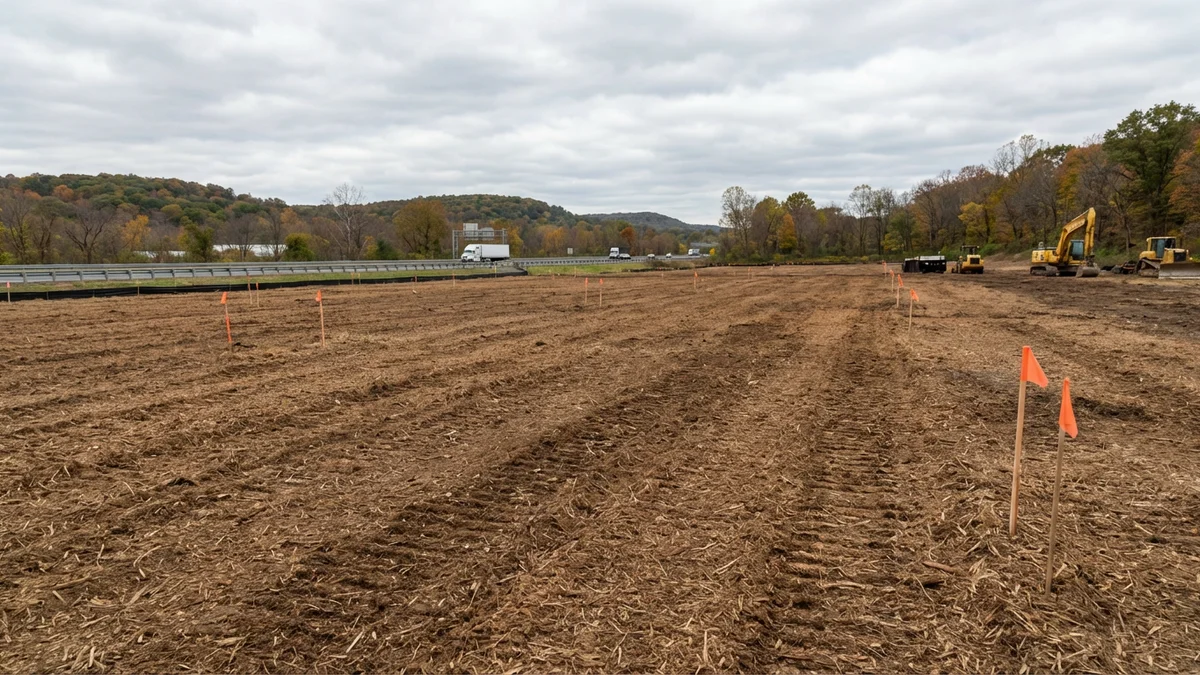
Scale and speed. Commercial projects measure clearing in acres, not square feet. A five-acre commercial pad, a twenty-lot subdivision, a half-mile utility corridor — these are multi-day production jobs where the mulcher runs from sunrise to dusk. Production speed on flat commercial ground is the fastest in our operation: two to three acres per day on moderate vegetation.
Regulatory layers. Commercial clearing in NJ triggers the Soil Erosion and Sediment Control (SESC) Act requirements on virtually every project (the 5,000 square foot disturbance threshold is met almost immediately). The project engineer files the SESC plan with the local Soil Conservation District. Forestry mulching simplifies SESC compliance because the mulch layer itself serves as an erosion control measure — reducing or eliminating the need for additional silt fence, erosion blankets, or temporary seeding on the cleared portions.
On Highlands parcels, commercial development triggers the most rigorous review tier. On wetland-adjacent sites, NJ DEP freshwater wetlands permits may be required. Municipal site plan approval adds another layer. The clearing is typically one component of a broader development application.
Multi-party coordination. The clearing crew needs to work within the boundaries set by the surveyor, avoid the areas flagged by the environmental consultant, clear access for the utility crews that follow, and stay off portions of the site reserved for later construction phases. A pre-clearing coordination meeting with the developer, engineer, and clearing crew prevents conflicts during execution.
Documentation. Commercial clearing generates documentation that residential work doesn’t: as-cleared site photos for the engineer, GPS-stamped boundary verification, erosion control installation photos for SESC compliance, and waste-handling records if any debris is hauled off-site (rare with forestry mulching, since nothing leaves the site).
The commercial clearing process
Phase 1: Pre-clearing. Survey and staking complete. SESC plan filed and approved. 811 utility markout completed. Environmental constraints mapped (wetland boundaries, buffer zones, protected areas). Pre-clearing site photos for compliance documentation.
Phase 2: Clearing. The mulcher clears the designated zones in a systematic production pattern. On multi-lot subdivisions, we clear lot by lot in the sequence the builder needs — first phase lots first, later phases left for subsequent clearing. Road corridors and utility easements are cleared at the width specified by the engineer. Erosion control measures (silt fence along downhill perimeters, mulch berms on slopes) are installed during or immediately after clearing.
Phase 3: Turnover. The cleared site is turned over to the grading contractor. Documentation package delivered: as-cleared photos, erosion control installation photos, area calculations, and any field notes on conditions encountered during clearing (rock, wet areas, existing utilities, abandoned structures).
Commercial clearing costs in NJ
Commercial production clearing on flat to moderate terrain costs $1,200 to $3,000 per acre with forestry mulching. The per-acre rate decreases on larger projects because mobilization and setup costs are spread over more acreage.
| Project type | Typical acreage | Cost range |
|---|---|---|
| Commercial pad (retail, warehouse, office) | 2–10 acres | $3,000–$25,000 |
| Subdivision (multi-lot) | 5–50 acres | $8,000–$100,000+ |
| Utility corridor (per mile) | varies | $15,000–$40,000/mile |
| Vacant lot clearing (code compliance) | 0.5–2 acres | $1,500–$5,000 |
These are clearing-only costs. They don’t include grading, stormwater infrastructure, or other site development work that follows clearing.
For multi-phase projects, we provide phase-level pricing so the developer can budget clearing costs against the construction timeline for each phase.
Why forestry mulching for commercial sites
SESC compliance advantage. The mulch layer satisfies erosion control requirements from the moment the machine passes. On a bulldozed site, you need to install temporary erosion controls immediately — silt fence, inlet protection, temporary seeding, and potentially erosion blankets. On a mulched site, the mulch IS the temporary erosion control. This reduces the SESC compliance burden and associated costs.
No debris hauling. Bulldozing and conventional clearing generate brush piles, stump piles, and soil windrows that need to be hauled off-site, burned (with permits), or buried. Each option adds cost and time. Forestry mulching processes everything in place — no debris trucks, no disposal fees, no burn permits.
Speed. A full-size production mulcher covers more ground per day than a dozer-and-chipper crew. On a five-acre commercial pad with moderate vegetation, the mulcher clears the entire site in two to three days. The dozer approach takes three to five days plus additional time for debris handling.
Topsoil preservation. On sites where topsoil will be stripped and stockpiled for later landscaping, the mulch layer holds the topsoil in place during the gap between clearing and grading. On sites where topsoil will remain in place (parking lot islands, landscape strips, buffer zones), the mulch protects it.
Code compliance clearing
A specific commercial clearing need in NJ: overgrown vacant commercial parcels that have received municipal code violation notices. Towns issue violations for overgrown vegetation on commercial properties — typically when the growth exceeds a height threshold or when the parcel becomes a dumping ground or safety hazard.
Code compliance clearing is usually straightforward: clear the entire parcel to ground level, demonstrate compliance to the municipal code enforcement officer, and maintain annually to prevent re-violation. The clearing cost ($1,500–$5,000 for a typical commercial lot) is far less than the accumulated fines for non-compliance.
On parcels along the Route 22 corridor in Bridgewater and the I-80 corridor in Mount Olive, tree of heaven is the dominant invasive on neglected commercial ground. Removing it addresses both the code violation and the spotted lanternfly management program.
Common Questions
How much does commercial land clearing cost in NJ?
$1,200–$3,000/acre on flat terrain. Rates decrease on larger projects. Request a commercial clearing quote.
Does forestry mulching satisfy SESC requirements?
The mulch layer serves as erosion control that satisfies many SESC requirements. Your engineer should verify with the local Soil Conservation District for your specific plan.
Can you coordinate clearing with our construction schedule?
Yes — we coordinate with surveyors, builders, and engineers. Pre-clearing meetings ensure alignment. Learn about our commercial services.
Do you provide documentation for compliance?
Yes — as-cleared photos, erosion control documentation, GPS boundary confirmation, and field condition notes. Standard on every commercial project.
How fast can you clear a commercial site?
2–3 acres/day on flat terrain. A 5-acre pad: 2–3 days. A 20-acre subdivision phase: 7–10 days. We provide specific schedules with every quote.
Can you handle multi-phase subdivision clearing?
Yes — we clear by phase in the developer’s construction sequence. No clearing acreage that sits idle. Learn about our builder services.
What about Highlands compliance on commercial sites?
Preservation Area triggers HPAA. Planning Area requires municipal conformance. Your engineer handles compliance; we clear within the approved scope. Read our Highlands guide.
Do you clear for code compliance violations?
Yes — site visit within a week, clearing within 2–3 weeks, compliance demonstrated. The cost is less than accumulated fines. Get a code compliance clearing quote.
Related Services
Commercial Land Clearing
Forestry mulching and site clearing for builders, developers, municipalities, and HOA common areas across North New Jersey.
Relevant City Pages
These city pages are a good fit if you want to compare the article advice with the kind of properties we see on the ground.
Helpful Resources
Builders & Developers
Want the full New Jersey land clearing playbook?
This article covers one piece of the puzzle. The complete guide ties together methods, costs, permits, terrain, and contractor selection in one place.
Commercial clearing on a construction timeline? We hit deadlines.
Production mulching, SESC-ready, multi-phase capable. Request a commercial quote.
Or call (908) 774-9235.