

Home / Field Notes — Land Clearing Knowledge Base / Property Line Clearing and Boundary Maintenance in New Jersey
Property Line Clearing and Boundary Maintenance in New Jersey
Published April 4, 2026 by Brush Busters • Last reviewed April 4, 2026
You know your property extends to the back of the lot, but you haven’t been able to see the boundary in years. The survey pins from when the lot was subdivided are buried under two decades of multiflora rose and barberry. The old wire fence that marked the line is somewhere under a wall of brush. And your neighbor may or may not be storing equipment on what you think is your side.
Property line clearing is one of the most practical clearing projects we do. It’s not glamorous — it’s not a pool or a barn pad. But knowing where your property ends, being able to see it, and keeping it visible solves problems before they become disputes.
Why property lines get lost
NJ’s aggressive vegetation swallows boundary markers within a few years of neglect. Survey pins — iron rods or pipes driven into the ground during the original survey — sit at ground level or just below. Once leaf litter, brush, and soil accumulate over them, they’re invisible without a metal detector. Old fence lines that once marked boundaries get buried under multiflora rose and wild grape until the fence is completely hidden. Blazed trees (trees marked with paint or ax cuts to indicate a boundary) have their marks obscured by bark growth.
On rural properties in Lebanon Township, Alexandria, and Delaware Township where lots are five to twenty acres and the boundaries run through woods, property lines can be invisible for hundreds of feet. On suburban properties where rear lot lines border other backyards or common areas, even a ten-year-old boundary can be completely obscured.
What property line clearing involves
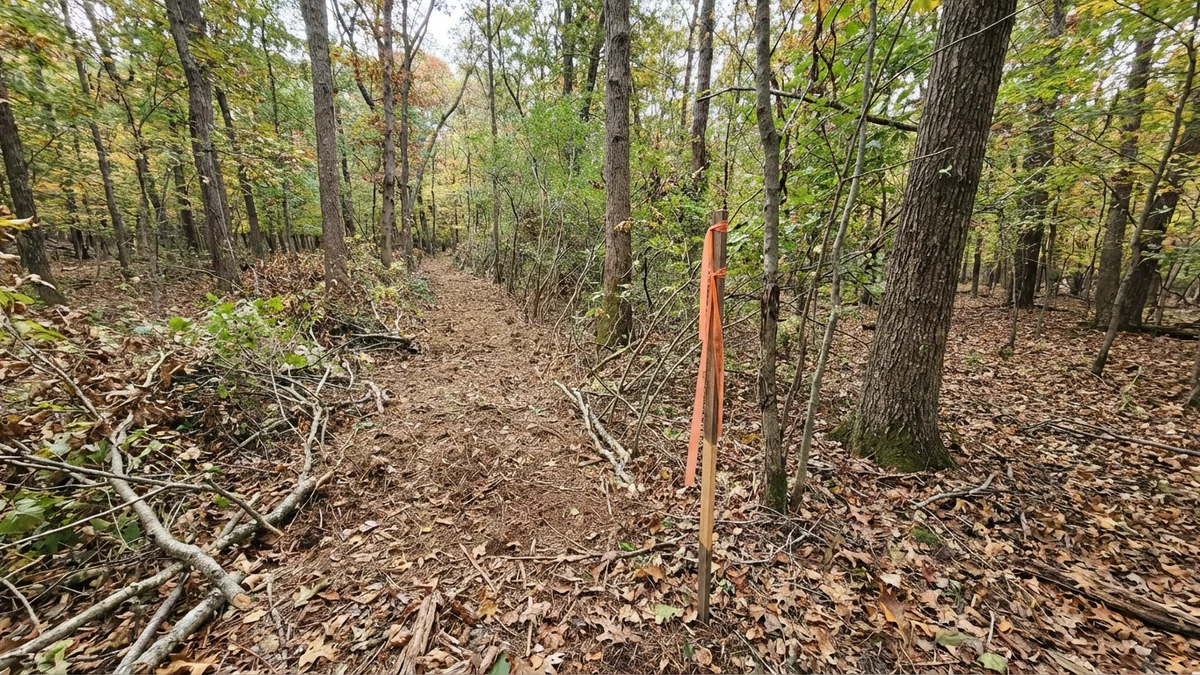
Clearing a corridor along the boundary. A cleared strip — typically six to ten feet wide, centered on the property line — makes the boundary visible and accessible. On wooded properties, this creates a maintained line through the forest that’s clearly different from the uncleared areas on either side. The corridor also provides access for surveyors, fence installers, and maintenance.
Exposing survey markers. Once the brush is cleared, survey pins, iron pipes, concrete monuments, and other markers become findable — either visually or with a metal detector. On properties where the boundary hasn’t been maintained in decades, finding the existing markers after clearing may eliminate the need for a full re-survey.
Restoring old fence lines. If a fence once marked the boundary, clearing reveals what’s still standing. Wire fencing buried under brush may still be intact — the fence posts may be rotted but the wire is often still in place. The clearing shows what can be repaired versus what needs full replacement.
Establishing visible boundaries on unfenced properties. The cleared and mulched corridor itself serves as a visual boundary marker. Maintained annually with a single mowing pass, it stays visible indefinitely.
When property line clearing matters
Before selling or subdividing. Clear, visible, and documented property boundaries are essential for any real estate transaction. Buyers, appraisers, and title companies all need to know where the property ends. Clearing the boundary before listing makes the property’s extent visible in listing photos and during showings.
Before building. Any structure near a property line — a pole barn, fence, driveway, addition — needs to comply with zoning setback requirements. If you can’t see the property line, you can’t measure the setback. Clear the boundary, find the pins, and measure accurately before building.
To resolve encroachment. If you suspect a neighbor is encroaching — mowing, storing equipment, or building on your land — the first step is establishing where the line actually is. A cleared boundary with visible survey markers creates a documented, defensible record. Most encroachment situations resolve through conversation once both parties can see the line.
For fence installation. A new fence should be on or inside your property line — not on the neighbor’s side. Clear the boundary, confirm the line with a surveyor, and the fence installer has a clean, verified path to work along.
Costs
Property line clearing is priced by linear footage.
| Condition | Cost per 100 linear ft |
|---|---|
| Light brush, walkable | $150–$300 |
| Moderate brush/saplings | $300–$500 |
| Dense brush, old fence buried | $500–$800 |
A typical residential property boundary — 200 to 500 feet of rear lot line — costs $600 to $2,500. A full perimeter clearing on a five-acre rural property (1,500+ linear feet) costs $3,000 to $8,000.
Common Questions
How much does property line clearing cost?
$150–$800 per 100 linear feet. Suburban rear line: $600–$2,500. Rural full perimeter: $3,000–$8,000. Get a free estimate.
Can you find my survey pins during clearing?
Clearing makes pins findable. We look for markers but aren’t surveyors. If pins aren’t found, a surveyor can locate them much faster on cleared ground.
How wide should the cleared boundary be?
6–10 feet wide, centered on the line. For fence installation, 12–16 feet gives installer room. Maintained with annual mowing.
Do I need my neighbor's permission to clear my property line?
You can clear your side without permission. We stay strictly on your side. Let the neighbor know beforehand as a courtesy. If the line is uncertain, get a surveyor first.
Can you clear around an existing fence?
Yes — we clear right up to posts and rails without contact. Learn about our fence line clearing service.
Should I clear the boundary before or after a survey?
Clear first. Surveyors work much faster on cleared ground — lower survey cost and faster completion. The clearing cost is the same either way.
Can I cut my neighbour's tree if it's on my side?
In NJ, you can trim branches and roots that cross onto your property – up to the property line. You cannot cross the line or damage the tree. If the trunk is on the property line, both owners share rights and neither can remove it alone. For property line clearing, notify your neighbor first.
Related Services
Fence Line Clearing
Buried fence rows and overgrown property borders opened up and made visible again.
Want the full New Jersey land clearing playbook?
This article covers one piece of the puzzle. The complete guide ties together methods, costs, permits, terrain, and contractor selection in one place.
Can't see where your property ends? Let's fix that.
We clear boundary lines so you can find your pins, install a fence, or settle a dispute. Free estimates.
Or call (908) 774-9235.