

Home / Field Notes — Land Clearing Knowledge Base / ATV and UTV Trail Building in New Jersey
ATV and UTV Trail Building in New Jersey
Published April 4, 2026 by Brush Busters • Last reviewed April 4, 2026
If you own wooded acreage in Hunterdon, Warren, or Morris county and you want to ride it, you need trails. And building trails through NJ’s dense, vine-choked, invasive-filled woods by hand is a project most people start enthusiastically and abandon by the second weekend.
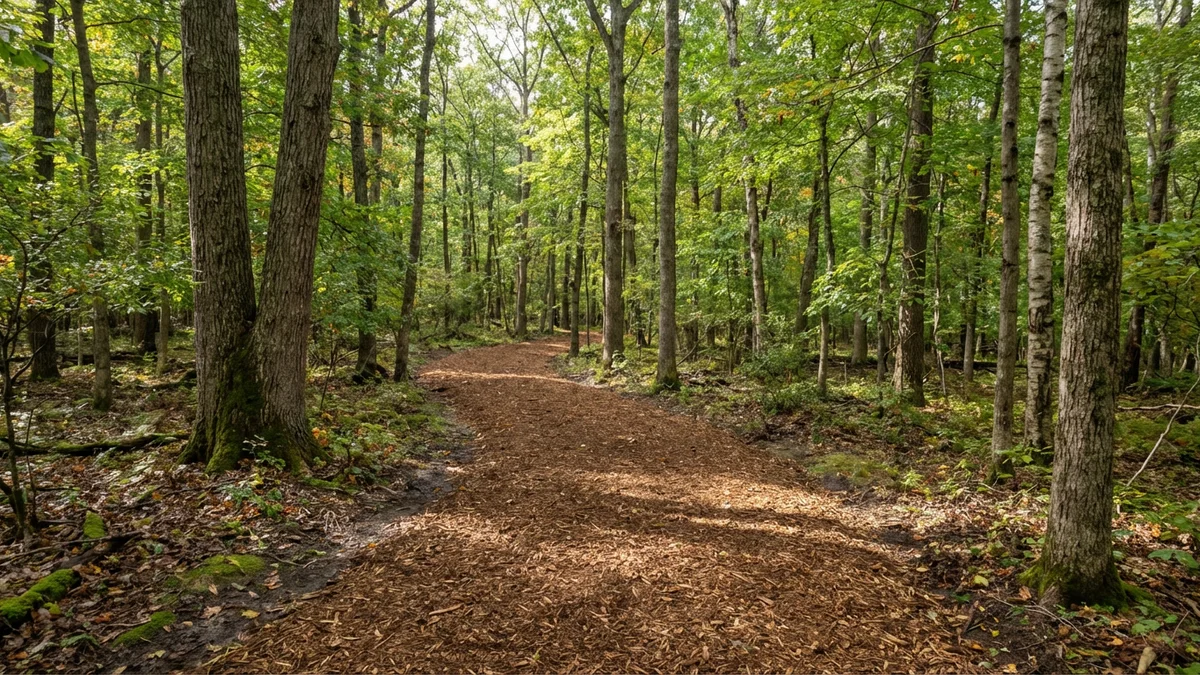
Forestry mulching builds ATV and UTV trails in hours, not weekends. The machine cuts a corridor through the woods — eight to twelve feet wide for single-track, twelve to sixteen feet for two-abreast — and leaves a mulched surface that’s immediately rideable. The mulch compacts under tire traffic into a firm, well-drained trail surface that outperforms bare dirt in every condition except standing water.
Trail design considerations
Width. Standard ATV width is four to five feet. Standard UTV width is five to six feet. A trail should be at least two feet wider than the widest vehicle on each side for clearance — eight to ten feet minimum for ATVs, ten to twelve feet for UTVs. Add width on curves (outside of the turn) for swing clearance.
Grade. Keep trail grades below 15% for comfortable, sustainable riding. On steeper terrain, switchback the trail to reduce the grade rather than going straight up. The mulcher can cut switchbacks efficiently because it turns in its own footprint. Steep straight climbs erode quickly and are hard on equipment.
Drainage. Trails concentrate water. Build in drainage features: outsloped trail surface (trail tilts slightly to one side so water runs off rather than down the trail), water bars on grades (diagonal berms that divert water off the trail at intervals), and culvert crossings at stream or drainage intersections. The mulcher operator can build water bars by leaving windrows of extra mulch diagonally across the trail during clearing.
Route selection. Route trails to showcase the best features of your property — ridgetop views, creek crossings, rock outcrops, specimen trees. Avoid routing through the lowest, wettest areas unless you’re prepared to install drainage improvements. Loop trails (returning to the start without retracing) are more enjoyable than out-and-back designs.
Connection points. Plan where trails connect to the parking/staging area, to the road, and to each other. These intersection and access points should be wider (16+ feet) for turning and passing.
Why mulched trails are better
Immediate use. A mulched trail is rideable the day it’s cut. No waiting for gravel, no seeding, no settling period. You ride the same day the machine leaves.
Self-draining surface. The coarse mulch structure allows water to percolate through rather than pooling on the surface. A mulched trail after rain is damp but firm. A bare dirt trail after rain is mud. A gravel trail after rain is fine but costs five to ten times more to build.
Compaction over time. ATV and UTV traffic compacts the mulch into a progressively firmer surface. After one season of use, a well-trafficked trail has a surface comparable to a packed dirt road — firm, smooth, and well-drained. The compacted mulch also resists erosion better than loose soil.
Low maintenance. Annual touch-up — mowing any brush that encroaches from the edges, clearing fallen branches — keeps a mulched trail in riding condition indefinitely. No gravel replenishment, no grading, no re-surfacing.
Cost. Trail cutting costs $200 to $500 per 100 linear feet with forestry mulching. A half-mile trail (2,640 feet) costs $5,000 to $13,000. A gravel trail of the same length would cost $25,000 to $50,000+.
Costs for ATV/UTV trail building
| Trail type | Width | Cost per 100 ft |
|---|---|---|
| ATV single-track through light brush | 8–10 ft | $200–$350 |
| UTV trail through moderate brush | 10–14 ft | $350–$600 |
| Wide connector/access trail | 14–16 ft | $500–$800 |
A typical one-mile trail system (5,280 linear feet) with a mix of widths and terrain costs $12,000 to $30,000 depending on vegetation density and slope. This includes the main loop and connecting spurs.
Common Questions
How much does it cost to build ATV trails with forestry mulching?
$200–$600 per 100 linear feet. Half-mile: $5,000–$13,000. One-mile system: $12,000–$30,000. Get a trail building estimate.
How wide should an ATV trail be?
8–10 feet for ATVs. 10–14 feet for UTVs. 14–16 feet for access routes. Widen on curves.
Can I ride on the mulch immediately?
Yes — same day. The mulch compacts under use and becomes progressively firmer. After one season, it’s comparable to a packed dirt road.
How long do mulched trails last?
The mulch surface: 1–2 seasons. The trail itself: indefinitely with annual mowing. The compacted surface and defined corridor persist.
Do I need permits for ATV trails on my property?
Private trails on your property generally don’t need permits. Stream/wetland crossings may need review. Check municipal zoning for ATV-specific rules.
Can you build trails on steep terrain?
Yes — up to 45% equipment capability. We keep trail grades below 15% for rideable surfaces using switchbacks. Learn about hillside capabilities.
Related Services
Trail Cutting
Private hiking trails, ATV paths, hunting lanes, and walking routes cut clean with a durable mulched surface.
Helpful Resources
Hunters & Recreational Land
Want the full New Jersey land clearing playbook?
This article covers one piece of the puzzle. The complete guide ties together methods, costs, permits, terrain, and contractor selection in one place.
Build your trail system this season.
Rideable the same day. Half-mile to five miles. We design the route and cut the trail.
Or call (908) 774-9235.