

Home / Field Notes — Land Clearing Knowledge Base / Day in the Life: Running a Land Clearing Company in New Jersey
Day in the Life: Running a Land Clearing Company in New Jersey
Published April 4, 2026 by Brush Busters • Last reviewed April 4, 2026
People see the before-and-after photos and think the work is the machine. It’s not. The machine is four to six hours of a day that starts at 5:30 AM and doesn’t end when the engine shuts off. This is what a typical day actually looks like.
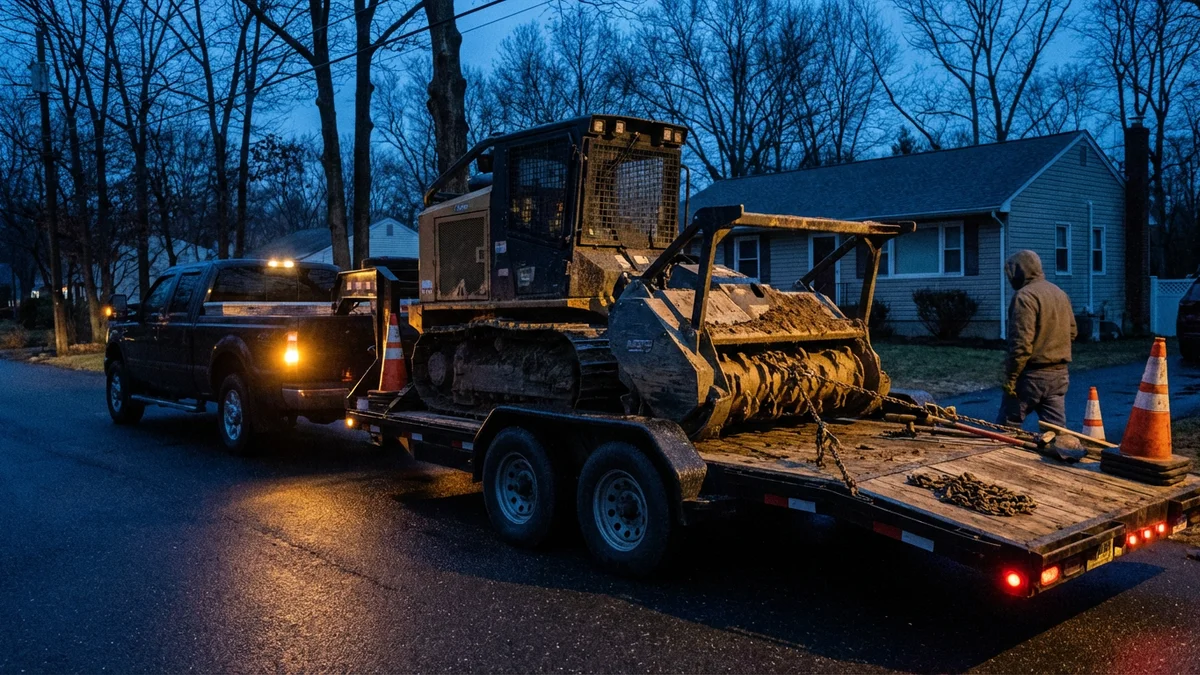
5:30 AM: Pre-dawn
The alarm goes off in Annandale. Coffee. Check the weather forecast — not for rain (light rain doesn’t stop work), but for ground conditions. Yesterday’s rain plus tonight’s temperatures plus tomorrow’s sun determines whether the site is firm enough. If the valley-floor property in Readington is marginal, there’s a ridgetop property in Chester that’s always firm. Flexibility in the schedule keeps production moving.
Check the truck. Check the trailer. Check the machine — fluid levels, track tension, cutting teeth. A broken tooth on-site costs an hour. A broken tooth in the shop costs ten minutes. The teeth get inspected every morning.
6:30 AM: Load and drive
The mulcher rides on a lowboy trailer behind a heavy-duty truck. Transport to most job sites in the service area takes 20 to 45 minutes. The morning drive is when the day’s work plan gets finalized — which zones to clear first, where the access route goes, what trees are flagged for preservation, where the property lines are. All of this was established during the site visit, but reviewing it fresh before the machine unloads prevents mistakes.
7:30 AM: Unload and walk
Machine comes off the trailer. But it doesn’t start yet. First: walk the site. Even on properties where the site visit was detailed, conditions change. Rain may have softened a low spot. A tree may have fallen across the access route overnight. The stakes flagging the preservation trees need to be confirmed — still standing, still visible, still in the right place.
Call 811 markings get verified. If the marks have faded (paint washes, flags blow away), the operator notes the utility locations from the original markout documentation. On properties with underground propane lines (common on rural NJ properties), the line from the tank to the house is always the highest-priority avoidance zone.
8:00 AM – 12:00 PM: Production clearing
The machine starts. This is the part that looks good on video — the cutting head spinning, the brush disappearing, the mulch flying. In reality, production clearing is methodical, not dramatic. The operator works in systematic passes, maintaining overlap between each pass to avoid leaving uncleared strips.
The operator is constantly making micro-decisions: this sapling is four inches — full speed. That one is seven inches — slow down, let the cutting head chew through it. Rock showing through the soil — lift the cutting head slightly to avoid contact. Flagged tree ahead — route around it with six-inch clearance. Property line stake — stop the pass, reposition, start the next pass from the other side.
On a typical morning production run, the machine clears one to one and a half acres before lunch. On a fallow field with light growth — two acres. On wooded understory with navigation around canopy trees — half an acre to three-quarters.
12:00 PM: Break
The machine shuts down. Teeth get checked — any cracked or worn teeth get swapped (a five-minute job per tooth). Fluid levels rechecked. A quick walk of the morning’s cleared area to verify quality — any spots missed, any stumps higher than they should be, any preservation trees that need the mulch pulled back from their base.
12:30 – 4:00 PM: Afternoon production
Second production run. The afternoon is usually when the “I had no idea” moment happens. The property owner stops by after work, walks the cleared area for the first time, and sees what was hidden under the brush. A stone wall. A natural clearing. A view they didn’t know they had. Rock formations. The shape of the land. After fifteen years of not seeing it, the terrain is visible.
This is the part that doesn’t show up on an invoice but matters more than the mulch. The property owner makes decisions about what to do with the land based on what they can finally see. The building site moves fifty feet to the right because there’s a rock ledge they didn’t know about. The driveway route curves around a specimen tree they didn’t know existed. The barn location shifts because the flat spot they assumed was there turns out to have a grade change.
4:00 PM: Wrap-up
Machine shuts down. Final walk of the day’s work with the property owner if they’re on-site. Review what was cleared, what’s next (if it’s a multi-day job), and any conditions encountered that the property owner should know about — rock near the surface, a wet spot, an old foundation, buried wire.
Load the machine. Strap it down. Clean the cutting head — debris packed around the drum gets cleared so it doesn’t dry and harden overnight.
5:00 PM: Drive back and admin
The drive home is when the next day’s logistics get finalized. Which property tomorrow. What time to arrive. Whether the ground conditions will hold. If it’s a new property, review the site visit notes one more time.
Back at base: refuel the truck, top off the machine’s hydraulic fluid, stage replacement teeth for the morning inspection. Update the property owner on progress — a text with a photo of today’s work. File the day’s documentation: hours, acreage cleared, conditions, any notes for the final invoice.
Dinner. Plan tomorrow’s walk. Bed.
And then 5:30 AM again.
Common Questions
Want the full New Jersey land clearing playbook?
This article covers one piece of the puzzle. The complete guide ties together methods, costs, permits, terrain, and contractor selection in one place.
This is what clearing your property looks like from our side.
Methodical. Careful. Every day, every property. Yours could be next.
Or call (908) 774-9235.