

Home / Forestry Mulching / Bernardsville, New Jersey
Forestry Mulching in Bernardsville, New Jersey
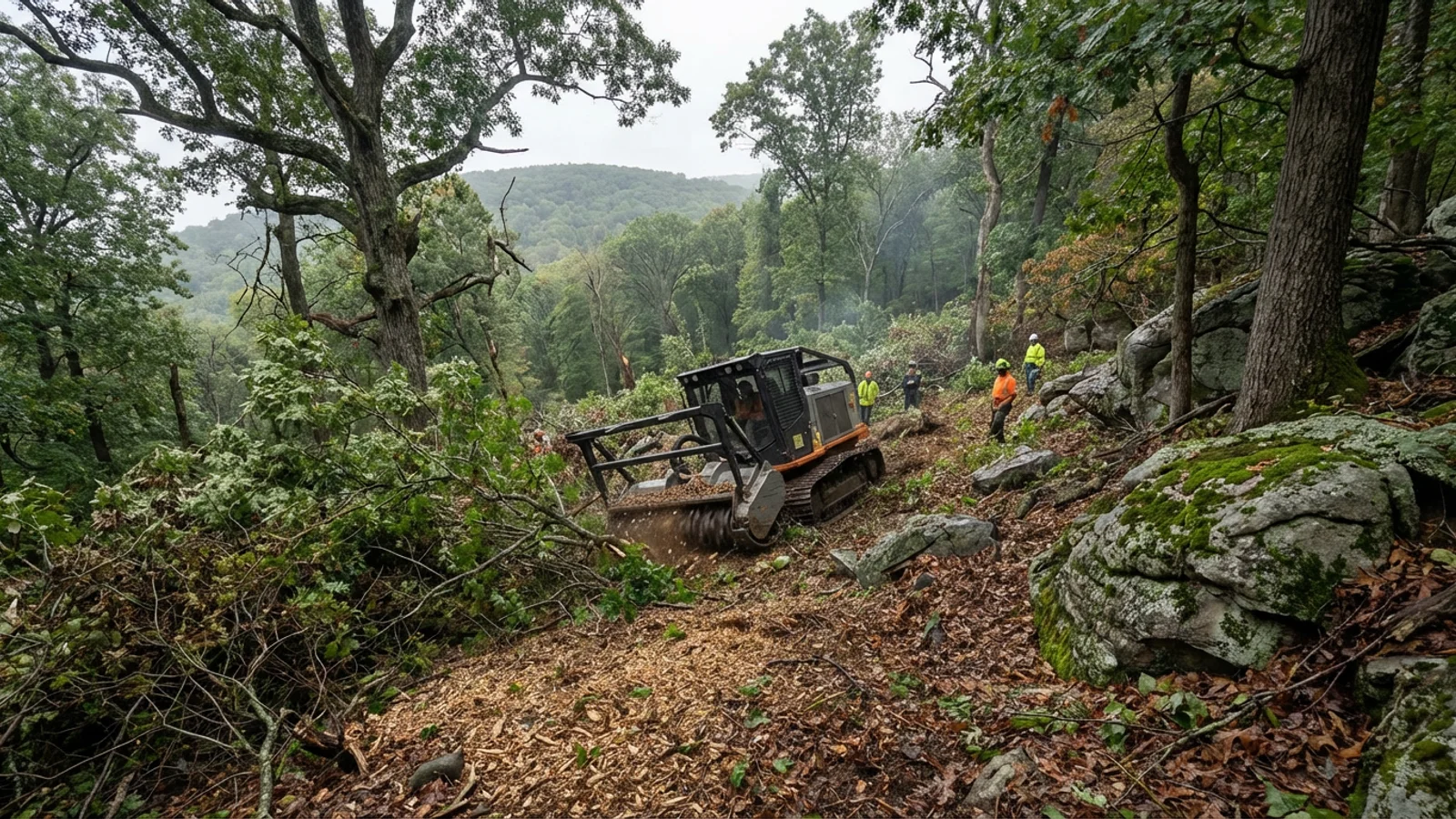
Bernardsville clearing isn't about flattening ground — it's about opening up a forest that invasive species have made unusable. The mature oak-hickory canopy on most Bernardsville properties is beautiful. The barberry, multiflora rose, and bittersweet choking the understory is not. Forestry mulching works here because it removes the problem layer — the chest-high invasive brush on the forest floor — while leaving every mature tree standing. The machine grinds barberry, rose, saplings, and vine growth at ground level, and the mulch that's left lets light reach the forest floor for the first time in years. Native ferns, wildflowers, and groundcover follow. So does a noticeable drop in the tick population.
Why Forestry Mulching Works in Bernardsville
Selectivity is everything in Bernardsville. Nobody here wants their forest removed — they want it restored. That eliminates bulldozing immediately. It also limits the usefulness of a chainsaw crew, which can take down individual trees and shrubs but can't efficiently process the thousands of barberry plants covering a half acre of forest floor. A forestry mulcher operates at ground level and can be adjusted in real time to grind invasive understory without contacting the bark of retained trees just a few feet away. An experienced operator moves through a Bernardsville woodland methodically, processing the barberry and rose at knee height while threading between oaks and beeches that are worth thousands of dollars apiece.
The environmental context reinforces the choice. Bernardsville sits at the headwaters of the Great Swamp watershed. Anything that exposes bare soil increases sediment transport and stormwater volume reaching the refuge. Forestry mulching doesn't expose soil. The mulch layer left behind absorbs rainfall, filters runoff, and stabilizes the ground surface. This isn't just a nice feature — on properties that drain toward a National Wildlife Refuge, it's a practical necessity.
The tick connection seals the case for many Bernardsville homeowners. The link between Japanese barberry density and blacklegged tick abundance is documented in peer-reviewed research. Barberry's dense, humid canopy at ground level creates ideal conditions for tick survival. Mulching the barberry opens the understory to sunlight and wind, which dries out the forest floor and dramatically reduces tick-friendly habitat. For families with children and pets, this alone justifies the work.
What We Typically Mulch in Bernardsville
Japanese barberry blankets the forest floor throughout the Mine Mountain area and on most wooded estate properties in the borough. It forms an impenetrable layer from ground level to about three feet, with arching thorny branches that interlock into a continuous hedge. Walking through it is painful and slow. Mulching removes it entirely in a single pass, processing the aboveground growth and grinding the shallow root system. Barberry regrowth is moderate — some resprouting occurs, but it's far less aggressive than species like knotweed or bittersweet. A spot treatment on resprouts in the first growing season handles the remainder.
Multiflora rose occupies the sunnier edges and any openings in the canopy where a tree has fallen or been removed. It grows faster than barberry and reaches head height in a single season. The mulcher processes rose canes and root crowns at ground level, killing the majority of plants on the first pass.
Oriental bittersweet is the canopy-level threat. It climbs mature trees, wraps around branches, and eventually shades and kills its host. Mulching severs the vine at ground level, cutting the aerial portion off from its root system. The vine in the canopy dries out and dies back over the following growing season. For trees that are heavily wrapped, this ground-level cut is the only practical intervention — sending a climber up every tree on a two-acre wooded lot is neither feasible nor cost-effective.
Volunteer saplings — red maple, sweetgum, and invasive Norway maple — fill gaps in the canopy wherever a mature tree has come down. They grow fast in the rich forest soil and, if left unchecked, create a dense young forest that further shades out native understory species. Selective removal of these saplings while retaining desirable species is part of most Bernardsville woodland thinning projects.
Equipment and Approach for Bernardsville Terrain
Selective woodland clearing requires a different approach than open-field work. In Bernardsville's forests, the operator weaves between retained trees rather than running in straight rows. The mulcher head stays at ground level and processes understory growth while the machine navigates around trunks, surface roots, and low-hanging branches. This is slower than open-field mulching — an operator clearing understory on a wooded Bernardsville lot covers roughly half an acre to one acre per day compared to two-plus acres per day on open ground.
On Mine Mountain's slopes, tracked equipment is essential. The grades on the north-facing side are moderate to steep, and the loam soils become slippery when wet. We schedule hillside work during dry periods and work across the slope rather than up and down to minimize downhill soil displacement.
For properties with tight access — gated driveways, stone wall entries, landscaping pinch points — we bring the compact tracked unit. Many Bernardsville estate driveways are lined with stone walls or specimen plantings that require the smaller machine to enter without damage.
Common Questions
How much does forestry mulching cost in Bernardsville, NJ?
Selective understory mulching runs $4,000 to $9,000. Woodland work is slower than open-field clearing. Get a free estimate.
How do you mulch understory without damaging the mature trees?
The mulcher processes growth at ground level while the operator navigates between trees. It requires experience and constant attention, but the retained trees are undamaged when we finish.
How long does it take to clear understory on a Bernardsville estate?
Roughly half an acre to one acre per day in dense understory. A two-acre lot with heavy barberry may take two to three days.
Will forestry mulching reduce the tick problem on my Bernardsville property?
Removing barberry is one of the most effective tick-reduction strategies. Opening the understory dries the forest floor and significantly reduces tick populations. Learn about our invasive species removal services.
Will the bittersweet in my trees die after you mulch the base?
Yes. Ground-level cutting severs the vine from its roots. The canopy portion dies over the following season. Dead vine loosens and falls as it dries.
Will the barberry grow back from adjacent preserved lands?
Over time, yes — preserved lands are source areas for barberry seed. A maintenance plan — annual mowing plus spot treatment of seedlings — keeps it in check. We recommend a schedule tailored to your property.
Restore your Bernardsville woods — don't just stare at a wall of barberry.
Get a free estimate for selective clearing that brings your forest back without losing the trees that make it worth having.
Or call (908) 774-9235.