

Home / Forestry Mulching / Mendham, New Jersey
Forestry Mulching in Mendham, New Jersey
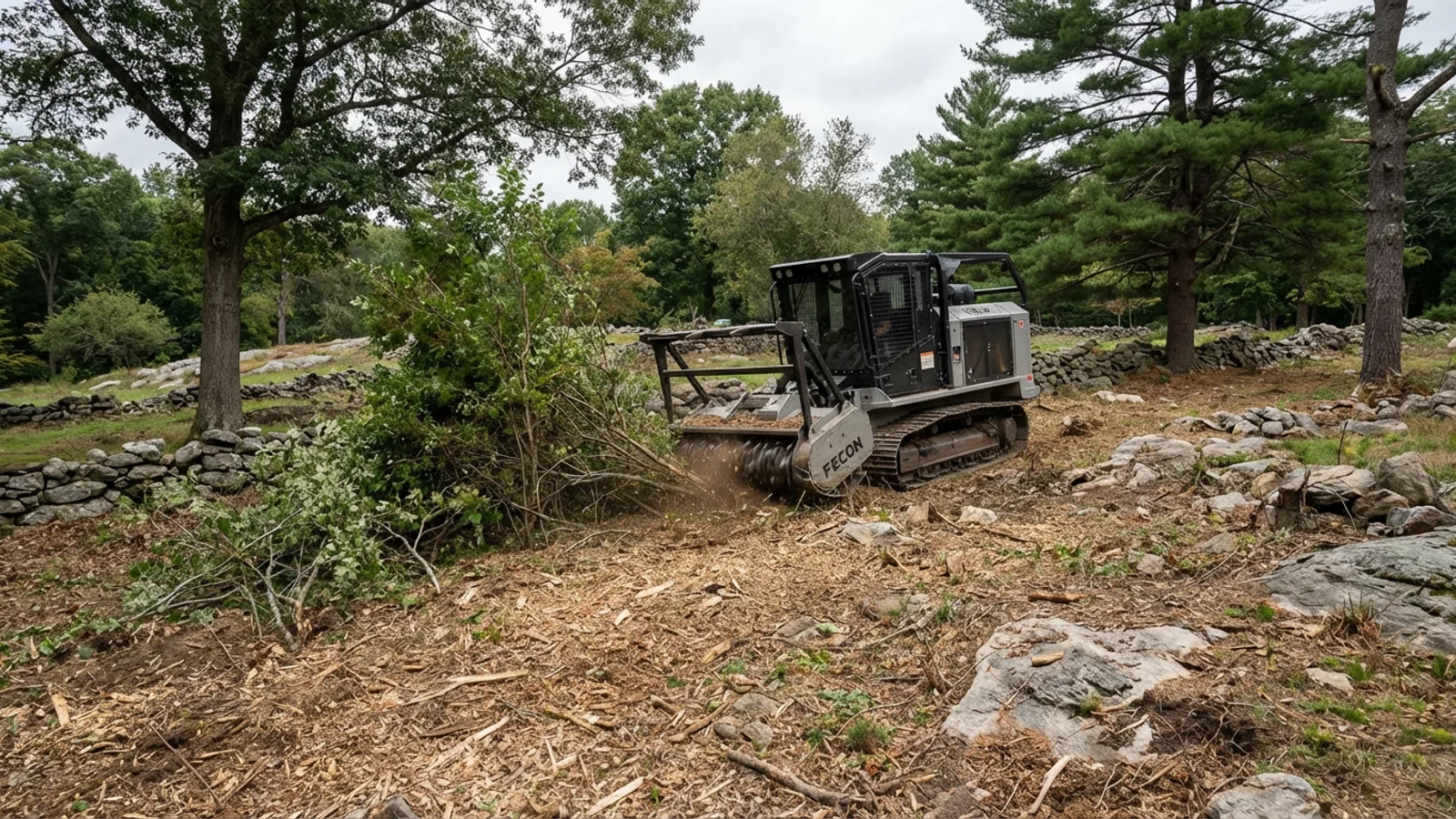
Mendham's tree ordinance is strict for a reason — the forest canopy defines this community. What the ordinance doesn't address is the invasive understory that's destroying the forest from the bottom up. Japanese barberry carpets the floor. Multiflora rose walls off every edge. Bittersweet strangles the trees the ordinance protects. Forestry mulching solves the understory problem without touching the trees the ordinance covers. The machine processes invasive brush at ground level while the operator works between retained trunks. The forest keeps its canopy. It loses the barberry. And you can actually walk through your woods again.
Why Forestry Mulching Works in Mendham
The tree ordinance is the reason forestry mulching is the default method in Mendham. Any clearing approach that involves removing trees — even as a side effect — runs into permitting requirements. Bulldozing is out of the question. Even aggressive chainsaw work risks taking down borderline trees that might trigger the caliper threshold. Forestry mulching operates below the ordinance's radar because it processes ground-level growth — barberry, rose, saplings, vines — without affecting the protected canopy. It's the one method that accomplishes meaningful clearing while staying fully consistent with the ordinance's intent.
The environmental context supports the choice. Mendham's southern drainage flows toward the Great Swamp headwaters. Exposing bare soil on these slopes sends sediment toward the watershed. Forestry mulching leaves a mulch layer that absorbs rainfall, filters runoff, and prevents the erosion that bare ground would cause. For properties in the watershed zone, this isn't optional — it's the responsible way to clear.
The aesthetic outcome matters in Mendham more than in most places. These are properties where appearance counts. Forestry mulching produces a clean, parklike result — open woodland floor, visible tree trunks, mulch surface that looks intentional rather than torn up. Compared to the aftermath of hand clearing (slash piles, stump remnants, disturbed ground) or bulldozing (total devastation), the mulched result looks like a property that was cared for, not cleared.
What We Typically Mulch in Mendham
Japanese barberry is the primary target on almost every Mendham property we work. It forms a continuous, thorny carpet across the forest floor, typically eighteen inches to three feet tall, dense enough that pushing through it means shredded clothing and scratched skin. The mulcher processes it at ground level — thorns, stems, root crowns, and all — in a single pass. The shallow root system means barberry has less regrowth potential than deeper-rooted invasives. A spot treatment on first-season resprouts typically provides lasting control.
Multiflora rose occupies the brighter spots — forest edges, canopy gaps, fence rows, and any opening where light reaches the understory. In Mendham, it often grows intermingled with barberry, creating a two-layer invasive system that's virtually impenetrable. The mulcher processes both species simultaneously.
Oriental bittersweet targets the specimen trees that make Mendham properties valuable. It wraps around trunks, ascends into the canopy, and blocks enough light that the host tree's crown thins and weakens. Left unchecked, bittersweet kills the host tree within a decade. Ground-level mulching cuts the vine off from its root system, and the canopy portion dies within a growing season. For a Mendham homeowner whose property value is partly in the mature tree canopy, removing bittersweet is a direct investment in protecting that asset.
Norway maple saplings fill canopy gaps and crowd out native tree regeneration. They're aggressive, shade-tolerant, and produce seedlings by the thousands. Removing them during understory clearing gives native species — oak, hickory, beech — room to regenerate in the gaps.
Equipment and Approach for Mendham Terrain
Mendham's wooded terrain requires the same selective-clearing approach used in Bernardsville — the operator navigates between retained trees, processing understory growth at ground level while maintaining clearance from trunks and surface roots. Production rates are slower than open-field work: roughly half an acre to one acre per day in dense understory with closely spaced retained trees.
Access is often the first logistical challenge on a Mendham property. Long driveways lined with stone walls and specimen trees require careful equipment routing. Some properties can only accommodate the compact tracked mulcher due to width constraints at the entry. Others have adequate driveway width but require the equipment to cross a lawn or landscaped area to reach the wooded section — in those cases, we use ground protection mats to prevent turf damage.
On the moderate slopes common throughout Mendham, tracked equipment is essential. The tracks maintain traction on grades that wheeled equipment would slip on, and the mulch layer left on slopes prevents the erosion that would follow if the understory were removed by any method that exposes bare ground.
Common Questions
How much does forestry mulching cost in Mendham, NJ?
Selective mulching in Mendham runs $4,000 to $9,000. Get a free estimate for your property.
Is forestry mulching compliant with Mendham's tree ordinance?
Yes — mulching processes ground-level growth without removing protected trees. If any trees near the caliper threshold need removal, get approval first. Read our NJ permits guide.
How long does selective understory mulching take in Mendham?
Roughly half an acre to one acre per day in dense understory. A two-acre wooded lot typically takes two to three days. We include timelines with every quote.
Can you remove bittersweet from my Mendham trees?
We mulch bittersweet at ground level, severing it from its roots. The canopy vine dies within a growing season. Learn about our invasive species removal approach.
Will you damage my lawn getting equipment to the wooded area?
We use ground protection mats to prevent turf damage when crossing lawns. Any light track impressions recover within a few weeks of normal growth.
What's the difference between what you do and what an arborist does?
An arborist works on individual trees. We work on the ground between them — removing invasive understory across entire wooded areas. The two services complement each other on Mendham properties.
Mendham's forest canopy is worth protecting. The barberry underneath it is not.
Get a free estimate for selective mulching that clears the invasives and keeps every tree the ordinance protects.
Or call (908) 774-9235.