

Home / Field Notes — Land Clearing Knowledge Base / Fence Row Clearing in New Jersey: A Guide for Farmers and Rural Property Owners
Fence Row Clearing in New Jersey: A Guide for Farmers and Rural Property Owners
Published April 7, 2026 by Brush Busters • Last reviewed April 7, 2026
Fence rows are the first thing to go on any rural NJ property that loses regular maintenance. The brush grows into the fence from both sides, the wire disappears under multiflora rose, the posts rot and lean, and within five to ten years the fence row is a linear thicket six to twelve feet wide and overhead tall that you can’t walk through, see through, or maintain.
Reclaiming overgrown fence rows is one of our highest-volume services on agricultural properties in Hunterdon and Warren counties. The work is linear (priced by the foot, not the acre), the results are immediate, and the impact on property function is significant — a cleared fence row restores the boundary between pastures, opens sight lines for livestock management, and often reveals fencing that’s still partially intact and repairable.
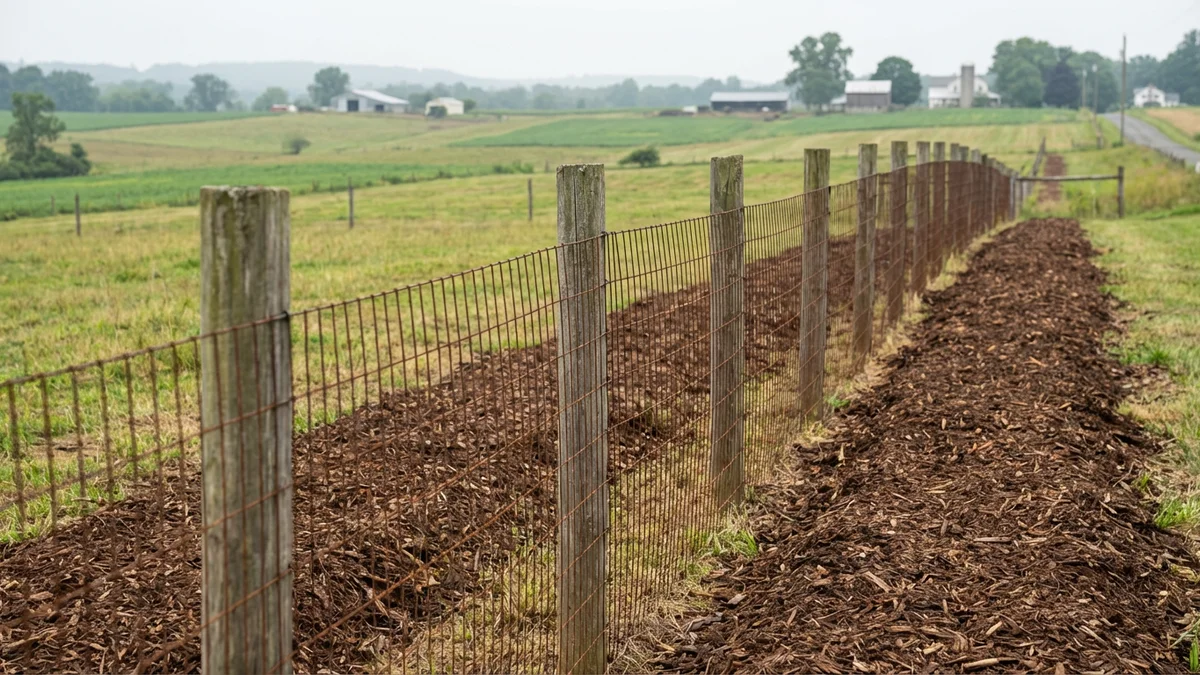
What grows in NJ fence rows
Fence rows are invasive species magnets. Birds perch on the fence posts and deposit seeds from their meals directly into the row. The fence itself provides a structure for climbing vines. The undisturbed soil beneath the brush is rich from decades of leaf litter accumulation. The result is a greatest-hits list of NJ invasives packed into a narrow corridor:
Multiflora rose is the most common — the thorny, arching canes that make fence rows impassable. Autumn olive fills in the gaps. Oriental bittersweet climbs the fence posts and any nearby trees. Wild grape drapes over everything. Poison ivy carpets the ground. Japanese honeysuckle twines through the wire. On the Warren County limestone, red cedar adds a row of evergreens growing through the fence line.
The old fence wire is buried somewhere inside all of this. That wire is the primary hazard during clearing — a wire wrapped around the mulcher cutting head is an expensive and time-consuming jam to clear. This is why we ask property owners to flag any known fence wire locations before we start.
The clearing approach
Step 1: Flag known wire. If you know where old fence runs are — even approximately — flag them with tape or stakes. If the wire is visible in any spots, flag those. If you have no idea where the wire is, tell us that too — we’ll proceed carefully with the assumption that wire is present.
Step 2: Clear one side at a time. The mulcher clears the vegetation on one side of the fence row first, working parallel to the fence. This reveals the fence from one side without crossing it. Then the other side is cleared. This two-pass approach minimizes the risk of hitting buried wire.
Step 3: Clear the row itself. Once both sides are cleared and the fence is visible, the operator carefully clears the vegetation growing directly in the row — working tight to the posts without contacting the wire. On badly deteriorated fences where the wire has fallen to the ground, the operator stays off the wire and clears above it.
Step 4: Assess the fence. With the brush gone, you can see what you’re working with. Posts that are still sound. Sections where the wire is intact. Sections that need replacement. This assessment is impossible when the fence is buried — clearing is the diagnostic step.
Costs
| Fence row condition | Cost per 100 linear ft |
|---|---|
| Light brush (2–3 years growth) | $200–$400 |
| Moderate brush (5–7 years, rose thickets) | $400–$700 |
| Heavy overgrowth (10+ years, buried fence) | $600–$1,000 |
A typical farm property fence row — 500 to 1,500 linear feet — costs $1,500 to $8,000 depending on condition. Many farm properties have multiple fence rows that can be cleared in a single mobilization for better per-foot pricing.
Common Questions
Can you clear around an existing fence without damaging it?
Yes — we work right up to posts without contact. Flag known wire locations before clearing to minimize buried-wire risk. Learn about our fence line clearing service.
What if the fence wire is buried and I don't know where it is?
We proceed carefully at reduced speed. If we hit wire, we stop and adjust. Flagging wire in advance saves time and money.
How much does fence row clearing cost?
$200–$1,000 per 100 linear feet. A typical farm fence row: $1,500–$8,000. Multiple rows in one trip get better pricing. Get a free estimate.
Should I clear the fence row before or after replacing the fence?
Clear first — it reveals fence condition, provides a clean work corridor for the installer, and may show sections that don’t need replacement.
How wide should I clear along the fence?
4–6 feet per side for maintenance. 8–10 feet for mower access. 10–12 feet for fence replacement projects.
Will the fence row grow back?
Without mowing, yes — within 3–4 years. One annual pass with a brush mower prevents it permanently.
Related Services
Fence Line Clearing
Buried fence rows and overgrown property borders opened up and made visible again.
Helpful Resources
Farms & Agriculture
Want the full New Jersey land clearing playbook?
This article covers one piece of the puzzle. The complete guide ties together methods, costs, permits, terrain, and contractor selection in one place.
Can't see your fence anymore? We'll find it.
We clear both sides without damaging the wire. You assess what's repairable.
Or call (908) 774-9235.