

Home / Field Notes — Land Clearing Knowledge Base / Land Clearing for Solar Installation in New Jersey
Land Clearing for Solar Installation in New Jersey
Published April 5, 2026 by Brush Busters • Last reviewed April 5, 2026
New Jersey ranks among the top ten states for solar installation, and ground-mounted solar projects are expanding across the agricultural and commercial landscapes of Hunterdon, Warren, Somerset, and Morris counties. Whether it’s a utility-scale solar farm on fifty acres of former farmland or a commercial ground-mount array on a two-acre commercial parcel, every ground-mounted solar project starts with clearing the site.
Solar site prep has specific requirements that differ from construction or agricultural clearing. The ground beneath and between panels needs to be vegetation-managed for the life of the installation (twenty to thirty years). The clearing method determines the long-term vegetation management cost.
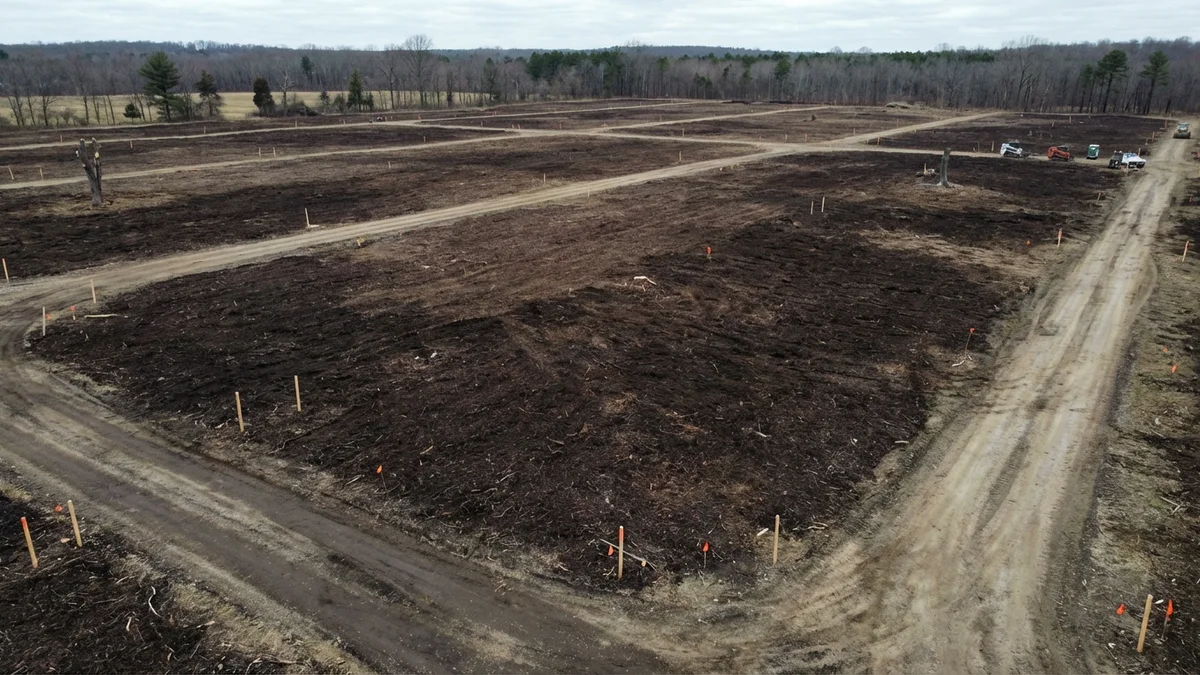
What solar site clearing involves
Panel array area. The entire footprint where solar panels will be installed needs to be cleared of trees, brush, and woody vegetation. Grass and low ground cover are typically allowed — and even encouraged — beneath panels for erosion control. The clearing target is woody vegetation, not all vegetation.
Access roads. Solar installations require internal access roads for construction vehicles (during installation) and maintenance vehicles (ongoing). These roads need to be wide enough for trucks and equipment — typically 16 to 20 feet.
Perimeter clearing. A cleared buffer around the array perimeter prevents tree shadow encroachment on panels. As trees grow, their shadow footprint extends. Clearing or selective trimming to 30–50 feet beyond the array edge prevents shading for the first decade of operation.
Interconnection corridor. The cable run from the array to the grid interconnection point (often a utility pole or substation) needs a cleared corridor for trenching.
Substation and inverter pads. Equipment pads need cleared, level ground — typically small areas (20×20 to 40×40 feet) but with specific grade and access requirements.
Why forestry mulching fits solar site prep
Erosion control during and after installation. Solar panel installation takes weeks to months. During that period, the cleared site is exposed to weather. Forestry mulch on the ground prevents erosion throughout the installation phase — no temporary seeding or erosion blankets needed.
Long-term ground cover establishment. After panel installation, the ground beneath and between rows is typically seeded with a low-maintenance grass or wildflower mix. Seed germinates through the mulch layer without soil prep. The mulch suppresses weed establishment during the critical first year while the permanent ground cover gets established.
No debris. Solar sites — especially those on former farmland — may have farmland preservation easements or environmental conditions that prohibit waste disposal on-site. Forestry mulching generates zero waste. Everything stays on the ground as mulch. No brush piles, no burn permits, no hauling.
Topsoil preservation. If the solar installation has a decommissioning plan that returns the land to agricultural use after twenty to thirty years, the topsoil needs to be intact. Bulldozing strips it. Forestry mulching preserves it.
Costs for solar site clearing
| Component | Cost range |
|---|---|
| Panel array area (per acre) | $1,200–$2,500 |
| Access roads (per 100 linear ft) | $300–$600 |
| Perimeter buffer clearing (per acre) | $1,500–$3,000 |
| Equipment pad clearing | $500–$1,500 per pad |
A ten-acre community solar project on fallow agricultural land with moderate brush typically costs $15,000 to $30,000 for complete site clearing. A two-acre commercial ground-mount on a previously developed lot costs $3,000 to $6,000.
For utility-scale projects (50+ acres), we provide project-level pricing after a detailed site assessment. The per-acre rate decreases significantly on large-scale production clearing.
NJ regulatory considerations for solar clearing
Farmland preservation. Solar installations on farmland-assessed properties interact with the farmland assessment. NJ has a dual-use solar program that allows agricultural activity to continue beneath elevated solar panels. Clearing for dual-use installations needs to preserve the agricultural capacity of the soil — another reason forestry mulching (soil preservation) is preferred over bulldozing (soil destruction).
Highlands. Solar installations on Highlands Preservation Area parcels face the same development review as any other construction. Planning Area parcels are subject to municipal conformance. The NJ Highlands Council has specific guidance on solar installations in the Highlands region.
Wetlands and buffers. Solar sites near wetlands or waterways need NJ DEP review. Panel arrays typically can’t extend into wetlands or buffer zones, but clearing for access roads or perimeter buffers may approach these boundaries.
Municipal approvals. Ground-mounted solar installations typically require site plan approval from the municipal planning or zoning board. The clearing is one component of the broader site plan application.
Common Questions
How much does solar site clearing cost in NJ?
Array clearing: $1,200–$2,500/acre. A 10-acre project: $15,000–$30,000 total. Utility-scale rates decrease. Request a solar clearing quote.
Does forestry mulching preserve the soil for future agricultural use?
Yes — topsoil stays intact for post-decommissioning agricultural return. Bulldozing would destroy it. Learn about forestry mulching.
Can you clear for dual-use (agrivoltaic) solar?
Yes — forestry mulching preserves soil capacity for continued agriculture beneath elevated panels. Ideal for NJ’s dual-use solar program.
How long does solar site clearing take?
10-acre site: 4–7 days. 2-acre commercial: 1–2 days. 50+ acres: 2–4 weeks. We coordinate with your installer’s timeline.
Do solar sites need ongoing vegetation management?
Yes — annual mowing prevents woody regrowth beneath panels. The initial mulch layer suppresses regrowth for the first 1–2 years, reducing early maintenance costs.
What about Highlands regulations for solar installations?
Preservation Area: development review. Planning Area: municipal conformance. The Highlands Council has solar-specific guidance. Read our Highlands guide.
Related Services
Commercial Land Clearing
Forestry mulching and site clearing for builders, developers, municipalities, and HOA common areas across North New Jersey.
Want the full New Jersey land clearing playbook?
This article covers one piece of the puzzle. The complete guide ties together methods, costs, permits, terrain, and contractor selection in one place.
Solar site needs clearing? We prep the ground.
Panel arrays, access roads, perimeter buffers. Soil preserved for future agricultural return.
Or call (908) 774-9235.