

Home / Field Notes — Land Clearing Knowledge Base / Land Clearing for Surveyors in New Jersey
Land Clearing for Surveyors in New Jersey
Published April 3, 2026 by Brush Busters • Last reviewed April 3, 2026
A surveyor charging $150 per hour shouldn’t be spending that hour fighting through multiflora rose with a machete. But that’s exactly what happens when a property owner hires a surveyor before clearing the boundary lines and access routes. The survey takes twice as long, costs twice as much, and the results may be less accurate because the surveyor can’t establish clean sight lines through dense vegetation.
Clearing before the survey is the most cost-effective sequencing on any project that requires both. The clearing costs the same whether you do it before or after the survey, but the survey costs significantly less on cleared ground.
What surveyors need cleared
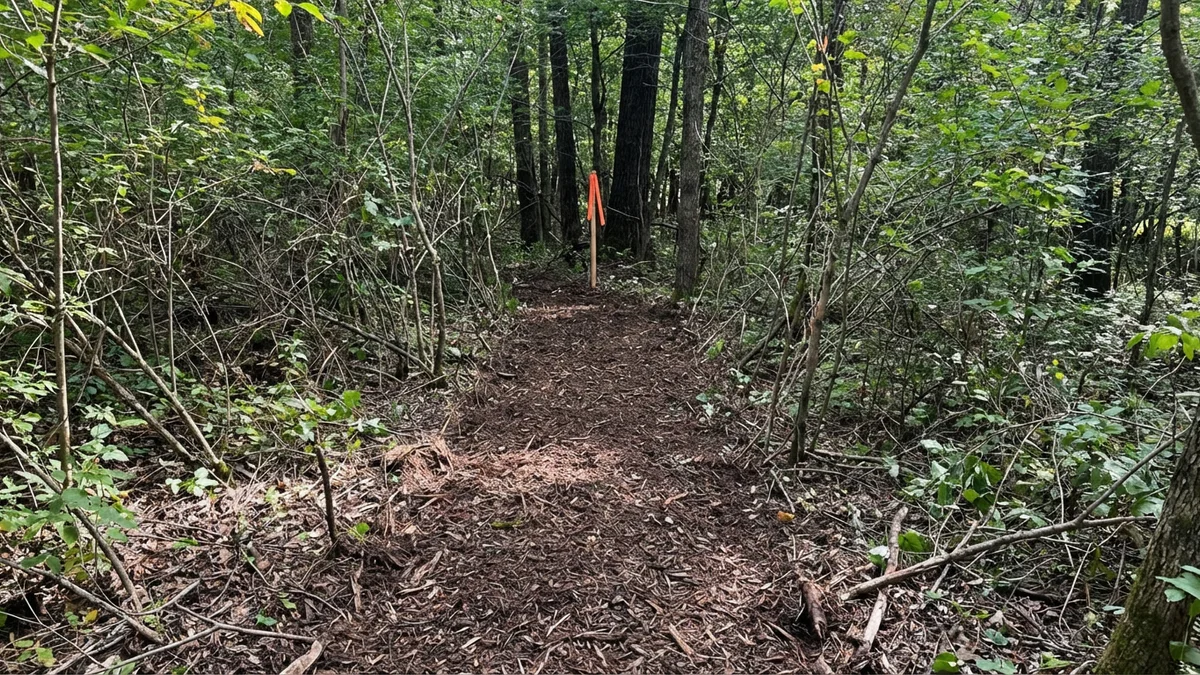
Property boundary corridors. A six-to-ten-foot-wide strip along the boundary lines — particularly the lines being surveyed. The surveyor needs to walk the line, set up a total station or GPS equipment at turning points, and establish sight lines between instrument positions. Dense brush blocks sight lines and forces additional instrument setups, which adds time and cost.
Access routes. The surveyor needs to reach the boundary from the road or from a known reference point. On large, wooded properties in Lebanon Township, Oxford, or Delaware Township, the surveyor may need 500+ feet of access through dense woods just to reach the first boundary pin. Clearing a path saves the surveyor (and you) hours.
Pin locations. If you know approximately where survey pins, monuments, or iron rods are located (from a previous survey plat or deed description), clearing those specific areas gives the surveyor a head start. On properties where the pins haven’t been accessed in decades, clearing the general area increases the chances of finding existing markers without a full re-survey.
Topographic survey areas. For topographic surveys (measuring elevation contours across a property), the surveyor needs to traverse the entire survey area with a rod and instrument. Every tree, bush, and vine they have to work around adds time. Clearing the survey area — or at least cutting corridors through it — speeds the topographic survey significantly.
The cost math
Here’s the comparison that makes the case for clearing first:
Without pre-clearing: A boundary survey on a heavily overgrown five-acre parcel might take the surveyor 12–16 hours at $125–$175/hour = $1,500–$2,800 for the survey. Plus the clearing still needs to happen for whatever project follows.
With pre-clearing: The same survey on cleared ground takes 6–8 hours = $750–$1,400 for the survey. The clearing cost is the same either way.
The survey savings ($750–$1,400 on a typical property) often covers a significant portion of the clearing cost. And the cleared property is ready for the next step (construction, fence installation, property sale) immediately after the survey — no second mobilization for clearing.
When to clear for a survey
Before a property sale. Sellers who clear boundaries before listing provide clear, documented property extent. The surveyor confirms boundary positions efficiently. The listing includes accurate acreage and boundary documentation.
Before construction. Any construction project near a property line — homes, pole barns, fences, additions — needs a setback measurement from the boundary. Clear first, survey second, build third.
Before subdivision. Subdividing a property requires a full boundary and topographic survey. Clearing the entire property before the surveyor arrives saves the most time and cost.
During boundary disputes. If there’s a disagreement about where the property line falls, clearing the disputed area makes the survey more accurate and gives both parties visible, verifiable results.
Common Questions
Should I clear before or after hiring a surveyor?
Clear before. Surveys are faster and cheaper on cleared ground. The clearing costs the same either way — but the survey savings are significant.
How much does pre-survey clearing save?
$750–$1,400 on a typical 5-acre property by cutting survey time roughly in half. Savings increase on larger properties.
How wide should the cleared corridor be for a surveyor?
6–10 feet wide. Ten feet preferred on wooded properties where sight lines are critical.
Can you clear just the boundary lines, not the whole property?
Yes — boundary corridors plus access route. This is the minimum needed for the surveyor and costs a fraction of full clearing. Read about property line clearing.
What if the surveyor can't find pins after clearing?
The surveyor sets new pins from deed descriptions and references. Cleared ground makes this faster and the new pins more reliably placed.
Do you coordinate directly with surveyors?
Yes — we coordinate with your surveyor on corridors, widths, and specific access needs. A brief call before clearing ensures the right areas are opened.
Related Services
Land Clearing / Lot Prep
Residential and small commercial lots cleared and prepped for building, grading, or landscaping.
Want the full New Jersey land clearing playbook?
This article covers one piece of the puzzle. The complete guide ties together methods, costs, permits, terrain, and contractor selection in one place.
Surveyor coming? Clear the lines first.
Faster survey, lower cost, better results. We clear boundary corridors and access routes.
Or call (908) 774-9235.