

Home / Field Notes — Land Clearing Knowledge Base / Porcelainberry Removal in New Jersey
Porcelainberry Removal in New Jersey
Published April 3, 2026 by Brush Busters • Last reviewed April 3, 2026
Porcelainberry (Ampelopsis glandulosa var. brevipedunculata) is the invasive vine that property owners often mistake for wild grape until it’s too late. The climbing vine drapes over trees, shrubs, fences, and structures with a dense curtain of foliage that shades out everything underneath. Its distinctive multicolored berries — shades of blue, purple, pink, lavender, and turquoise on the same cluster — are almost too beautiful for an invasive. But those berries are the problem: birds eat them and spread the vine across every property edge, stream corridor, and suburban lot border in central New Jersey.
Porcelainberry is most prevalent in the suburban-to-forest transition zones of Somerset County — the edges of properties in Bridgewater, Hillsborough, Branchburg, and Bernardsville. It’s also expanding into Hunterdon County stream corridors and forest edges.
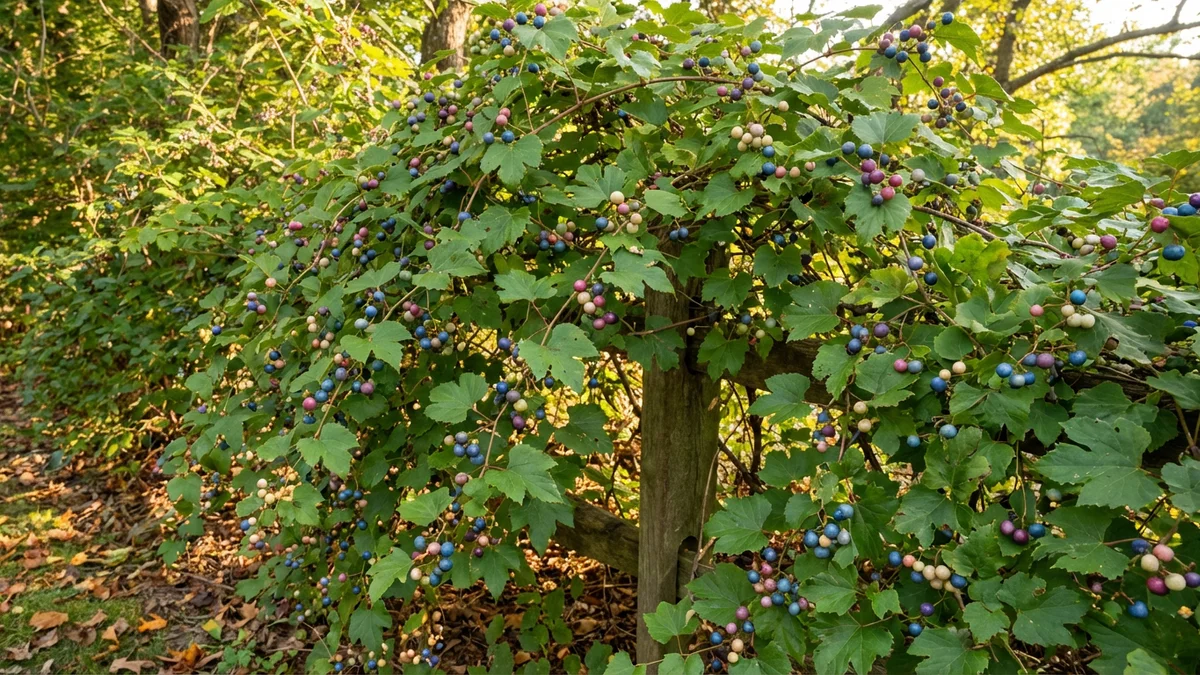
Identification
Leaves: Deeply lobed (three to five lobes), similar to grape leaves but with more variable and irregular lobing. The leaves have a coarser texture and a more deeply cut margin than grape.
Berries: The diagnostic feature. Small, round berries in clusters that ripen to a striking range of colors — white, yellow, lilac, turquoise, blue, and purple — often all on the same cluster simultaneously. No native NJ vine produces this multicolored berry display. Ripe in September-October.
Stems: Woody, climbing by tendrils (similar to grape). Bark on older stems is light brown with visible lenticels (small raised dots). Young stems are smooth and greenish.
Growth form: Vigorous climbing vine that can reach 20+ feet into the canopy. Also forms dense ground cover in open areas. Creates a heavy blanket of foliage that smothers understory vegetation and small trees.
Grape vs. porcelainberry: The most common confusion. Grape leaves have fewer, shallower lobes. Grape berries are uniformly colored (green to purple). Grape bark shreds in strips on mature vines. Porcelainberry bark is smoother. The multicolored berry clusters are the definitive identifier.
Removal approach
Porcelainberry removal follows the same approach as oriental bittersweet: cut the climbing vines, clear the ground-level growth, and follow up with herbicide.
Cut climbing vines at the base. Sever every vine climbing into trees or onto structures. Cut in two places, remove the section between, and apply triclopyr to the cut stump immediately. The vine above the cut dies and drops from the canopy over several months.
Clear ground-level growth with forestry mulching. The mulcher handles the ground cover, tangled vine mass, and associated brush in a single pass. The mulch layer suppresses regrowth.
Herbicide on resprouts. Porcelainberry resprouts from root fragments. Foliar triclopyr application on spring regrowth (when leaves are fully expanded) translocates to the root system and kills it. One to two years of follow-up treatment eliminates established plants.
Prevent seed rain. Birds depositing new seeds are an ongoing source of reinfestation. Annual monitoring and removal of new seedlings prevents reestablishment. This is an ongoing maintenance activity, not a one-time project.
Costs
Porcelainberry removal is typically part of broader understory clearing or fence-line clearing. As part of a full clearing project: no additional charge. For targeted vine cutting and treatment on specific trees: $200–$500 per tree. For forest-edge clearing where porcelainberry is the dominant species: $2,500–$4,500 per acre including understory mulching and vine cutting.
Common Questions
How do I tell porcelainberry from wild grape?
The multicolored berries (white, turquoise, blue, purple on the same cluster) are definitive. Grape berries are uniform in color. Porcelainberry leaves have deeper, more irregular lobes.
Is porcelainberry as bad as bittersweet?
Similar smothering damage but different mechanism — porcelainberry kills by light deprivation rather than girdling. Both need prompt removal.
Will porcelainberry come back from the roots?
Yes — treat cut stumps with triclopyr immediately and spray resprouts the following spring. Most plants are eliminated in 1–2 seasons with treatment.
Where is porcelainberry worst in our area?
Somerset County suburban-forest edges — Bridgewater, Hillsborough, Branchburg. Expanding into Hunterdon County stream corridors.
How much does porcelainberry removal cost?
Included in standard clearing. Targeted vine cutting: $200–$500/tree. Forest-edge clearing: $2,500–$4,500/acre. Get a free estimate.
When should I remove porcelainberry?
Cut climbing vines immediately (any season). Herbicide on stumps right away, foliar treatment in late summer. Mechanical clearing best in fall/winter.
Related Services
Invasive Species Removal
Japanese knotweed, multiflora rose, mile-a-minute vine, and other NJ invasives eliminated at ground level.
Relevant City Pages
These city pages are a good fit if you want to compare the article advice with the kind of properties we see on the ground.
Want the full New Jersey land clearing playbook?
This article covers one piece of the puzzle. The complete guide ties together methods, costs, permits, terrain, and contractor selection in one place.
Porcelainberry is smothering your forest edge. We clear it.
Vine cutting, ground clearing, and mulch suppression in a single operation.
Or call (908) 774-9235.