
Home / Field Notes — Land Clearing Knowledge Base / Utility Easement and Right-of-Way Clearing in New Jersey
Utility Easement and Right-of-Way Clearing in New Jersey
Published April 6, 2026 by Brush Busters • Last reviewed April 6, 2026
Every property with underground gas, water, or sewer lines, overhead power lines, or access easements has vegetation management obligations — whether the property owner realizes it or not. Utility companies have the legal right to access their easements for maintenance, and many require that the easement corridor be kept clear of woody vegetation that could interfere with infrastructure.
On rural properties in Hunterdon, Warren, and Morris counties, utility easements that were cleared at installation ten or twenty years ago have since grown in with brush, saplings, and full-size trees. The utility company sends a notice — clear the easement or we’ll do it ourselves (and bill you, or do it in a way that’s less careful than you’d prefer).
Beyond utility company requirements, right-of-way clearing serves private needs: maintaining private road easements, clearing shared driveway corridors, opening sight lines at road intersections, and keeping access routes passable for emergency vehicles.
Types of utility easement clearing
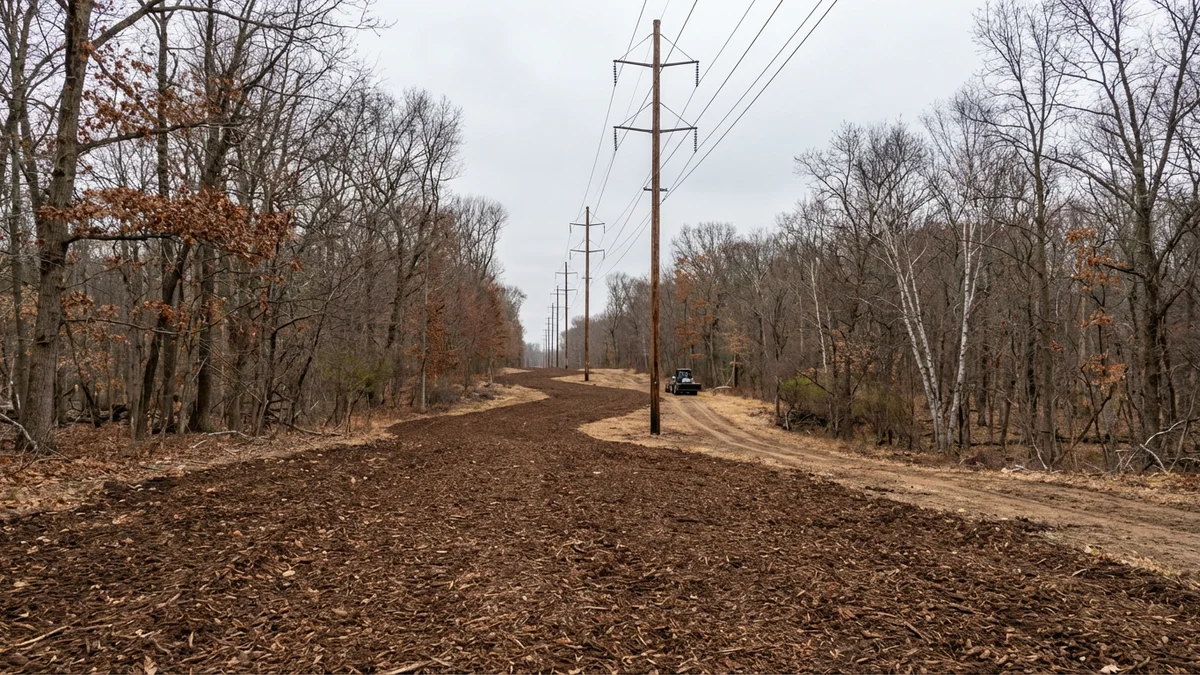
Overhead power line easements. The utility requires a clear corridor — typically 20 to 30 feet wide — beneath and adjacent to power lines. Vegetation within this corridor cannot exceed a certain height (varies by line voltage — distribution lines may allow 15-foot growth; transmission lines require full clearing). Trees and tall shrubs that could fall into the lines from outside the corridor also need removal or trimming.
Underground gas pipeline easements. Gas companies require their pipeline corridors (typically 25 to 50 feet wide) to be kept free of deep-rooted vegetation. Tree roots can damage buried pipelines, and the utility needs clear access for inspection and maintenance equipment. Grass and low ground cover are acceptable; trees and large shrubs are not.
Underground water and sewer easements. Similar to gas — the utility needs root-free zones over the pipes and access for maintenance equipment. The corridor width varies by municipality and utility.
Private road and driveway easements. Shared access roads and private drives on rural properties need vegetation management to maintain drivable width, sight lines, and emergency vehicle access. These aren’t regulated by a utility company but are the property owner’s (or easement holder’s) responsibility.
Drainage easements. Municipal and private drainage easements need vegetation clearing to maintain water flow. Blocked drainage easements cause flooding on adjacent properties — and the easement holder is liable.
The forestry mulching advantage for easements
Utility easement clearing is one of the best applications for forestry mulching because of three factors:
Linear corridor efficiency. The mulcher works in straight-line passes along the easement, similar to mowing a row. The production rate on linear corridor work is high because there’s minimal maneuvering — just forward progress along the easement path.
No debris on the easement. Brush piles and log stacks left on a utility easement violate the clearance requirement. The utility needs open access. Forestry mulching processes everything in place — the mulch sits flat on the ground and doesn’t obstruct access. No debris piles, no hauling, no secondary cleanup.
Root-free surface. For underground utility easements, the mulch layer suppresses woody regrowth from the root crown of cleared vegetation. Combined with periodic mowing (annual or biannual), this keeps the easement in compliance without chemical treatment.
Costs for easement clearing
Easement clearing is priced by linear footage rather than acreage because the width is fixed and the length varies.
| Easement type | Width | Cost per 100 linear ft |
|---|---|---|
| Light brush, flat terrain | 20–30 ft | $200–$400 |
| Moderate brush/saplings | 20–50 ft | $400–$800 |
| Dense growth with trees | 25–50 ft | $700–$1,500 |
| Private road/driveway | 14–20 ft | $200–$600 |
A typical 500-foot utility easement clearing with moderate brush runs $2,000 to $4,000. A quarter-mile pipeline corridor through heavy growth runs $5,000 to $15,000.
Regulatory notes
Call 811 first. Before clearing ANY utility easement, call 811 for a utility markout. This applies even to overhead-line easements — there may be underground services running alongside the overhead corridor.
Utility company coordination. For overhead power line easements, contact the utility company before clearing. Some utilities have specific requirements for clearing within their easement, and some prefer to coordinate the work or provide oversight. For gas pipeline easements, the gas company may require a representative on-site during clearing.
Municipal right-of-way. Clearing within the public road right-of-way (the strip between the road edge and your property line) may require municipal approval. Most municipalities allow vegetation management in the right-of-way but may have specific rules about what can be removed.
Common Questions
How much does utility easement clearing cost?
$200–$1,500 per 100 linear feet depending on density and width. A 500-foot easement: $2,000–$4,000. Get a free estimate.
Am I responsible for clearing the utility easement on my property?
Usually yes — proactively clearing is cheaper and more careful than waiting for the utility to do it. Check your deed or easement agreement for specifics.
How often do easements need clearing?
Every 3–5 years without maintenance. Annual mowing keeps them clear indefinitely. Gas companies may require more frequent access.
Do I need to call 811 before clearing an easement?
Yes — always. Even overhead-line easements may have underground utilities. Call 811 at least 3 days before clearing. Free and required by law.
Can you clear near overhead power lines?
We clear ground-level vegetation beneath lines. Trimming near live conductors is the utility’s responsibility. We coordinate with the utility on transmission-line easements.
Will the mulch obstruct utility access?
No — mulch sits flat at 2–4 inches. Maintenance trucks drive over it. No brush piles or log stacks blocking access.
Can you clear a shared private driveway easement?
Yes — we clear to the width in your easement agreement. Coordinate with other easement holders before scheduling. Learn about our ROW clearing service.
How long does easement clearing take?
500-foot easement: half to one day. Quarter-mile corridor: 2–3 days. We provide specific timelines with every quote.
Related Services
Right-of-Way Clearing
Keep easements, utility corridors, private roads, and long access runs open, visible, and easier to maintain.
Want the full New Jersey land clearing playbook?
This article covers one piece of the puzzle. The complete guide ties together methods, costs, permits, terrain, and contractor selection in one place.
Utility easement growing in? Clear it before they do.
We clear power line, gas pipeline, and access easements with no debris and no obstruction. Free estimates.
Or call (908) 774-9235.