

Home / Forestry Mulching / Tewksbury Township, New Jersey
Forestry Mulching in Tewksbury Township, New Jersey
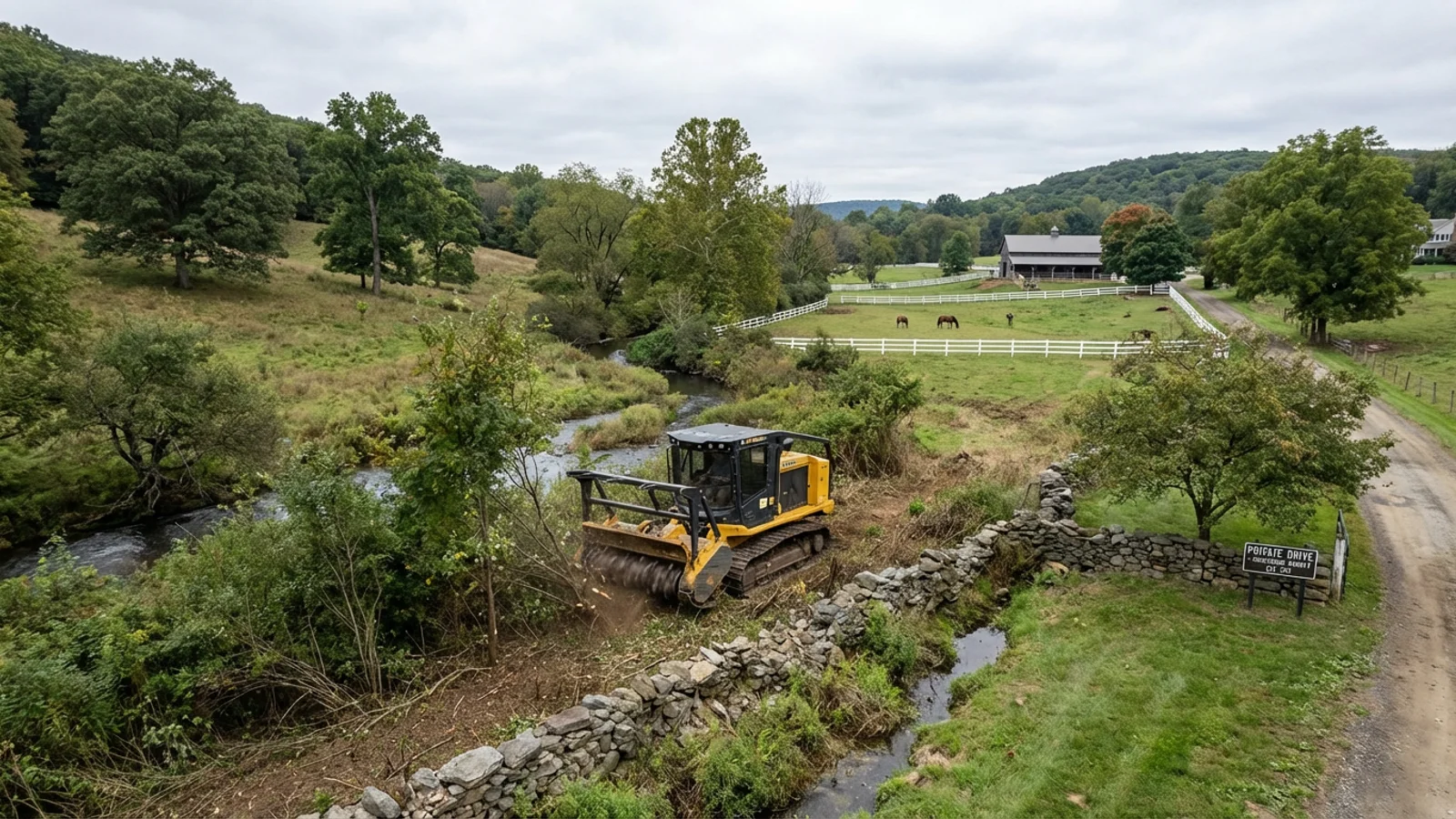
A Tewksbury horse property with overgrown fence lines and pastures filling in with autumn olive needs a clearing method that works fast across large acreage, leaves the soil ready for reseeding, and doesn't destroy the fencing that costs twenty dollars a foot to replace. Forestry mulching checks all three. The machine processes multiflora rose, autumn olive, saplings, and vine overgrowth in a single pass — grinding everything at ground level and leaving a natural mulch layer that suppresses regrowth. On a five-acre Tewksbury property, that's the difference between a week-long project with a chainsaw crew and a one-day job with a mulcher.
Why Forestry Mulching Works in Tewksbury
Tewksbury properties are measured in acres, not fractions of acres. That scale makes hand clearing or chainsaw-and-chipper work cost-prohibitive for anything beyond a small garden bed. A forestry mulcher covers ground five to eight times faster than a manual crew and produces a finished result in a single pass. For a horse property with a thousand feet of overgrown fence row and three acres of pasture reverting to brush, the mulcher completes in one day what would take a crew a week or more — and there's nothing to haul, burn, or pile.
The soil preservation matters in Tewksbury more than most places because these are working landscapes. The topsoil on a Tewksbury pasture took decades to build. A bulldozer would strip it in an afternoon, leaving heavy clay that compacts under the first rain and takes years to re-establish grass on. A mulcher leaves that topsoil exactly where it is. The mulch layer on top breaks down into organic material that actually enriches the soil over the next twelve to eighteen months. Horse property owners who plan to reseed cleared ground for grazing or hay can overseed directly into or through the decomposing mulch.
The precision along fence lines is the third advantage that makes mulching the default method in Tewksbury. The mulcher head operates within inches of fence posts without contacting the rails, boards, or wire. On properties with ten-thousand-dollar fencing investments, that precision is worth the call.
What We Typically Mulch in Tewksbury
Multiflora rose accounts for the majority of what we grind in Tewksbury. It buries fence rows so completely that the posts disappear inside the canes. It fills pasture corners and wood edges with head-high thickets that nothing short of heavy equipment can penetrate. The mulcher processes the entire plant — thorns, canes, and root crown — at ground level. A high percentage of plants die when the root crown is ground through. Spot herbicide treatment on resprouts in the first growing season eliminates the survivors.
Autumn olive dominates the fields that stopped being mowed or grazed. It produces thousands of berries per plant that birds distribute across the township every October. The resulting seedlings grow fast in Tewksbury's well-drained upland soils and shade out pasture grasses within three to four years. Mulching grinds autumn olive at and below the root crown, producing high kill rates on younger plants and substantial knockback on established ones.
Oriental bittersweet is the vine problem on wooded Tewksbury properties. It wraps around trunks, climbs into the canopy, and shades out the host tree until it dies under the vine's weight. Mulching severs the vine at ground level, cutting the aerial portion off from water and nutrients. The canopy vine dies back over the following season and eventually falls.
Cedar encroachment fills abandoned fields from the edges inward, starting where the mower stopped reaching. Tewksbury's well-drained upland soils are ideal for red cedar establishment, and a five-year-old field can have cedars so dense that a person can't walk through. Cedars mulch quickly — shallow roots and soft wood — and a field of chest-high cedars can be open ground again in a few hours.
Equipment and Approach for Tewksbury Terrain
Tewksbury's rolling terrain and large lot sizes call for a full-size tracked forestry mulcher on nearly every project. The machine runs efficiently on the moderate slopes, handles the clay-heavy drainage swales without bogging, and covers acreage at a rate that makes multi-acre projects economically viable.
For fence line work, the operator runs parallel to the fencing, clearing a swath on each side in a single pass. The mulcher head height is set to ground level and adjusted continuously to avoid contact with fence posts, bottom rails, and tension wire. On properties with multiple paddocks and cross-fencing, we plan the work sequence in advance to minimize gate crossings and reduce wear on the ground at high-traffic points between paddocks.
For trail clearing, the operator follows a pre-flagged route and clears a consistent width — typically eight to ten feet for equestrian use. Stumps are ground flush with the surface and the mulch is spread evenly to create a smooth, well-drained path surface.
On the few Tewksbury properties with tighter access — narrow stone-wall-flanked farm lanes, bridge crossings over feeder streams — we scale down to a compact tracked unit that fits through openings the larger machine can't navigate.
Common Questions
How much does forestry mulching cost in Tewksbury, NJ?
Forestry mulching in Tewksbury ranges from $3,000 to $10,000+. Get a free estimate for your property.
How many acres can a mulcher clear in a day on a Tewksbury property?
One to two acres per day in moderate-to-heavy brush. Lighter growth like cedar saplings can go faster. Fence line work is timed separately. We include estimates with every quote.
Will the mulch layer interfere with reseeding my Tewksbury pasture?
The mulch layer is 2–4 inches deep. Some owners overseed directly through it. Others wait 12–18 months for it to decompose. Both approaches work. Learn about our pasture reclamation process.
Does forestry mulching kill multiflora rose permanently?
Mulching kills the majority of plants by grinding the root crown. Established plants may resprout. One round of spot herbicide finishes the job. Learn about our invasive species approach.
Can you mulch trails for horseback riding in Tewksbury?
Yes. We clear 8–10 foot trails, grind stumps flush, and leave a mulch surface that horses walk comfortably on. Learn more about our trail cutting service.
Does my agricultural preservation easement affect what I can clear in Tewksbury?
Agricultural easements generally allow clearing for pasture, fence lines, and field restoration. Restrictions usually apply to wooded areas or new construction. Review your easement language before scheduling.
Tewksbury's horse country runs on clean fence lines and open pasture.
Get a free estimate — we'll walk the property and tell you what one day with a mulcher can accomplish.
Or call (908) 774-9235.