

Home / Field Notes — Land Clearing Knowledge Base / Clearing Land for Home Building in New Jersey
Clearing Land for Home Building in New Jersey
Published April 8, 2026 by Brush Busters • Last reviewed April 8, 2026
Your builder can’t pour a foundation into a thicket of multiflora rose. Before any construction happens on a wooded or overgrown lot in New Jersey, the site needs to be cleared — and how you clear it affects everything that follows. Strip the topsoil with a bulldozer and you’ve just made your grading, drainage, and landscaping more expensive. Clear it with forestry mulching and the topsoil stays in place, erosion is controlled from day one, and the builder inherits a stable surface to work from.
This guide covers what NJ homebuilders and lot owners need to know about the clearing phase — what to clear, what to leave, what permits you might need, and how to coordinate clearing with the rest of the construction timeline.
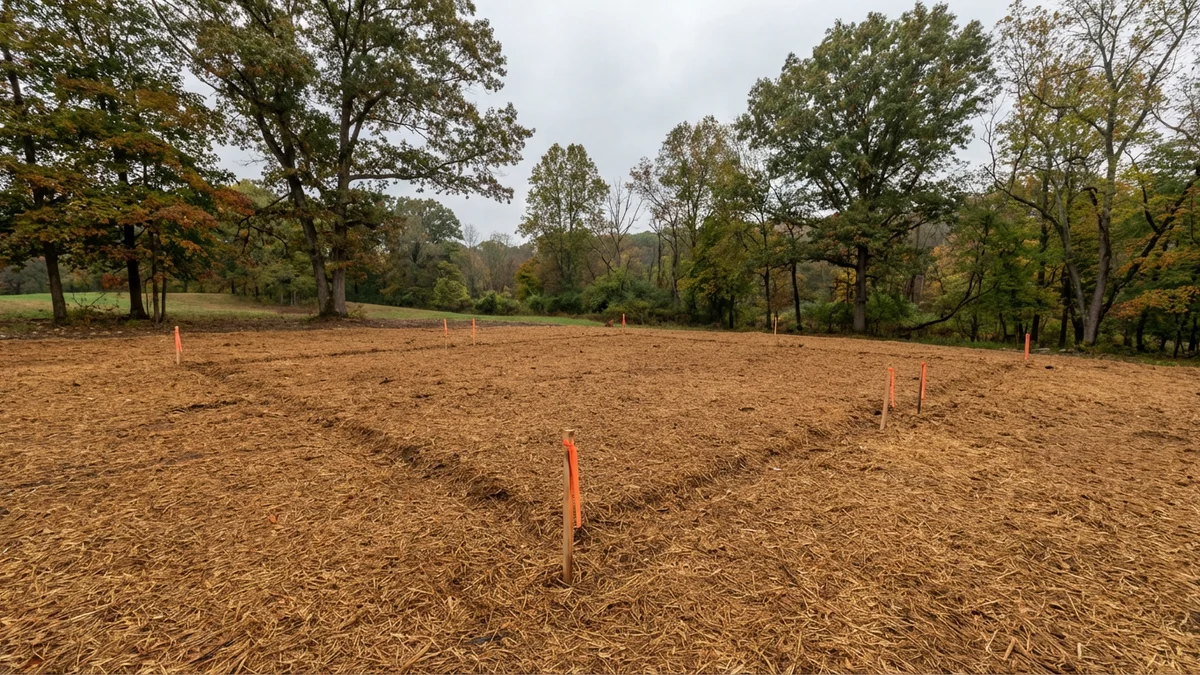
What gets cleared on a building lot
The clearing scope on a residential lot depends on the building plan, but it almost always includes more area than just the house footprint. You need to clear the building envelope (the house plus 10–15 feet on all sides for equipment access and scaffolding), the driveway from the road to the house, the septic field area (if not on public sewer), the well location (if not on public water), and any grading transitions between the house pad and the existing grade.
In our service area, that typically means clearing a half acre to two acres on lots that may be three to ten acres total. The rest of the property stays wooded or undisturbed. This is where selective clearing matters — you want the building zone opened up while preserving the trees that give the lot its value and privacy.
On lots in Flemington, Hillsborough, and the growing parts of Mount Olive, the remaining vacant lots are the ones previous developers skipped — steep terrain, rocky ground, awkward access. The clearing phase on these lots often reveals conditions (shallow bedrock, seasonal wet spots, steep subgrades) that affect the building plan. Better to find them during clearing than after excavation starts.
The order of operations
The clearing phase sits between “you own the lot” and “the builder mobilizes.” Here’s the correct sequence:
Step 1: Survey. Know exactly where your property lines are. The surveyor stakes the corners and the building envelope. Without this, the clearing crew doesn’t know where to stop.
Step 2: Call 811. Non-negotiable. Dial 811 or visit nj1call.org at least 3 business days before clearing. Utility companies mark underground gas, electric, water, sewer, and telecom lines for free. Even though forestry mulching doesn’t dig, the machine’s tracks compact ground over shallow lines, and the operator needs to know where they run.
Step 3: Identify trees to preserve. Walk the lot with the clearing crew AND the builder. Flag every tree that should stay — for privacy screening, shade, aesthetics, or because the municipality requires it. This needs to happen before the machine enters the property, not after.
Step 4: Clear. Forestry mulching handles the building envelope, driveway corridor, septic area, and utility runs. The mulch layer covers the cleared ground and prevents erosion until construction begins.
Step 5: Let the builder assess. Once the site is cleared, the builder (and often a soil engineer) can see the actual ground conditions — rock, wet areas, grade changes — and finalize the foundation design, grading plan, and drainage strategy.
Step 6: Excavation and grading. This is the builder’s phase. The cleared, mulched surface gives the excavator a stable work platform. The mulch can be scraped into the grading fill or pushed to the edges of the building zone.
The gap between clearing and excavation can be days or months depending on the permit timeline. The mulch layer protects the site during that gap — no erosion, no regrowth, no re-clearing needed.
Permits and regulations for building lots in NJ
The clearing itself typically doesn’t need a separate permit on most residential lots in New Jersey — it’s considered site preparation under the broader building permit. But there are layers to check:
Highlands Act. If your lot is in the Highlands Preservation Area, the building project (not just the clearing) needs a Highlands Applicability Determination from NJ DEP. Routine vegetation management for site prep is generally folded into the construction approval. Lots in High Bridge, western Roxbury, and northern Lebanon Township are the most likely to have Preservation Area coverage in our service area.
Municipal tree ordinances. Some municipalities — Mendham, Bernardsville, Bridgewater — regulate removal of trees above a certain diameter. On a building lot, tree removal may require a permit or replacement planting. Check with your municipal zoning office.
Wetlands and buffers. If the lot contains mapped wetlands or borders a stream, clearing within the buffer zone is restricted. NJ DEP riparian buffers extend 50–300 feet from waterways depending on classification. Your builder’s site engineer should identify these before clearing begins.
Soil erosion and sediment control. NJ requires a soil erosion and sediment control plan for any project disturbing more than 5,000 square feet. Your builder typically handles this as part of the construction permit application. Forestry mulching helps satisfy these requirements because the mulch layer itself is an erosion control measure.
What clearing costs for a building lot in NJ
Clearing a residential building lot in New Jersey with forestry mulching typically costs $2,500 to $8,000 depending on the area to clear, vegetation density, and terrain. Here’s how it breaks down:
A half-acre clearing on flat ground with moderate brush runs $2,500 to $4,000. A one-to-two-acre clearing with denser growth or slope runs $4,000 to $7,000. Lots with significant rock — like the limestone terrain in Oxford — or extreme slope — like the Watchung ridge in Bridgewater — add 30–50% for slower equipment operation.
This is typically a fraction of the overall construction budget, but it’s also the one phase where the wrong method choice can create expensive downstream problems. Bulldozing strips the topsoil and creates erosion that the builder has to fix. Hand clearing on anything over a quarter acre takes weeks and costs three to five times more. Forestry mulching gets the lot cleared in one to three days, preserves the topsoil, and leaves the site stable.
For builders and developers working on multiple lots, we offer project pricing across subdivisions. See our builders and developers page for more on multi-lot coordination.
Why forestry mulching is the right method for lot prep
Every clearing method has a context where it’s the right choice. For residential lot prep in New Jersey, forestry mulching wins on four counts:
Topsoil stays. The mulcher processes vegetation at ground level without disturbing the soil underneath. On NJ’s thin Highlands soils and clay-heavy valley floors, preserving topsoil means less fill import, less grading cost, and better drainage performance for the finished lot.
Erosion control is built in. The mulch layer covers the cleared ground from the moment the machine passes. On lots that sit for months between clearing and construction start, this prevents the washouts and rutting that plague bulldozed sites after spring rains.
Selective preservation. The operator can work within inches of trees you want to keep. On lots where the builder’s plan preserves a tree line or screening buffer along the property boundary, this precision is essential.
One-pass, no debris. No brush piles to burn or haul. No chipper crew. No secondary cleanup. The site is cleared and stable in a single operation. The builder can mobilize directly onto the mulched surface.
Common Questions
How much does it cost to clear a building lot in New Jersey?
Clearing a building lot costs $2,500–$8,000 depending on scope. A half-acre on flat ground runs $2,500–$4,000. Get a free estimate for your lot.
Do I need a permit to clear a building lot in NJ?
Clearing usually falls under the construction permit. Check for Highlands Act coverage, tree ordinances, and wetland buffers. Your builder’s application typically covers clearing.
Should I clear the lot before or after getting a building permit?
Clearing can happen before or during the permit process, but survey first. Some municipalities require the building permit before site work. Check with your zoning office.
How long does it take to clear a building lot in NJ?
Most building lots take 1–3 days with forestry mulching. Heavy vegetation, steep terrain, or rock adds time. We provide timelines with every quote.
What should I clear and what should I leave?
Clear the building envelope, driveway, septic area, and grading zones. Leave boundary trees, required preservation trees, and anything outside the construction zone. Walk the lot with the clearing crew and builder beforehand.
Should I call 811 before clearing a building lot?
Yes — call 811 at least 3 business days before clearing. It’s free, required by law, and marks all underground utility lines on your lot.
Can I clear the lot myself?
For anything beyond a quarter acre of woody growth, you need professional equipment. Renting without experience is dangerous, especially on slopes. Get a free estimate.
How do I coordinate clearing with my builder?
Survey → clear → builder assesses. Share the builder’s site plan with us during the estimate. On tight timelines, we coordinate directly with your builder.
Will the mulch interfere with construction?
No — mulch can be scraped aside, mixed into fill, or pushed to the edges when excavation starts. It provides a more stable work surface than bare soil.
What happens if clearing reveals rock or wet conditions?
Discovery during clearing saves money. Shallow bedrock and wet spots are common on undeveloped NJ lots — finding them early avoids expensive redesign during excavation.
Related Services
Land Clearing / Lot Prep
Residential and small commercial lots cleared and prepped for building, grading, or landscaping.
Relevant City Pages
These city pages are a good fit if you want to compare the article advice with the kind of properties we see on the ground.
Helpful Resources
Builders & Developers
Related Articles
Do You Need Permits for Land Clearing in New Jersey?
Do you need a permit to clear land in New Jersey? Learn when tree ordinances, wetlands, and the Highlands Act can affect your project.
Land Clearing Cost Per Acre in New Jersey: Pricing Guide
New Jersey land clearing cost per acre explained: method, terrain, tree size, access, and how to compare quotes without getting burned.
See Land Clearing Cost Per Acre in New Jersey: Pricing Guide
Want the full New Jersey land clearing playbook?
This article covers one piece of the puzzle. The complete guide ties together methods, costs, permits, terrain, and contractor selection in one place.
Got a lot that needs clearing before your build?
We coordinate with builders, preserve the trees that matter, and leave a stable site. Free estimates.
Or call (908) 774-9235.