

Home / Field Notes — Land Clearing Knowledge Base / Clearing Land for a Pole Barn in New Jersey
Clearing Land for a Pole Barn in New Jersey
Published April 5, 2026 by Brush Busters • Last reviewed April 5, 2026
Pole barns and post-frame buildings are the most common outbuilding type on rural properties in Hunterdon, Warren, Somerset, and Morris counties. They’re used for equipment storage, workshops, livestock shelters, hay barns, and increasingly for garages and hobby buildings on residential properties. Every one of them starts with the same problem: the site where you want the building is overgrown.
Pole barn site prep is a different job than residential lot clearing. The building itself has different ground requirements (pole barns don’t need a continuous foundation — they’re post-set), the sites are typically rural with easier access, and the surrounding property often needs additional clearing for turnaround space, drainage, and approach roads. Here’s the full picture for NJ.
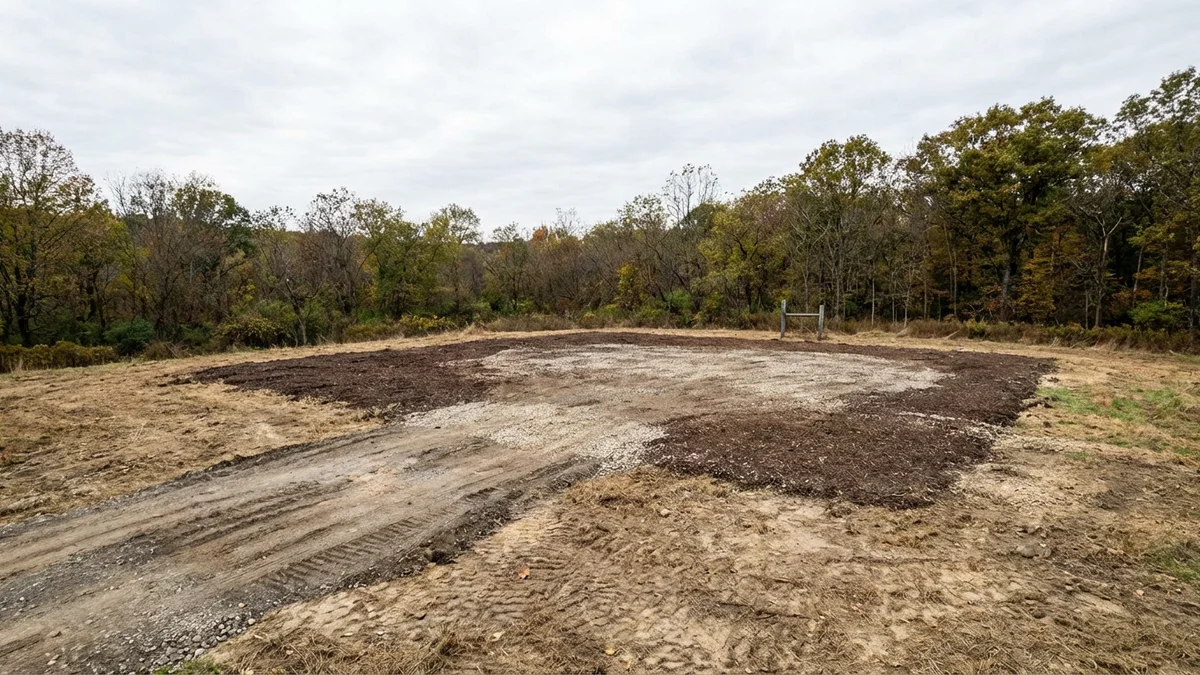
What needs to be cleared
The building footprint plus a working perimeter. A standard 30×40 pole barn needs at least a 50×60 cleared area — the building footprint plus 10 feet on all sides for the builder’s equipment, material staging, and post-hole drilling access. Larger buildings need proportionally larger clearing zones.
The approach road. On rural NJ properties, the pole barn is often set back 100–500 feet from the road, behind the house or in a separate area of the property. You need a cleared path at least 14–16 feet wide for delivery trucks (lumber, trusses, metal panels) and equipment (concrete trucks, telehandlers). On properties in Lebanon Township, Alexandria, and Mansfield, this approach road through wooded property is often the most significant part of the clearing job.
Turnaround space. Delivery trucks need room to turn around — they’re not backing a 40-foot flatbed out through 300 feet of woods. A cleared turnaround area near the building site, roughly 40×40 feet, gives trucks room to swing. This area often doubles as the gravel pad in front of the barn doors.
Drainage and grading zone. Pole barns need positive drainage away from the building. Depending on the site’s natural grade, you may need to clear additional area for the grading contractor to establish the drainage pattern. On flat or low-lying sites in Pohatcong and the valley-floor areas, this means ensuring water flows away from the barn rather than pooling around the posts.
Pole barn site prep vs. house site prep
The key difference: pole barns are more forgiving of imperfect ground conditions than houses.
A house with a continuous foundation needs a level pad with compacted fill and precise grading. A pole barn sets posts into the ground (typically 4–6 feet deep) and the floor is usually compacted gravel or a concrete slab poured after the frame is up. This means:
The surface doesn’t need to be graded to the same tolerance. Gentle slopes can be accommodated by varying the post depth. Rough mulched ground is an acceptable starting surface — the builder works on it directly.
The soil doesn’t need the same load-bearing capacity as a foundation. The posts transfer the building’s weight deep into the ground, so the surface soil conditions matter less than for a slab-on-grade house.
Rock is less of a problem. Post-hole augering through rock is common on rural NJ properties and pole barn builders expect it. You don’t need to remove subsurface rock — you just need the surface cleared.
All of this means forestry mulching is an especially clean fit for pole barn prep. Clear the vegetation, leave the mulch, and the builder mobilizes directly onto the mulched surface.
Costs for pole barn site clearing
Site clearing for a standard pole barn project in NJ typically breaks down as follows:
| Component | Typical cost |
|---|---|
| Building footprint + perimeter (half to one acre) | $1,500–$3,500 |
| Approach road (100–500 linear feet) | $500–$2,000 |
| Turnaround area | $500–$1,000 |
| Total | $2,500–$6,500 |
Properties with lighter brush (less than 5 years of regrowth) fall on the low end. Properties with dense saplings, multiflora rose, and established trees push toward the high end. Rocky terrain in Oxford and steep terrain add 30–50%.
Compare this to the pole barn itself, which typically costs $25,000 to $75,000+ depending on size, finish, and features. The clearing is 5–10% of the building cost — and getting the site properly prepared saves the builder time and you money.
NJ regulations for pole barns
Building permit. Most NJ municipalities require a building permit for pole barns and post-frame buildings, even on agricultural land. The permit requirement typically applies to structures over a certain square footage (commonly 100–200 sq ft). Check with your municipal building department.
Agricultural exemption. On farmland-assessed properties, agricultural buildings used exclusively for farming purposes may be partially exempt from certain building code requirements under the NJ Right to Farm Act. However, a permit is still typically required. The exemption affects code compliance requirements, not the permit itself.
Setbacks. Pole barns must comply with zoning setback requirements — distance from property lines, road frontage, and other structures. Setback distances vary by municipality and zone. This affects WHERE you place the building, which in turn determines WHERE you clear. Get your zoning setbacks before planning the clearing.
Highlands. On lots in the Highlands Preservation or Planning areas, the pole barn may trigger review depending on size and use. Agricultural buildings on agricultural land are treated differently than residential accessory structures. Check the Highlands Act applicability for your parcel.
Common Questions
How much does it cost to clear land for a pole barn in NJ?
Total clearing for a pole barn project runs $2,500–$6,500 including the building footprint, approach road, and turnaround. Get a free estimate.
Do I need to remove stumps for a pole barn?
Usually no — pole barns set posts between stumps. Forestry mulching grinds everything to ground level, which is sufficient. If pouring a concrete slab, large stump remnants in the slab area may need removal.
Can I put a pole barn on a slope?
Yes — post depths can be varied to level the building on a slope. A gentle slope actually helps drainage. Clearing reveals the true grade for the builder’s plan.
How wide does the access road need to be?
Minimum 14–16 feet wide for trucks and equipment. Widen curves to 20 feet for turning radius. The mulched surface serves as a base for permanent gravel.
Do I need a permit for a pole barn in NJ?
Most NJ municipalities require a permit. Agricultural buildings may have partial code exemptions. Check with your building department. Read our permits guide.
Can you clear in winter for a spring pole barn build?
Winter clearing is ideal — frozen ground, dormant vegetation, and months of lead time before spring construction. Read our seasonal guide.
Will the mulch settle enough for gravel to go over it?
Yes — mulch compacts over 4–8 weeks. Gravel lays directly over mulch for roads and pads. Builders typically work directly on the mulched surface.
How long does pole barn site clearing take?
Building footprint and turnaround: one day. Add half to a full day for a long approach road. Most projects take 1–2 days total.
Related Services
Land Clearing / Lot Prep
Residential and small commercial lots cleared and prepped for building, grading, or landscaping.
Right-of-Way Clearing
Keep easements, utility corridors, private roads, and long access runs open, visible, and easier to maintain.
Relevant City Pages
These city pages are a good fit if you want to compare the article advice with the kind of properties we see on the ground.
Related Articles
Clearing Land for Home Building in New Jersey
Complete guide to clearing a residential lot for new construction in New Jersey. Site prep costs, permits, Highlands Act, 811, and what to do before the builder shows up.
Cutting a Driveway Through Wooded Property in New Jersey
How to clear a driveway or access road through wooded land in New Jersey. Route planning, width, costs, permits, and why the mulched surface works as a road base.
See Cutting a Driveway Through Wooded Property in New Jersey
Want the full New Jersey land clearing playbook?
This article covers one piece of the puzzle. The complete guide ties together methods, costs, permits, terrain, and contractor selection in one place.
Building a pole barn? We clear the site.
Footprint, approach road, turnaround — one to two days, clean ground for your builder. Free estimates.
Or call (908) 774-9235.