

Home / Field Notes — Land Clearing Knowledge Base / Clearing Land for a Pond in New Jersey
Clearing Land for a Pond in New Jersey
Published April 8, 2026 by Brush Busters • Last reviewed April 8, 2026
A pond starts as a hole in the ground, but the work starts long before that — with clearing the site and getting heavy equipment to it. On rural properties in Hunterdon, Warren, and Somerset counties, the best pond sites are often in the lowest part of the property where natural drainage concentrates. That’s also where the vegetation is thickest — Japanese knotweed along the drainages, multiflora rose on the banks, and a tangle of wild grape and sapling growth choking whatever gap the water carved. Before the excavator can dig, all of that has to come off.
Pond site clearing isn’t just about removing brush from the hole. You’re clearing the dig zone, the spoil staging area (where the excavated soil goes), the dam footprint (if it’s a dammed pond), and the access corridor for the excavator and dump trucks. Here’s the full scope for NJ.
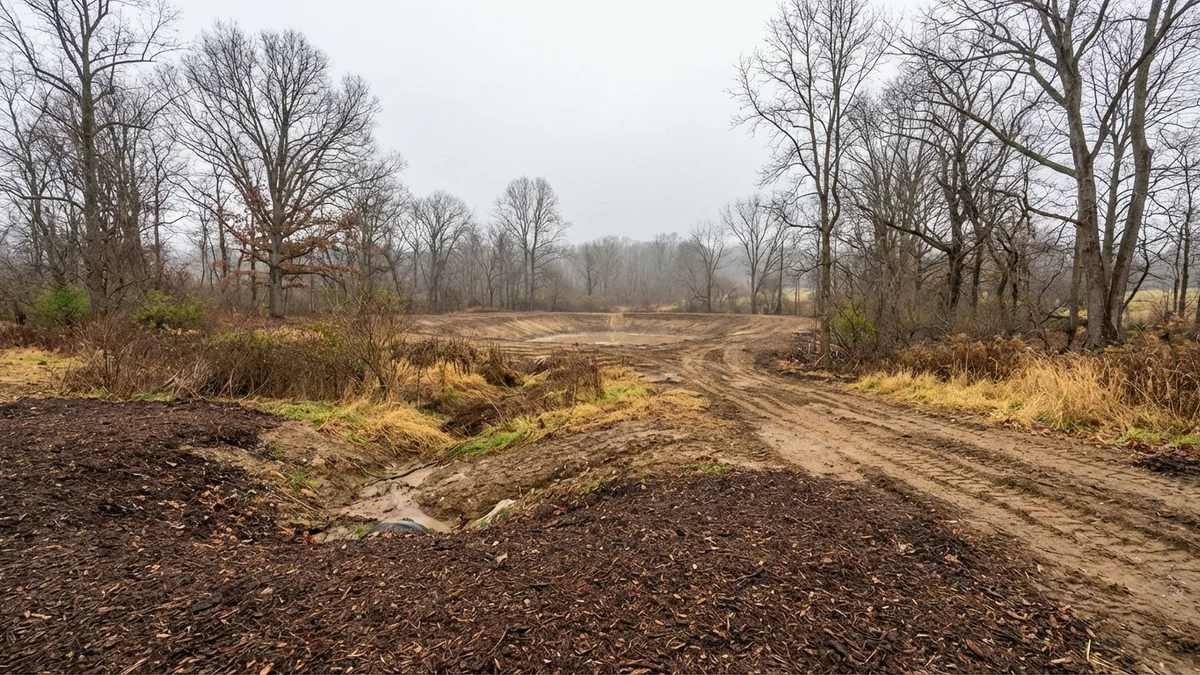
What needs to be cleared
The pond footprint plus the dam zone. A typical farm pond in NJ is a quarter acre to one acre of water surface. The clearing zone is larger — you need to clear the full pond outline plus 20–30 feet beyond the water’s edge for the excavator to work around the perimeter. If the pond is dammed (built across a drainage draw), the dam footprint adds another 30–60 feet of clearing downstream.
Spoil staging area. Excavating a pond generates a massive volume of soil. A quarter-acre pond, 8 feet deep, produces roughly 3,000 cubic yards of material — enough to fill 300 dump trucks. Most of that stays on-site, spread in a designated spoil area adjacent to the pond. That area needs to be cleared and accessible.
The excavator access road. The machine that digs the pond is typically a 30–40 ton hydraulic excavator — larger than what most property owners expect. It needs a cleared path at least 14 feet wide from the nearest road to the pond site. On properties in Lebanon Township, Alexandria, and Delaware Township, this access road through wooded terrain can be the longest and most expensive part of the clearing job.
The surrounding buffer. Most pond designers recommend clearing 30–50 feet around the pond perimeter to reduce leaf litter input (which degrades water quality), provide sunlight exposure (which promotes healthy water temperature and plant growth), and give access for future maintenance.
Pond site selection and what clearing reveals
The best pond site on a property is determined by three factors: drainage pattern, soil type, and terrain. You won’t fully understand any of them until the brush is removed.
Drainage. Ponds need water. The best sites are in natural drainage draws where surface runoff concentrates. Clearing the draw reveals how water moves across the property — where the flow lines are, how steep the banks are, and whether there’s enough watershed above the site to keep the pond full. On properties with multiple potential sites, clearing two or three candidate areas before the pond designer visits gives more options.
Soil. Ponds need clay-heavy soil in the bottom and dam to hold water. Sandy or rocky soils leak. The pond contractor evaluates soil by digging test pits after the site is cleared. In our service area, the valley-floor soils in Pohatcong and Mansfield tend to have good clay content. The ridgetop soils in Oxford and the Highlands towns are thinner and rockier — not impossible for ponds but more challenging.
Terrain. The ideal pond site has a gentle slope with a natural low point — a bowl or draw. Steep terrain means more excavation and more dam engineering. Clearing reveals the actual contour of the ground, which the pond designer needs to calculate the cut-and-fill volumes and the dam height.
Costs for pond site clearing
| Component | Typical cost |
|---|---|
| Pond footprint + perimeter (0.5–1.5 acres) | $2,000–$5,000 |
| Spoil staging area | $500–$1,500 |
| Access road (100–500 linear feet) | $500–$2,000 |
| Total | $3,000–$8,500 |
Compare this to the pond excavation itself, which typically costs $8,000 to $25,000+ depending on size and dam requirements. Clearing is 15–25% of the overall pond budget — a significant portion, driven mainly by the access road on remote sites.
Properties with existing access to the pond site (an old farm lane, a field edge road) cut the access road cost to near zero.
NJ regulations for ponds
Dam safety. NJ DEP regulates dams under the Dam Safety Standards (N.J.A.C. 7:20). Any dam that impounds water above natural ground level may be subject to dam safety review depending on height and storage volume. Small farm ponds with low dams (under 5 feet of impoundment height) are often exempt, but confirm with NJ DEP before construction.
Wetlands. If the pond site is in or near a mapped wetland, you need NJ DEP freshwater wetlands approval. Clearing within the wetland or its buffer zone (50–150 feet, potentially 300 feet from C1 waterways) is restricted. Forestry mulching is more compatible with buffer zones than bulldozing because it doesn’t expose bare soil, but “compatible” doesn’t mean “unrestricted.” Get a wetland delineation if there’s any question.
Stormwater. Ponds that intercept stormwater runoff may be subject to NJ stormwater management regulations depending on the project’s overall scope. If the pond is part of a larger development project, the engineer handles this. Standalone farm ponds on existing agricultural land are generally simpler.
Highlands. On Preservation Area properties, the pond may be reviewed as part of the broader land use. On Planning Area properties, municipal conformance with the Highlands Regional Master Plan applies.
Fish stocking. If you plan to stock the pond, NJ Division of Fish and Wildlife has stocking regulations and may require a permit for certain species. This doesn’t affect clearing, but it’s worth knowing early.
Why forestry mulching is the right method for pond prep
Pond sites are typically in the lowest, wettest, most erosion-prone areas of a property — exactly where soil disturbance is most harmful and most regulated.
Forestry mulching clears the vegetation without exposing bare soil. The mulch layer that’s left behind prevents erosion on the slopes around the future pond, stabilizes the access road surface, and keeps the cleared spoil staging area from washing away in the first rain. On pond sites adjacent to streams or wetland buffers, the no-soil-disturbance characteristic of forestry mulching is often what keeps the project within NJ DEP’s comfort zone.
Bulldozing a pond site before the excavator arrives exposes all that soil to the elements — and on a drainage-draw site, the first storm washes that soil directly into the waterway you’re building beside. That’s a sediment violation waiting to happen.
Common Questions
How much does it cost to clear land for a pond in NJ?
Total pond site clearing runs $3,000–$8,500 including dig zone, staging, and access road. Existing access saves significantly. Get a free estimate.
Do I need a permit to build a pond in NJ?
Depends on size, dam height, and location. Small farm ponds are often exempt from dam safety review. Ponds near wetlands need DEP approval. Check with NJ DEP and your municipality.
Should I clear before the pond designer visits?
Yes — the designer needs to see terrain, drainage, and soil. Clear first so they can evaluate real conditions instead of guessing what’s under the brush.
How wide does the access road need to be for a pond excavator?
Minimum 14 feet for the excavator, 16–18 feet if dump trucks use it too. Widen curves to 20 feet. The mulched surface serves as a stable road.
How long does pond site clearing take?
Pond footprint and perimeter: one day. Add half to a full day for a long access road. Most projects take 1–2 days.
Can you clear near a stream for a pond site?
We can, but riparian buffers apply. Forestry mulching is buffer-compatible because it doesn’t expose soil. Get a wetland delineation before clearing near waterways.
What happens to the mulch where the pond will be dug?
The excavator removes it with the soil during digging — not an extra step. On the access road and staging area, the mulch stays and prevents erosion.
What's the best time of year to clear for a pond?
Late fall and winter — firm ground and the site is ready for spring excavation. Avoid wet spring clearing on low-lying pond sites. Read our seasonal guide.
Related Services
Land Clearing / Lot Prep
Residential and small commercial lots cleared and prepped for building, grading, or landscaping.
Right-of-Way Clearing
Keep easements, utility corridors, private roads, and long access runs open, visible, and easier to maintain.
Relevant City Pages
These city pages are a good fit if you want to compare the article advice with the kind of properties we see on the ground.
Related Articles
Clearing Land for Home Building in New Jersey
Complete guide to clearing a residential lot for new construction in New Jersey. Site prep costs, permits, Highlands Act, 811, and what to do before the builder shows up.
Want the full New Jersey land clearing playbook?
This article covers one piece of the puzzle. The complete guide ties together methods, costs, permits, terrain, and contractor selection in one place.
Planning a pond? The site needs clearing first.
Dig zone, spoil area, and access road — we prep the site so your excavator can work. Free estimates.
Or call (908) 774-9235.