

Home / Field Notes — Land Clearing Knowledge Base / Cutting a Driveway Through Wooded Property in New Jersey
Cutting a Driveway Through Wooded Property in New Jersey
Published April 6, 2026 by Brush Busters • Last reviewed April 6, 2026
You own the land but you can’t get to it. This is one of the most common situations we encounter on undeveloped rural parcels in Hunterdon, Warren, and Morris counties. The property has road frontage, technically — maybe a farm gate or an old logging road entrance — but between the road and the interior of the property is 200 to 1,000 feet of dense woods and brush that hasn’t been passable in years.
Cutting an access road is almost always the first step before anything else can happen on a property: before building, before clearing the interior, before the surveyor can reach the back boundary, before the soil scientist can test for septic. If the equipment can’t get in, nothing else starts.
Planning the route
Don’t just aim for the shortest line between the road and your destination. The best driveway route accounts for five factors:
Grade. A driveway grade over 12–15% is uncomfortable to drive and erodes in heavy rain. If the direct route climbs a steep hill, a switchback or angled approach that traverses the slope at a gentler grade may add length but saves the road surface. On properties in High Bridge and the Highlands terrain of Roxbury, grade management is the primary route consideration.
Drainage. Water follows driveways — it runs down them, pools in low spots, and undercuts the surface. Route the driveway to cross drainage draws at an angle (not parallel to the flow) and include high points or crowning that sheds water to the sides. Avoid routing through the lowest part of the property unless there’s no alternative.
Trees worth keeping. A driveway that curves around a 200-year-old white oak looks better and adds value compared to one that goes straight through where the tree stood. During the estimate, we walk the route and identify trees that the driveway should work around.
Soil and rock. The mulched surface from forestry mulching compacts into a firm driveway base, but some soils perform better than others. Sandy and rocky soils drain quickly and support weight well. Clay soils hold water and rut in wet seasons. If the route crosses a known wet area, plan for gravel surfacing or a culvert crossing.
Future use. If the driveway will eventually serve a house, a pole barn, or regular vehicle traffic, build it to finished standards from the start — 14 to 16 feet wide with gentle curves. If it’s temporary access for a construction project or seasonal hunting use, 10 to 12 feet is adequate.
Width, clearance, and surface
Standard residential driveway: 14 to 16 feet wide cleared width. This accommodates a pickup truck with room to open doors, and allows two vehicles to pass if one pulls to the shoulder. Emergency vehicles (fire trucks, ambulances) typically need a minimum 12-foot clear width and 14 feet of vertical clearance.
Construction access: 16 to 20 feet wide. Concrete trucks, lumber delivery flatbeds, and excavators need wider clearance, especially on curves. If the driveway will serve a building project, clear to construction width from the start — widening later after the driveway surface is established is more disruptive than doing it right the first time.
Seasonal/recreational access: 10 to 12 feet wide. Adequate for ATVs, UTVs, and single-vehicle passage to a hunting camp, recreational area, or back acreage that doesn’t need daily access.
Vertical clearance: Clear overhead branches to at least 14 feet. This accommodates delivery trucks and emergency vehicles. The mulcher handles everything at ground level; overhead branches above the machine’s reach may need chainsaw trimming.
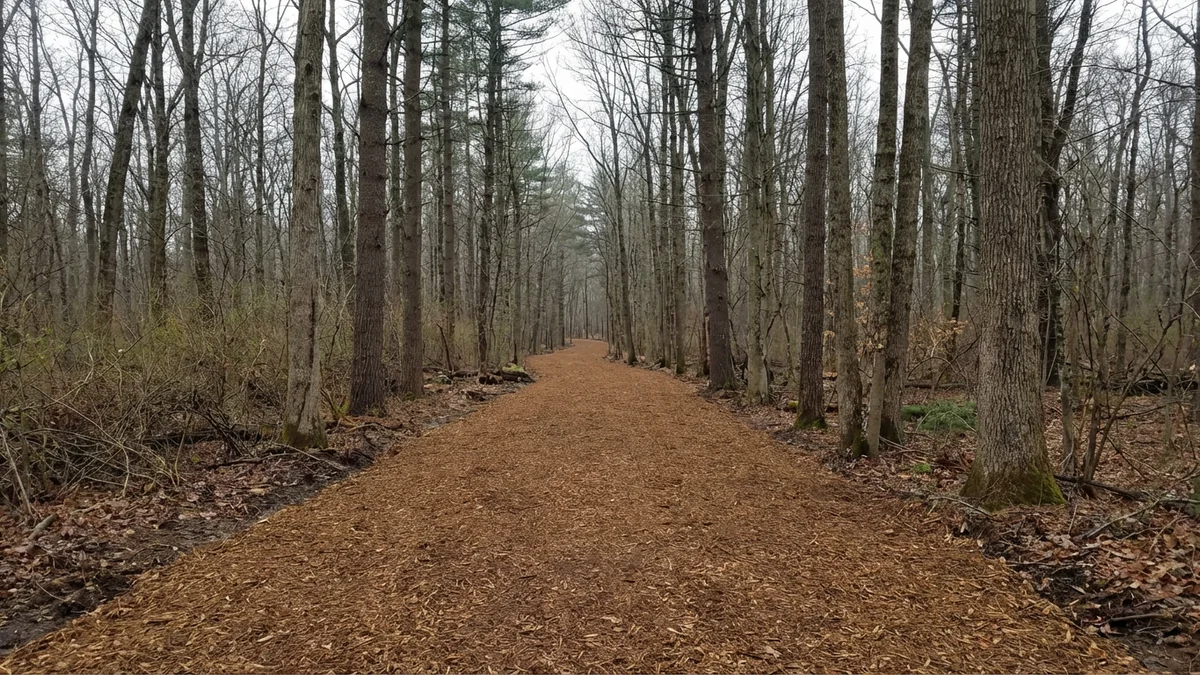
The mulch surface. After clearing, the driveway is covered in a two-to-four-inch layer of shredded wood mulch. This is immediately drivable — you can drive a pickup truck on it the same day. Over time (four to eight weeks of traffic and weather), the mulch compacts into a firm, stable surface. For permanent driveways, lay gravel over the compacted mulch — the mulch acts as a stabilization layer under the gravel, reducing how much gravel you need and preventing it from sinking into soft soil.
Costs for driveway clearing in NJ
Driveway clearing is priced by linear footage rather than acreage because the width is fixed and the length varies.
| Driveway type | Cost per 100 ft | Notes |
|---|---|---|
| Light brush, flat terrain | $200–$400/100 ft | Saplings, low shrubs, easy going |
| Moderate brush, gentle grade | $400–$700/100 ft | Autumn olive, rose, some larger stems |
| Dense woods, steep or rocky | $700–$1,200/100 ft | Larger trees, slope work, rock navigation |
A typical 300-foot residential driveway through moderate brush runs $1,200 to $2,100. A 500-foot driveway through heavy woods on hilly terrain runs $3,500 to $6,000. Properties with very long access roads — 1,000 feet or more through dense growth — are quoted as full project prices after the site visit.
The driveway clearing cost is often combined with whatever else you’re clearing at the destination (building site, pond site, barn pad). A single mobilization for the whole project is more cost-effective than separate trips.
NJ regulations for driveways
Driveway permits. Most NJ municipalities require a driveway opening permit (also called a curb cut or road opening permit) for new driveway connections to a public road. This regulates where the driveway meets the road, sight-line requirements, and drainage. The clearing of the driveway corridor through your own property doesn’t require a separate permit — it’s the road connection that triggers the permit.
Highlands. On Highlands Preservation Area parcels, a new driveway associated with new construction may be included in the Highlands Applicability Determination. A driveway to access existing agricultural land for management purposes is generally treated as routine activity.
Wetlands and streams. If the driveway route crosses a stream or mapped wetland, you may need a NJ DEP stream crossing permit or wetland permit. Forestry mulching can clear the approach on both sides of the crossing; the crossing itself (culvert, bridge, ford) is a separate engineering and permitting question.
Tree ordinances. If your route requires removing mature trees in a municipality with a tree ordinance, check permit requirements. The clearing crew can work around protected trees, but the driveway designer needs to know the constraints before finalizing the route.
Common Questions
How much does it cost to clear a driveway through woods in NJ?
Driveway clearing runs $200–$1,200 per 100 linear feet. A typical 300-foot driveway costs $1,200–$2,100. Get a free estimate for your property.
Can I drive on the mulch right away?
Yes — immediately drivable. The mulch compacts over 4–8 weeks. For permanent driveways, add gravel over the compacted mulch as a base layer.
How wide should the driveway be?
14–16 feet for residential, 16–20 feet for construction access, 10–12 feet for seasonal use. Build to the widest anticipated use from the start.
Do I need a permit to clear a driveway on my own property?
Clearing on your property typically doesn’t need a permit. The road connection needs a municipal driveway/curb cut permit. Stream crossings or protected trees may need permits.
Can you cut a driveway through steep terrain?
Yes — our tracked equipment handles slopes up to 45%. We traverse steep terrain at an angle for a drivable grade. Learn about our hillside clearing.
How long does driveway clearing take?
A 300-foot driveway takes half a day to one day. We usually combine it with clearing at the destination in one mobilization.
Should I clear the driveway before the surveyor comes?
Yes — surveyors need access to boundary pins. A cleared corridor saves them time and you money. More on clearing for surveyors.
What if the driveway needs to cross a wet area?
We clear to both edges. The crossing structure (culvert, ford, bridge) is a separate step. Mapped streams or wetlands may need NJ DEP permits for the crossing itself.
Related Services
Right-of-Way Clearing
Keep easements, utility corridors, private roads, and long access runs open, visible, and easier to maintain.
Land Clearing / Lot Prep
Residential and small commercial lots cleared and prepped for building, grading, or landscaping.
Relevant City Pages
These city pages are a good fit if you want to compare the article advice with the kind of properties we see on the ground.
Related Articles
Clearing Land for Home Building in New Jersey
Complete guide to clearing a residential lot for new construction in New Jersey. Site prep costs, permits, Highlands Act, 811, and what to do before the builder shows up.
Clearing Land for a Pole Barn in New Jersey
How to clear and prep a site for a pole barn or outbuilding in New Jersey. Costs, grading, drainage, access roads, and what your builder needs from you.
Want the full New Jersey land clearing playbook?
This article covers one piece of the puzzle. The complete guide ties together methods, costs, permits, terrain, and contractor selection in one place.
Can't get to your property? We cut the road.
Access roads through woods, from 200 feet to half a mile. Drivable the same day. Free estimates.
Or call (908) 774-9235.