
Home / Field Notes — Land Clearing Knowledge Base / Poison Ivy Removal in New Jersey
Poison Ivy Removal in New Jersey
Published April 7, 2026 by Brush Busters • Last reviewed April 7, 2026
Poison ivy (Toxicodendron radicans) grows on virtually every property in New Jersey — from the most suburban quarter-acre lot in Bridgewater to the most remote ten-acre parcel in Lebanon Township. It’s native, it’s aggressive, and the urushiol oil it produces causes allergic contact dermatitis in roughly 85% of people. That reaction ranges from mild itching to severe blistering that sends people to urgent care.
The reason poison ivy is relevant to land clearing: it’s often the vegetation that makes property owners realize they have a clearing problem. The backyard that used to be walkable now gives someone a rash every time they step off the mowed edge. The fence line is untouchable. The trail through the woods is lined with three-leafed ground cover. Poison ivy is the species that turns a neglected lot from “I should deal with this” into “I need to deal with this now.”
Identifying poison ivy in NJ
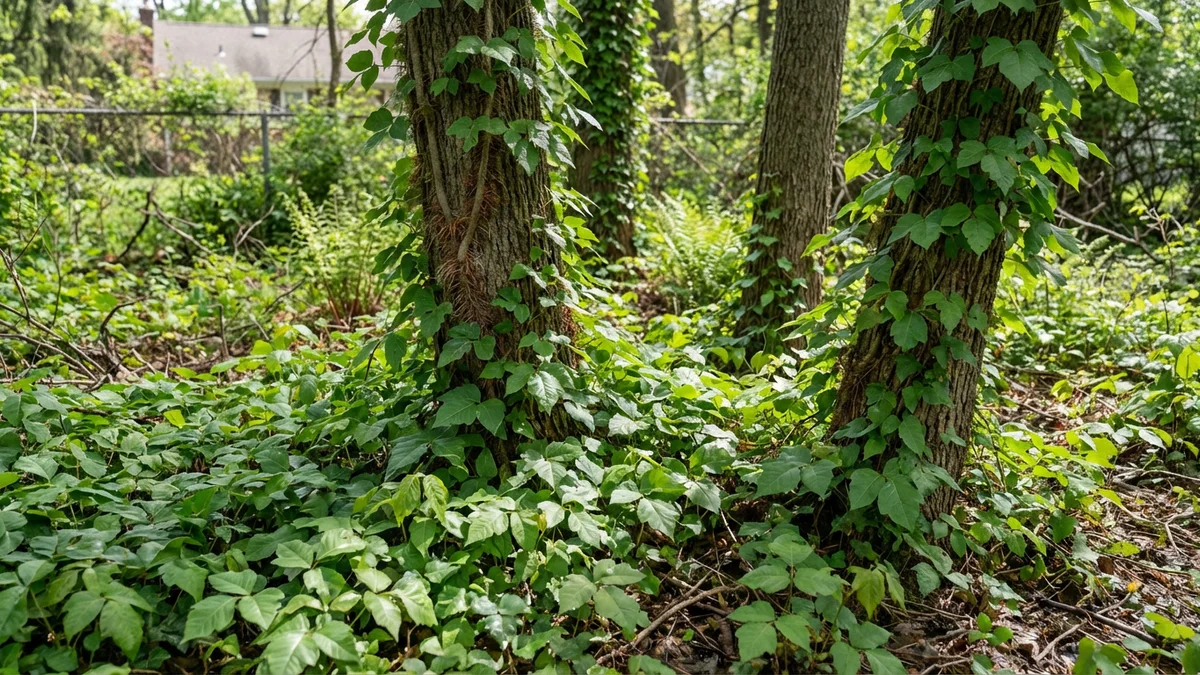
“Leaves of three, let it be” is the starter rule, but it’s not enough. Several harmless plants have three-leaflet leaves (box elder seedlings, Virginia creeper at certain growth stages, raspberry). Here’s how to positively identify poison ivy:
Leaf shape. Three leaflets per leaf. The center leaflet has a longer stem (petiole) than the two side leaflets. Leaf margins may be smooth, toothed, or lobed — they vary even on the same plant. The leaves are glossy in spring (often with a reddish tint), matte green in summer, and yellow-orange-red in fall.
Growth forms. Poison ivy takes three forms in NJ, and you may see all three on the same property: – Ground vine: Low-growing, spreading across the forest floor and lawn edges. This is what most people encounter first. – Climbing vine: Thick, hairy vines climbing tree trunks. The “hairy rope” aerial rootlets are a dead giveaway — no other common NJ vine has this look. Old climbing vines can reach several inches in diameter. – Shrub form: Upright, bush-like growth two to four feet tall. Common in open areas, field edges, and along roads.
Berries. Small, round, grayish-white berries in clusters. Present in late summer and fall. Birds eat them and spread the plant.
Where it grows. Everywhere. Sun, shade, wet, dry. It’s most abundant at forest edges, along fence lines, on stone walls, and at the base of trees. In our service area, it’s a constant presence on suburban lots backing up to woods and on every rural property with a neglected perimeter.
Why DIY removal is a bad idea at scale
For a single small patch in a garden bed, careful hand removal with full protective clothing is reasonable. For property-wide poison ivy clearing — the kind where it’s in the fence line, climbing trees, covering the forest floor, and mixed into brush thickets — DIY is impractical and dangerous.
Contact risk at scale. Pulling, cutting, or weed-whacking poison ivy at scale creates airborne urushiol particles. The oil persists on clothing, tools, gloves, and equipment for months. One unguarded moment — wiping sweat, adjusting glasses, scratching an itch — and you’ve transferred urushiol to your skin. Even people who have never reacted before can develop sensitivity after repeated exposure.
Burning is worse. Never burn poison ivy. Urushiol vaporizes in smoke and can cause severe respiratory reactions — essentially a poison ivy rash in your lungs. This is an emergency room situation.
It grows back. Cutting poison ivy without treating the root system guarantees regrowth. The vine resprouts from any root fragment left in the soil. Mowing it repeatedly helps over time but doesn’t eliminate it — and every mowing pass sends urushiol-contaminated particles into the air.
Professional removal: what works
Forestry mulching for large areas. The mulcher grinds poison ivy vines, ground cover, and mixed brush to ground level in a single pass. The operator is inside an enclosed cab — no skin contact with the vegetation. The mulch layer covers the root zone and suppresses regrowth. This is the right approach when poison ivy is mixed into a larger clearing job — fence lines, understory clearing, backyard reclamation.
Forestry mulching doesn’t kill the roots. Poison ivy can resprout through mulch from root fragments. However, the regrowth is weaker and easier to manage. Follow-up herbicide treatment (glyphosate or triclopyr applied by a licensed applicator) on any regrowth three to four weeks after mulching finishes the job.
Targeted herbicide for isolated stands. For poison ivy growing on trees you want to keep, in garden beds, or in areas too tight for the mulcher, targeted herbicide application is the most effective standalone method. A licensed applicator sprays or paints the foliage or cut stems. Triclopyr-based herbicides are most effective on poison ivy and can be applied selectively without damaging nearby plants when painted on cut stems.
The combination approach (recommended). Forestry mulching removes the bulk of the vegetation and makes the property usable immediately. Follow-up herbicide on regrowth four to six weeks later kills the remaining root system. This one-two approach clears the property in one day and achieves long-term elimination within one growing season.
Costs
Poison ivy removal is rarely a standalone service — it’s almost always part of a broader clearing job. When you hire us to clear an overgrown backyard, fence line, or wooded understory, the poison ivy comes off with everything else. We don’t charge extra for poison ivy in the clearing zone.
For reference: – Backyard clearing with heavy poison ivy (0.25–1 acre): $1,500–$5,000 – Fence line clearing with poison ivy (200–500 linear feet): $600–$2,000 – Understory clearing for tick/ivy reduction (1–3 acres): $3,000–$8,000 – Herbicide follow-up (licensed applicator, separate from our service): $200–$600 per treatment
If your property’s poison ivy problem is limited to a few trees or a small garden area, a licensed pesticide applicator is more cost-effective than mobilizing clearing equipment.
After removal: preventing regrowth
Poison ivy regrowth comes from two sources: root fragments in the soil and bird-deposited seeds.
Root regrowth appears within weeks of clearing. The sprouts are small, recognizable, and vulnerable. A single herbicide application at this stage kills the root system. Without treatment, the vine reestablishes within one to two growing seasons.
Seed regrowth is slower and less predictable. Birds eat poison ivy berries and deposit seeds across your property. New seedlings appear in random locations. Annual monitoring and spot treatment (pulling small seedlings or spot-spraying) keeps them in check.
Mulch helps. The forestry mulch layer suppresses seed germination by blocking light. Most poison ivy seeds that germinate under mulch don’t reach the surface. This is another reason forestry mulching outperforms hand clearing — the mulch provides ongoing suppression that bare soil doesn’t.
Common Questions
Can forestry mulching remove poison ivy?
Yes — the mulcher grinds it at ground level from inside an enclosed cab. Follow-up herbicide finishes the root system. Learn about our invasive removal approach.
Is poison ivy dangerous during clearing?
Minimal with forestry mulching — the operator is inside an enclosed cab. The urushiol in the mulch degrades over several weeks of sun and rain exposure.
Will poison ivy grow back after mulching?
It can resprout from roots, but the regrowth is weak. One herbicide treatment 3–6 weeks after mulching typically eliminates it permanently.
How much does poison ivy removal cost?
Poison ivy removal is included in clearing — no extra charge. Backyard clearing with heavy ivy runs $1,500–$5,000. Get a free estimate.
Can you remove poison ivy climbing trees I want to keep?
We cut the climbing vine at the base, killing everything above. The dead vine desiccates and drops naturally over several months. No need to pull it from the tree.
Should I burn poison ivy?
Never. Urushiol in the smoke causes severe respiratory reactions. This is an emergency room situation. It’s also illegal without a burn permit.
How do I know if it's poison ivy or something else?
Three leaflets (center on a longer stem), hairy climbing vines, white berries. Not sure? Don’t touch it. Send us a photo and we’ll identify it during the site visit.
When is the best time to remove poison ivy?
For herbicide treatment: late spring through early fall. For clearing: any season. We identify locations during the growing-season estimate.
Related Services
Invasive Species Removal
Japanese knotweed, multiflora rose, mile-a-minute vine, and other NJ invasives eliminated at ground level.
Brush Clearing
Thick undergrowth, vines, and overgrown fence lines cleared down to clean, walkable ground.
Helpful Resources
Homeowners
Related Articles
Tick Prevention Through Land Clearing in New Jersey
Land clearing reduces tick habitat on NJ properties. How barberry removal, brush clearing, and understory management lower Lyme disease risk in your yard.
How to Clear an Overgrown Backyard in New Jersey
How to clear an overgrown backyard in New Jersey: when DIY works, when it doesn’t, what it costs, and how long it takes.
Want the full New Jersey land clearing playbook?
This article covers one piece of the puzzle. The complete guide ties together methods, costs, permits, terrain, and contractor selection in one place.
Done getting poison ivy rashes in your own yard?
We clear it with the brush — no extra charge. The operator's in the cab, not in the weeds.
Or call (908) 774-9235.