

Home / Field Notes — Land Clearing Knowledge Base / Before and After: What Land Clearing Actually Looks Like in New Jersey
Before and After: What Land Clearing Actually Looks Like in New Jersey
Published April 3, 2026 by Brush Busters • Last reviewed April 3, 2026
The most common reaction from property owners after clearing: “I had no idea this was under there.” That’s because you can’t see the terrain, the rock features, the old stone walls, the natural clearings, or the actual shape of the land when it’s buried under fifteen years of multiflora rose and autumn olive.
This page shows what land clearing results actually look like on NJ properties — not stock photos, not renders, but the kind of transformations you can expect from forestry mulching on the terrain in our service area.
*Note: We’ll add actual before-and-after photos from completed projects as we build the portfolio. In the meantime, here’s what to expect from each project type based on the hundreds of properties we’ve cleared.*
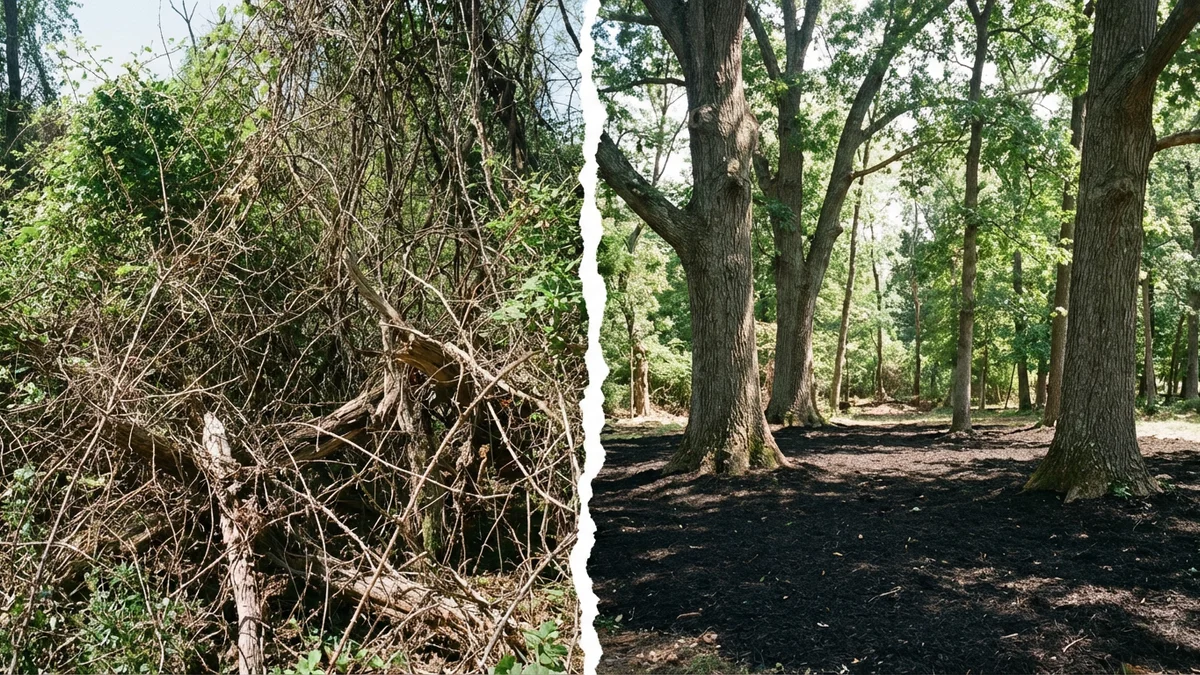
What the "before" looks like
Every overgrown NJ property follows a pattern. Understanding what you’re looking at helps set expectations for what clearing will reveal.
The 3-year fallow field. Chest-high goldenrod and asters with scattered autumn olive seedlings three to four feet tall. You can still walk through it — barely. The ground is grass underneath. This is the easiest clearing and the best time to act.
The 5-year fallow field. Autumn olive is head-height with woody stems. Multiflora rose thickets have formed at the edges and are expanding inward. Red cedar is establishing in scattered clumps. You can’t walk through it. A bush hog can’t mow it. This is when most property owners realize they need professional clearing.
The 10-year overgrown lot. The canopy is closing. Autumn olive trunks are three to five inches thick. Rose thickets are six feet tall and eight feet wide. Young hardwood saplings are mixed in. Wild grape and bittersweet drape over everything. The property feels like forest — but it’s not healthy forest, it’s an invasive monoculture.
The 15-year+ neglected woods. Closed canopy. The understory is barberry carpet with bittersweet climbing every tree. You can’t see ten feet through the undergrowth. The property is ecologically degraded, tick-infested, and completely unusable.
What the "after" looks like
Cleared fallow field. A uniform layer of brown mulch covering the entire field, with the underlying terrain now visible — the gentle rolls, the drainage draws, the rock outcrops that were hidden. The mulch has parallel track impressions from the machine’s passes. The edges are clean — the cleared area transitions sharply to the uncleared perimeter. It looks like farmland ready for the next chapter.
Cleared suburban backyard. Open space from the house to the tree line. The lawn edge is clean. The invasive brush is gone. Mature trees that were buried in the undergrowth are now standing free with clean trunks and visible canopy. The yard feels twice as large because you can see to the back of the property for the first time in years.
Cleared wooded understory. Park-like open forest. Mature oaks and maples with clean trunks rising from a mulched floor. The sight lines extend 100+ feet between the trunks. Sunlight reaches the ground for the first time in decades. It looks like a maintained estate woodland — open, walkable, and beautiful.
Cleared fence line. The fencing is visible — posts, rails, and wire that were completely hidden under brush. The ground on both sides of the fence is clean mulch extending four to six feet out. The fence line reads as a property feature again instead of a vegetation obstacle.
Setting realistic expectations
The mulch is brown, not green. After clearing, the ground is covered in brown wood mulch — not grass. The green comes later through seeding or natural regrowth. Expect the property to look “cleared” for three to twelve months before vegetation recolonizes and the mulch weathers into a natural tone.
Some stems remain at ground level. The mulcher grinds everything to ground level, but short stubs (one to two inches) of the thickest stems remain. These are flush with the mulch surface, not trip hazards, and decompose within one to two years.
The canopy stays. On selective clearing jobs (wooded understory, estate properties), the canopy trees are untouched. The dramatic change is below the canopy — the impenetrable understory is replaced by an open mulched floor. From a distance, the property still looks wooded. From underneath, it’s transformed.
Edges are sharp. The boundary between cleared and uncleared is abrupt — the machine stops where you tell it to. There’s no gradual transition. Some property owners want this (clear property delineation). Others prefer a softer edge, which we can create by partially clearing the transition zone.
Common Questions
How dramatic is the transformation?
Striking on neglected properties. A lot that’s impassable at 7 AM is walkable by 3 PM. You’re revealing terrain and space hidden for a decade.
Will my property look like a construction site after clearing?
No — that’s bulldozing. Forestry mulching leaves clean mulch, preserved trees, and no exposed dirt. It looks like a maintained woodland, not a construction site.
How long until it looks "natural" again?
2–3 months for the mulch to weather. 6 months for green to establish. One year for a fully natural appearance. Seeded properties look established by the next spring.
Do you take before-and-after photos?
Yes — before, during, and after. The photos support insurance claims, assessment records, and property listings. We share them with you.
Can I see examples of your past work?
We’re building a portfolio. Contact us and we can share photos from projects similar to yours.
What's the most surprising thing owners discover after clearing?
Stone walls, old foundations, wells, cisterns, and terrain features nobody knew existed. Clearing reveals the history of your land.
How long does it take to clear a brush?
A forestry mulcher clears 1-3 acres per day depending on vegetation density. Half-acre suburban lot: half a day. 3-acre field: 1-2 days. 10-acre wooded property: 3-5 days. Dense vegetation, steep terrain, and rocky ground slow it down. We provide specific timelines with every project quote.
Related Services
Forestry Mulching
We grind brush, saplings, and small trees into mulch on the spot – no hauling, no burn piles, no mess.
Want the full New Jersey land clearing playbook?
This article covers one piece of the puzzle. The complete guide ties together methods, costs, permits, terrain, and contractor selection in one place.
Ready to see what's under the brush?
Every property has a before and after. Yours starts with a free site visit.
Or call (908) 774-9235.