
Home / Forestry Mulching / Washington Township, Morris County, NJ
Forestry Mulching in Washington Township, Morris County, NJ
Washington Township throws more at a clearing crew than most places in Morris County. You've got Schooley's Mountain with its steep grades and thin rocky soil. You've got the Long Valley floor with its deeper loam and former farm fields filling in with cedars. You've got Highlands Preservation Area restrictions that eliminate some clearing methods before you even start. Forestry mulching works across all of it because the equipment stays stable on slopes, preserves topsoil that can't afford to be stripped, and leaves a mulch layer that satisfies erosion concerns the Highlands rules were written to address. It's the one method that's both practical and compliant on the widest range of Washington Township properties.
Why Forestry Mulching Works in Washington Township
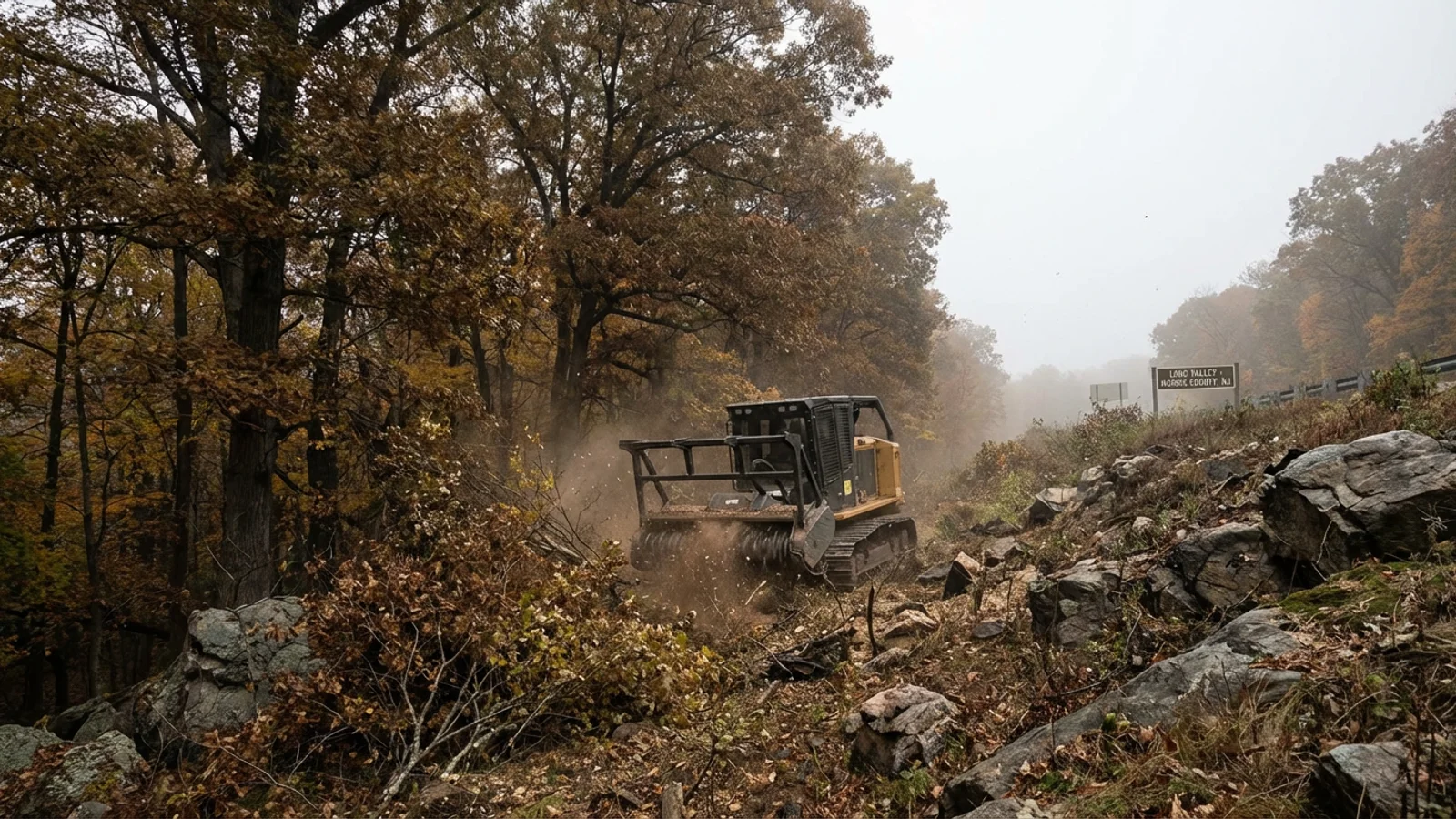
On Schooley's Mountain, the soil is the limiting factor. It's thin — sometimes only six to twelve inches of rocky loam over fractured shale. Strip that layer with a bulldozer and what's left is exposed rock and subsoil that will never support vegetation again without importing new topsoil. Forestry mulching doesn't remove soil at all. The machine grinds vegetation at ground level, the root structures stay in the ground holding the soil in place, and the mulch blanket on top protects the surface from rain impact and runoff. On slopes where six inches of soil is all that stands between a functioning landscape and a permanent scar, that preservation is not optional — it's the entire point.
In the Long Valley corridor, the terrain is gentler but the invasive problem is worse. Former agricultural fields that went fallow five to fifteen years ago are now dense with autumn olive, cedar, and multiflora rose. The growth is too heavy for a brush hog (which only cuts above ground and everything grows back) and too extensive for a chainsaw crew (which would take weeks and cost more than the mulching). A full-size forestry mulcher processes these fields at one to two acres per day, grinding everything at ground level and leaving clean, reseeable ground.
For properties within the Highlands Preservation Area, forestry mulching's minimal-disturbance profile is a practical advantage. The method doesn't constitute "major Highlands development" for routine clearing work — there's no grading, no soil stripping, no change in the land's fundamental character. The ground surface looks different after mulching, but it's the same ground, intact, with its soil structure preserved.
What We Typically Mulch in Washington Township
Japanese barberry is the invasive that sets Washington Township apart from neighboring towns. It thrives in the shaded, moist conditions on Schooley's Mountain's north-facing slopes and forms an impenetrable understory carpet that makes the forest floor impossible to walk through. Barberry is also a documented driver of tick populations — its dense structure creates the humid, sheltered microclimate that blacklegged ticks need to survive. Mulching removes the barberry and opens the understory to light and airflow, which degrades the tick habitat.
Multiflora rose fills the transitional zones between maintained areas and wild ground across the entire township. Fence rows, field edges, and wood borders are all buried under it. The thorns make hand clearing painful and slow. The mulcher doesn't care — it processes the entire plant, canes and all, at ground level.
On the valley floor, autumn olive and red cedar are the primary colonizers of former farm fields. Autumn olive spreads by bird-distributed berries and can convert a clean field to a dense shrub thicket in five years. Red cedar establishes on well-drained upland soils and, once it reaches about four feet tall, shades out the grass underneath. Both species mulch cleanly with high kill rates when the root crown is processed.
Oriental bittersweet wraps through the canopy on the older wooded properties along Long Valley Road and Schooley's Mountain Road. Ground-level mulching severs the vine from its roots, and the aerial portion dies back over the following growing season.
Equipment and Approach for Washington Township Terrain
Schooley's Mountain is the most demanding terrain in our regular service area. The slopes frequently exceed fifteen degrees, with sections of exposed rock and thin soil that require constant attention from the operator. We use a full-size tracked mulcher with low ground pressure that distributes weight across the full track footprint. The operator works across the slope — not up and down — to maintain stability and minimize downhill soil displacement.
On the steepest pitches where conventional tracked equipment reaches its operational limit, we evaluate whether a remote-controlled mulching unit is appropriate. These machines operate on slopes that no manned equipment can safely handle, and the operator controls them from stable ground.
In the Long Valley corridor, the terrain is much more forgiving. Standard tracked equipment runs efficiently on the gentle slopes and deeper soils of the valley floor. The primary consideration here is soil moisture — valley-bottom soils stay wet longer, so we schedule work during dry periods to avoid rutting.
For residential properties in the developed parts of the township, we match the equipment to the access. Larger lots with clear driveway access get the full-size machine. Properties with narrow drives or rear-only access get the compact tracked unit.
Common Questions
How much does forestry mulching cost in Washington Township, Morris County?
Forestry mulching ranges from $2,500 to $9,000. Mountain properties cost more due to terrain. Get a free estimate.
Can you forestry mulch on the steep slopes of Schooley's Mountain?
Yes. Our tracked equipment handles Schooley’s Mountain slopes. For the steepest sections, we may use remote-controlled units. The mulch layer is essential — it prevents erosion on these thin, rocky soils. Learn about our hillside clearing service.
Will forestry mulching trigger Highlands permitting on my property?
Routine mulching generally doesn’t trigger Highlands permitting. It doesn’t grade or strip the land. If your project is tied to new construction, additional review may apply. Read our Highlands Act guide.
Does mulching the barberry on my property actually reduce ticks?
Yes. Research shows Japanese barberry creates the microclimate blacklegged ticks need. Mulching it and opening the understory degrades that habitat, significantly reducing tick populations. Learn about our invasive species removal services.
How long does forestry mulching take on a Washington Township property?
Valley properties: one to two acres per day. Mountain properties take longer — a one-acre hillside may take a full day. We include a timeline with every quote.
Can you clear a former farm field in the Long Valley area without destroying the soil?
That’s exactly what forestry mulching does. The soil stays completely intact under the mulch layer. Root systems remain in the ground holding soil in place. The field is ready for reseeding within a season. Learn about our pasture reclamation service.
Schooley's Mountain terrain. Long Valley brush. We handle both.
Get a free estimate — we know this township and we'll give you a straight answer on what it takes.
Or call (908) 774-9235.