

Home / Forestry Mulching / Bridgewater, New Jersey
Forestry Mulching in Bridgewater, New Jersey
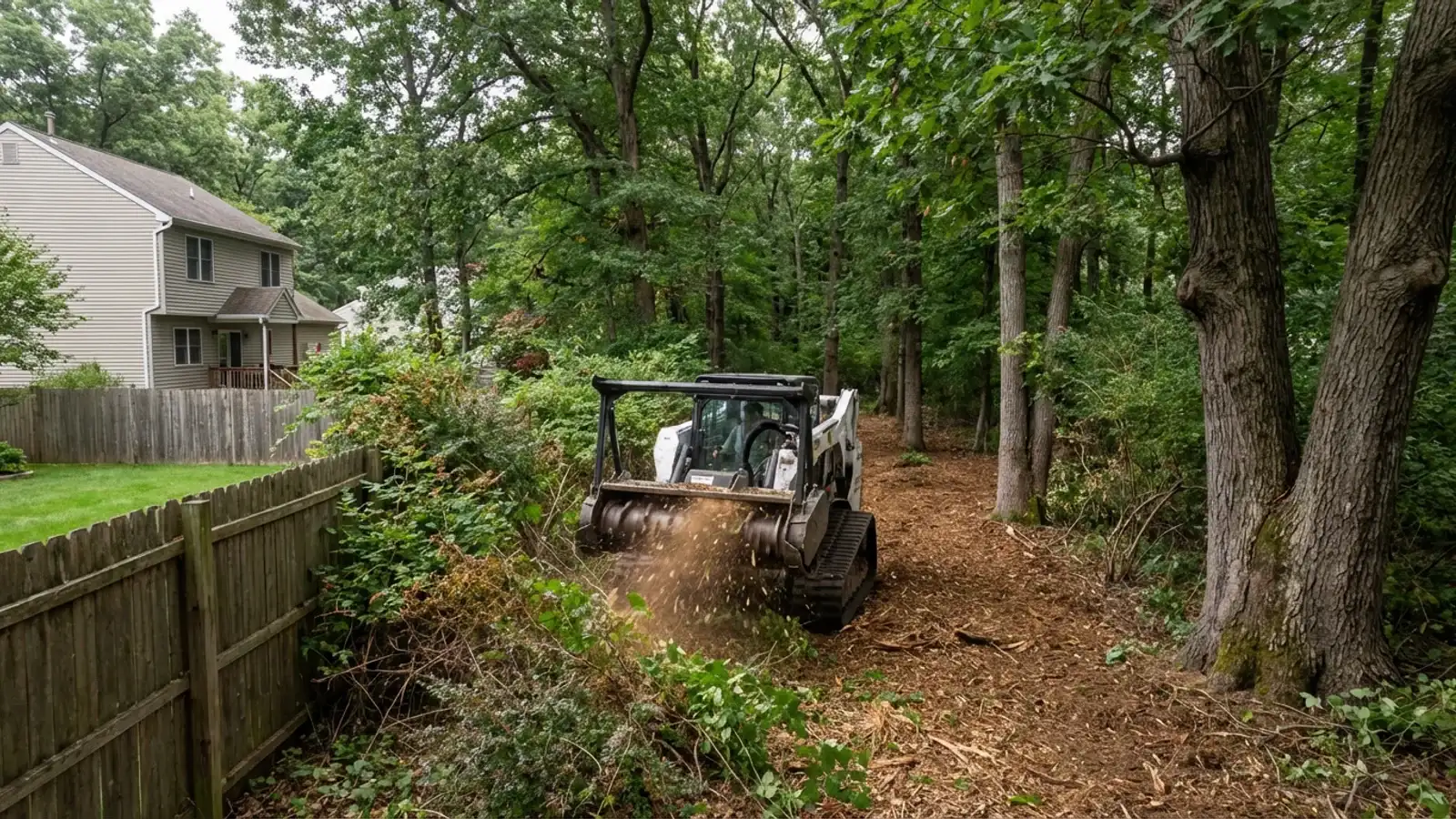
Bridgewater spans two different landscapes in one township — the wooded Watchung ridge in the north and the suburban valley floor to the south — and forestry mulching handles both. On the ridge, tracked equipment climbs the basalt slopes and grinds bittersweet, barberry, and multiflora rose out of the understory without disturbing the thin volcanic soil. In the valley, the same machine clears overgrown suburban backyards, HOA buffer zones, and vacant commercial parcels at production speed on flat ground. Most clearing methods force you to choose between power and precision. Forestry mulching does both, which is why it works across every neighborhood in a township this varied.
Why Forestry Mulching Works in Bridgewater
Bridgewater's diversity is the reason forestry mulching is the right method here. The Watchung ridge properties need a machine that can handle thirty-percent grades on thin, rocky soil — the same basalt trap rock that forms the First Watchung Mountain. Bulldozing would strip the soil to bedrock. Hand clearing would take weeks. The tracked mulcher grinds everything at surface level and leaves a mulch layer that protects the thin soil from the erosion that would otherwise follow clearing on a slope.
In the valley neighborhoods, the challenge shifts from terrain to context. Suburban lots in Bridgewater mean working around existing landscaping, fences, sheds, and trees the homeowner wants to keep. Forestry mulching is selective by nature — the operator controls exactly where the cutting head goes, clearing within inches of a tree trunk or fence post without contacting it. There's no debris pile to haul, no chipper crew blocking the street, no burn pile smoking for days. The brush goes in and mulch comes out, all on the same footprint.
For HOA common areas and commercial parcels, the speed advantage matters. A three-acre wooded buffer between townhouse sections that would take a hand crew two weeks to clear takes a mulcher two to three days. The cost difference is proportional.
What We Typically Mulch in Bridgewater
Oriental bittersweet is the worst invasive on Bridgewater's Watchung ridge properties. This woody vine climbs into the canopy of mature trees, weighing down branches until they snap and slowly girdling the trunk. On the forest floor, it creates a dense ground cover that prevents native regeneration. Mulching the ground-level growth and cutting the climbing vines at the base stops the vine's canopy invasion — though established bittersweet may need follow-up treatment to prevent root sprouting.
Japanese barberry carpets the understory throughout the wooded portions of northern Bridgewater. The deer-resistant shrub (deer avoid its thorns and bitter foliage) spreads relentlessly in the shade under mature oaks and beeches. Barberry also alters soil chemistry and creates habitat for blacklegged ticks — the primary carrier of Lyme disease. Removing barberry improves forest health, reduces tick density, and makes the woods usable.
In the valley and along stream corridors, mile-a-minute vine covers disturbed ground with shocking speed — the annual vine can grow six inches per day during peak season, blanketing fences, shrubs, and even small trees in a single summer. Knotweed holds the stream banks along Green Brook and Middle Brook.
On commercial parcels near Route 22, tree of heaven is the dominant problem species. Its aggressive root-suckering habit means a single tree can produce dozens of satellite stems across a parking lot or vacant lot within a few years.
Equipment & Approach for Bridgewater Terrain
Bridgewater jobs require matching the equipment to the specific neighborhood. Washington Valley and Chimney Rock properties get the tracked mulcher configured for slope work — low center of gravity, slow traversal across the grade, elevated cutting head to clear the basalt outcrops. These are the same setup we use in High Bridge and the Highlands towns.
Suburban backyard jobs in the valley neighborhoods may require compact equipment that fits through side-yard access. Many Bridgewater lots have six- to eight-foot gaps between the house and the fence line — too narrow for a full-size mulcher but accessible with a compact tracked unit. We assess access during every estimate and bring the right machine.
HOA and commercial jobs on flat ground use the full-size mulcher at production speed. These are the highest-efficiency jobs in Bridgewater — wide access, flat terrain, and large clearing areas.
Common Questions
How much does forestry mulching cost in Bridgewater, NJ?
Suburban backyards: $2,000–$5,000. Ridge properties run higher due to slope. Get a free estimate for your Bridgewater property.
Can you mulch on the Watchung ridge slopes in Bridgewater?
Yes — we use tracked equipment configured for Watchung ridge slopes. Learn about our hillside clearing service.
Does forestry mulching work for Japanese barberry removal in Bridgewater?
Yes — the mulcher grinds barberry to ground level and suppresses regrowth with the mulch layer. Learn about invasive removal.
Can you get equipment into a narrow side yard in Bridgewater?
Our compact mulcher fits through openings as narrow as 4 feet. We assess access during every estimate.
How long does it take to mulch an HOA common area in Bridgewater?
A 1–3 acre wooded buffer takes 2–3 days. Stream corridor work takes longer. We provide specific timelines with every HOA quote.
Will forestry mulching help with the tick problem in Bridgewater's wooded areas?
Removing barberry reduces tick habitat. The mulch layer creates drier conditions less favorable to ticks. Opening the understory increases light and airflow.
Ridge to valley — we mulch every terrain in Bridgewater.
Backyards, HOA common areas, commercial sites, hillside lots. Get a free estimate.
Or call (908) 774-9235.