

Home / Field Notes — Land Clearing Knowledge Base / Horse Property Clearing in New Jersey: Pastures, Trails, and Paddocks
Horse Property Clearing in New Jersey: Pastures, Trails, and Paddocks
Published April 6, 2026 by Brush Busters • Last reviewed April 6, 2026
Horse properties have the most complex clearing needs of any residential property type. The pasture that was productive five years ago is now half autumn olive. The riding trail through the back woods has narrowed to a deer path. The fence rows are buried. The back paddock has overgrown into brush because you ran out of time to maintain it three seasons ago. And every acre that reverts to brush is an acre your horses can’t use.
In the horse country of Bedminster, Peapack-Gladstone, Chester, Tewksbury, and Mendham, we clear horse properties regularly — restoring grazing acreage, reopening trail systems, and reclaiming fence rows that haven’t been visible in years. Here’s how the different project types work.
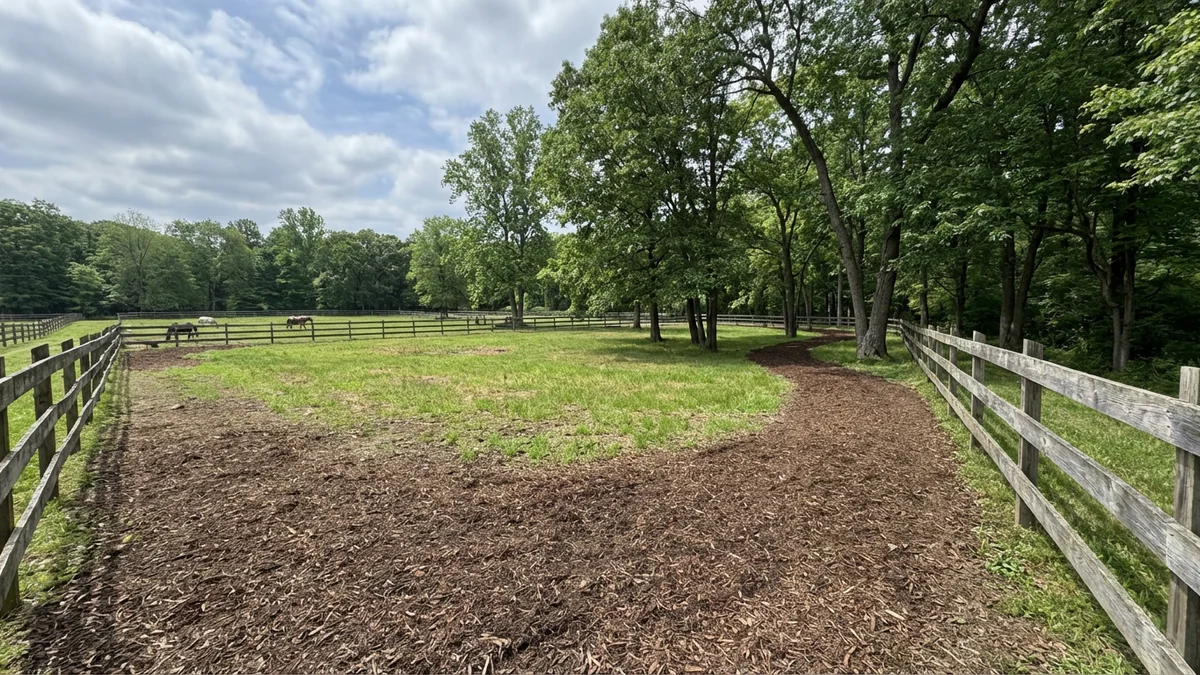
Pasture reclamation
The most common need. Pastures that stop getting mowed or grazed are colonized by autumn olive and multiflora rose within three to five years. By the time the woody growth is thicker than about two inches, a bush hog can’t handle it and the pasture needs forestry mulching.
The clearing returns the pasture to ground level. The mulch layer decomposes over the following six to twelve months. For immediate reuse as pasture, the recommended sequence is:
1. Mulch the overgrown pasture in late fall or winter 2. Disc the mulch into the soil in early spring (optional — for faster grass establishment) 3. Seed with a horse-appropriate pasture mix (orchardgrass, timothy, bluegrass, clover) in April-May or September 4. Keep horses off the seeded pasture for one full growing season to allow establishment
For properties where immediate turnout is needed, horses can graze on mulched ground once the mulch has settled (four to six weeks) — the mulch isn’t harmful to horses. However, the pasture won’t produce significant forage until the new grass is established.
Horse-safe considerations: Forestry mulching processes everything — including plants that may be toxic to horses. Tree of heaven, red maple, and black walnut are all present on NJ properties and all are toxic to horses in different ways. The mulching process grinds the plant material into fine mulch where the toxic compounds dilute and degrade rapidly. However, if large quantities of these species are present, discuss the specific risk with your veterinarian before turning horses onto freshly mulched ground.
Riding trail restoration
Horse trails need to be wider than ATV trails — ten to twelve feet minimum for single-file riding, fourteen to sixteen feet for riding abreast or for carriage driving. The mulched surface compacts under hoof traffic into a firm, well-drained trail that’s gentler on legs and hooves than hard-packed dirt or gravel.
Trail design for horses has a few specific requirements:
Low-hanging clearance. Clear overhead branches to at least ten feet (rider on horseback). The mulcher handles ground-level vegetation; overhead branches above the machine’s reach need chainsaw trimming.
Footing. The forestry mulch layer provides excellent footing for horses — firm but with some give, well-drained, and free of rocks. As the mulch compacts over one season, the surface becomes comparable to an arena-quality footing layer. Some horse property owners add a thin layer of sand over the compacted mulch for premium trail footing.
Slopes. Horses handle moderate slopes well, but steep descents are slippery on loose mulch. On steep sections, allow the mulch to compact (give it a few weeks of rain and foot traffic) before riding. Or add gravel on steep spots where traction is critical.
Water crossings. Horse trails that cross streams need safe footing at the crossing. The mulcher clears the approach on both sides; the crossing itself may need gravel or stepping stones for stable footing.
Paddock and turnout expansion
Adding grazing area by clearing brush adjacent to existing paddocks is one of the most cost-effective improvements on a horse property. The infrastructure (fencing, water, shelter) is already in place — you’re just expanding the cleared area to add usable acreage.
The mulcher clears the brush up to the existing fence line. For expansion beyond the current fencing, clear the new area, then extend the fence into the cleared ground. The mulched ground provides a clean, level surface for new fence post installation.
For paddock footing in high-traffic areas (around gates, water troughs, run-in shelters), the forestry mulch serves as a base layer. Add gravel or sand over the compacted mulch for a durable surface that handles the heavy traffic without turning to mud.
Fence line restoration
Horse property fencing — three-board, four-board, and high-tensile wire — gets buried under brush just like farm fencing. The fence row clearing approach is the same: clear both sides, expose the fence, assess condition, repair or replace.
On horse properties, the urgency is higher because fence integrity is a containment issue. A horse that can see through a gap in the brush and fence will test it. Clearing and repairing fence rows is a safety investment as much as a maintenance one.
Costs for horse property clearing
| Project | Typical scope | Cost range |
|---|---|---|
| Pasture reclamation | 2–5 acres | $3,000–$12,000 |
| Trail system (0.5–1 mile) | 2,640–5,280 linear ft | $6,000–$20,000 |
| Paddock expansion | 0.5–2 acres | $1,500–$6,000 |
| Fence row clearing | 500–2,000 linear ft | $1,500–$8,000 |
| Comprehensive (all of the above) | varies | $10,000–$35,000 |
A single mobilization covering pasture, trails, paddock expansion, and fence rows is significantly more cost-effective than separate trips. Horse properties typically have the most diverse clearing needs of any property type — consolidating the work saves 20–30%.
Common Questions
Is forestry mulch safe for horses?
The mulch itself is safe. If toxic plants were present (tree of heaven, red maple, black walnut), allow 4–6 weeks for compounds to degrade before turnout. Discuss with your vet.
How much does horse property clearing cost?
$1,500 for a paddock expansion to $35,000 for comprehensive property clearing. One mobilization saves 20–30% vs. separate trips. Get a free estimate.
How soon can horses graze on mulched pasture?
Walking: immediately. Grazing: wait for the mulch to settle (4–6 weeks) and ideally for new grass to establish (one growing season after seeding).
Can the mulcher work near horses?
Remove horses from the work area — the machine is loud and can spook from a distance. Move to a stall or distant paddock for 1–3 days of clearing.
What pasture seed mix works best after clearing in NJ?
Orchardgrass (50%), bluegrass (20%), timothy (15%), clover (15%). Seed in September or April-May directly over the mulch. Soil test and lime first.
Can you build trails through hilly terrain for riding?
Yes — up to 45% equipment capability. We keep trail grades below 10–12% for safe riding. Switchbacks on steep terrain create comfortable grades. Learn about trail cutting.
Related Services
Pasture & Property Reclamation
Reclaim overgrown pastures, abandoned fields, and neglected acreage so the land becomes usable again.
Trail Cutting
Private hiking trails, ATV paths, hunting lanes, and walking routes cut clean with a durable mulched surface.
Fence Line Clearing
Buried fence rows and overgrown property borders opened up and made visible again.
Relevant City Pages
These city pages are a good fit if you want to compare the article advice with the kind of properties we see on the ground.
Want the full New Jersey land clearing playbook?
This article covers one piece of the puzzle. The complete guide ties together methods, costs, permits, terrain, and contractor selection in one place.
Your horses need the acreage back.
Pastures, trails, paddocks, fence rows — one mobilization, everything cleared. Free site visit.
Or call (908) 774-9235.