

Home / Field Notes — Land Clearing Knowledge Base / Storm Damage Clearing in New Jersey: Fast Response When It Matters
Storm Damage Clearing in New Jersey: Fast Response When It Matters
Published April 2, 2026 by Brush Busters • Last reviewed April 2, 2026
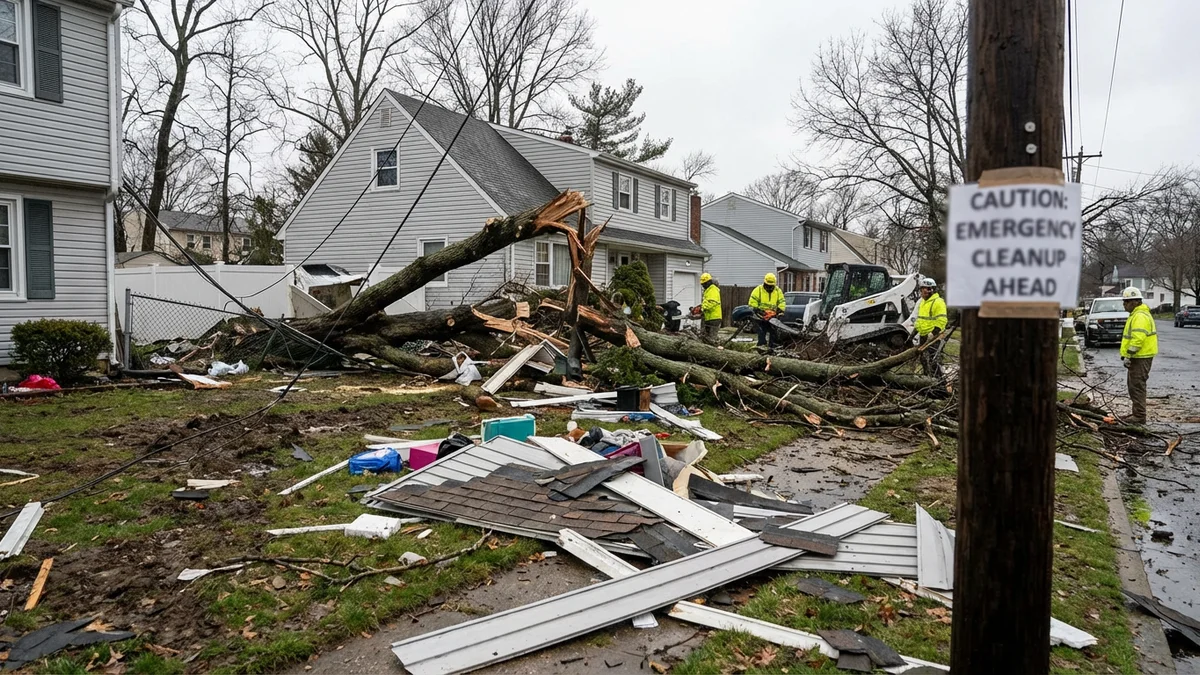
NJ gets hit. Nor’easters, summer thunderstorms with microbursts, tropical storm remnants, and ice storms all bring wind, water, and weight that break trees and scatter debris across properties. The aftermath on wooded properties is often worse than the initial damage — a single large tree that falls into other trees creates a chain reaction of broken branches, tangled crowns, and dangerous hanging limbs (widow-makers) that can drop without warning.
Storm damage clearing is a different operation than planned land clearing. The urgency is higher, the hazards are more dangerous, and the scope isn’t known until you walk the site. Here’s what to expect and how we handle it.
What storm clearing involves
Access restoration. The first priority after a storm is getting in and out of the property. Fallen trees across driveways, access roads, and road frontage block vehicle access and may prevent emergency vehicles from reaching the property. We clear access routes first — cutting and grinding the downed material in place to open the road.
Hazard tree removal. Trees that were damaged but didn’t fall — cracked trunks, split forks, hanging branches, root-heaved trees leaning at an angle — are more dangerous than trees that have already fallen. These need to be assessed and either removed or trimmed before someone walks under them. An arborist assesses; we clear the debris after removal.
Debris field processing. A severe storm can scatter broken branches, tree tops, and uprooted material across acres of property. Hand cleanup of this material takes days to weeks. The forestry mulcher processes debris fields at ground level in hours — grinding the scattered material into mulch in place. No brush piles, no hauling, no burn permits.
Stump and root ball cleanup. Uprooted trees leave exposed root balls — dirt, rock, and root mass standing three to six feet high. These can be pushed back into the hole (if the tree is removed), backfilled with soil, and the area mulched. On properties where the uprooted tree is still partially attached and leaning, the tree needs to be removed before the root ball can be addressed.
The forestry mulching advantage for storm cleanup
Traditional storm cleanup involves chainsaws, chippers, and trucks — cut the wood, chip the brush, load the debris, haul it off-site. This is slow, expensive, and generates enormous volumes of material to dispose of.
Forestry mulching collapses the process into a single step for the brush and branch material. The mulcher grinds branches, brush, and small trunks (up to eight inches) at ground level. The material stays on the property as mulch — no hauling, no disposal, no burn piles. The large-diameter trunks that are beyond the mulcher’s capacity are bucked by chainsaw and either left for firewood or removed separately.
For debris fields — acres of scattered branches and tree tops — the mulcher is dramatically faster than a hand crew with chainsaws and a chipper. The machine drives through the debris field, grinding everything it encounters. The cleared area behind the machine is clean mulch. The cleanup that would take a crew of four a week takes the mulcher one to two days.
Storm damage clearing costs
Storm damage clearing costs vary widely because every storm event is different. General ranges:
| Situation | Cost range |
|---|---|
| Access road clearing (1–3 fallen trees) | $500–$1,500 |
| Debris field processing (0.5–2 acres) | $2,000–$6,000 |
| Comprehensive storm cleanup (multi-acre) | $5,000–$15,000+ |
| Emergency same-day mobilization surcharge | 15–25% |
Insurance note: Storm damage clearing may be covered by your homeowner’s insurance if the damage was caused by a covered peril (wind, ice, fallen trees on structures). Document everything — take photos before, during, and after clearing. Keep all invoices. File the claim with your carrier and include the clearing cost. We provide detailed invoices that include the scope of work, cause of damage, and the clearing performed.
When to call us vs. an arborist
Call an arborist when: A large tree is leaning on a structure (house, garage, power line). A tree has a cracked trunk and could fall in any direction. Hazardous hanging branches are suspended over a walkway, driveway, or play area. These situations require the rigging, climbing, and directional felling skills of a certified arborist.
Call us when: The trees are already down and the debris needs to be processed. The access road needs to be opened. A large area of scattered branches and tree tops needs cleanup. Stumps and root balls need to be ground or backfilled. The property needs to be restored to a usable state after the emergency removal is complete.
The typical sequence: Arborist handles the hazardous situations (day one). We come in after the arborist and process the debris field, grind the remaining brush and small wood, and restore the property (day two to three).
On some properties the damage is all ground-level — wind-snapped small trees and branch scatter with no hazardous standing trees. In those cases, we handle the entire cleanup without an arborist.
Common Questions
How fast can you respond to storm damage?
Site assessment within 24–48 hours. Clearing within a few days. After major storms, call early — demand is high. Report storm damage now.
How much does storm damage clearing cost?
$500–$1,500 for access clearing. $5,000–$15,000+ for comprehensive cleanup. We provide a written quote after site assessment.
Will insurance cover storm clearing?
It may — document everything with photos and keep invoices. We provide detailed invoices that support insurance claims. Contact your carrier to confirm coverage.
Do you remove large trees that are leaning on structures?
Trees on structures need an arborist. We process the debris after they remove hazardous trees. Ground-level damage with no structural hazards — we handle the full cleanup.
Can you process a debris field faster than a chipper crew?
Significantly — a 1-acre debris field takes half a day with the mulcher vs. 2–3 days with a chipper crew. Cleaner result too.
Should I wait for insurance approval before clearing?
For safety hazards: document with photos and clear immediately. For non-urgent cleanup: you can wait for the adjuster but most policies allow proceeding and submitting for reimbursement.
Who is responsible if my neighbor's tree falls on my house in NJ?
In NJ, your homeowner’s insurance typically covers storm damage from a neighbor’s healthy tree. If the tree was dead or visibly hazardous and the neighbor knew but didn’t act, they may be liable for negligence. Document the tree’s condition with photos and consult your insurer. For cleanup, read our storm damage clearing guide.
Related Services
Land Clearing / Lot Prep
Residential and small commercial lots cleared and prepped for building, grading, or landscaping.
Helpful Resources
Homeowners
Want the full New Jersey land clearing playbook?
This article covers one piece of the puzzle. The complete guide ties together methods, costs, permits, terrain, and contractor selection in one place.
Storm hit your property? We clear the aftermath.
Access roads, debris fields, and full site restoration. Fast response, production equipment.
Or call (908) 774-9235.