

Home / Field Notes — Land Clearing Knowledge Base / Clearing Land for a Garden or Small Farm in New Jersey
Clearing Land for a Garden or Small Farm in New Jersey
Published April 7, 2026 by Brush Busters • Last reviewed April 7, 2026
You bought the property. You have the vision — a market garden, a homestead plot, a cut flower operation, a small livestock setup. The problem is the three acres of autumn olive and multiflora rose between you and that vision. Every fallow field in Hunterdon, Warren, and Somerset counties has the same story: productive ground ten or twenty years ago, impenetrable brush today.
The clearing method you choose determines what the soil looks like when you’re done. Get this wrong and you spend the first two years rebuilding what the clearing destroyed. Get it right and you go from brush to planting in one season.
Why the clearing method matters more for farms
Every other project in this article series — building lots, pools, pole barns — involves clearing ground that’s going to be excavated, graded, or covered. The soil quality after clearing doesn’t matter much because the soil is getting moved or buried. Farming is the opposite. The soil IS the product. Its structure, biology, organic content, and drainage capacity determine whether your crops grow or fail.
Bulldozing strips the topsoil — the top 6–12 inches where 90% of the biological activity happens. On NJ’s agricultural soils, that layer took decades to build. A bulldozer removes it in minutes, mixes it into a subsoil pile, and leaves you farming on clay or sand. Rebuilding takes years of cover cropping, compost application, and patience.
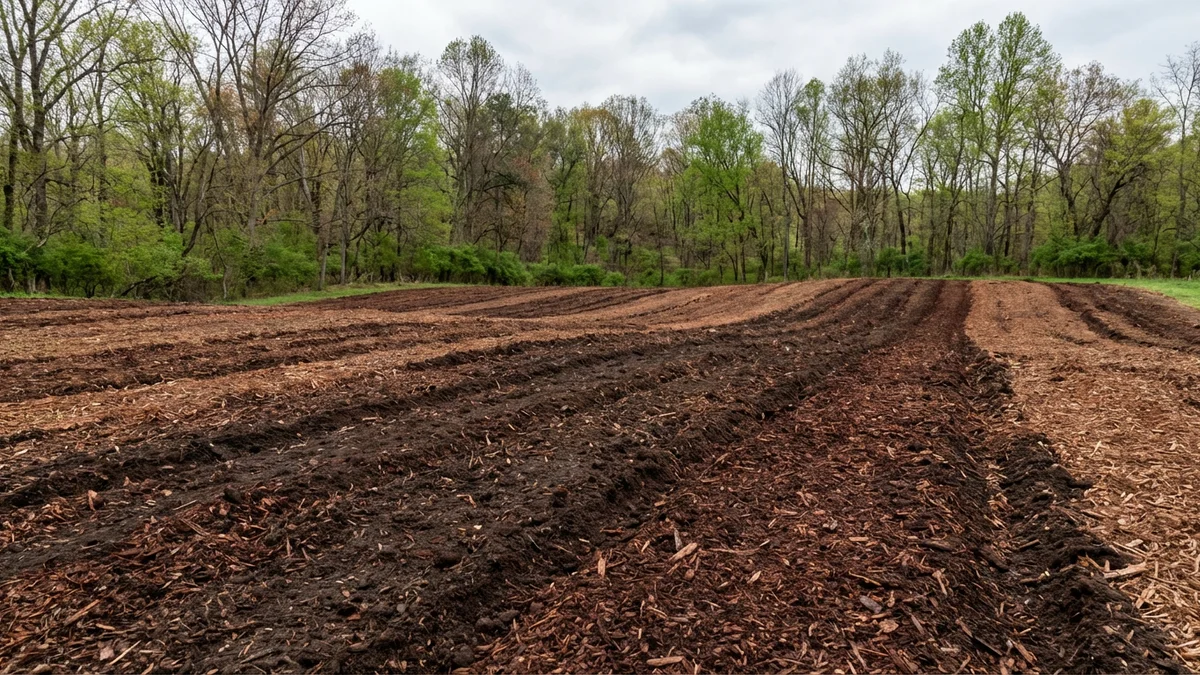
Forestry mulching preserves the topsoil and adds to it. The mulch left on the surface decomposes over six to eighteen months, depositing organic matter directly into the soil. On former farmland that’s been fallow for ten years, the underlying agricultural soil is still there — it just has brush growing on it. Remove the brush with a method that doesn’t damage the soil and you have productive ground again within one growing season.
Bush hogging works if — and only if — the growth is grass and light brush under two inches in diameter. On NJ fallow fields older than about four years, the autumn olive and multiflora rose are too woody for a bush hog. If someone tells you to bush hog a field with chest-high autumn olive, they haven’t tried it.
The path from brush to planting
Year zero: Clear. Forestry mulching grinds everything to ground level. The mulch covers the field in a two-to-four-inch layer of shredded organic material. This is late fall or winter work — clear before the growing season you intend to plant.
Spring: Assess and amend. Once the mulch has settled through winter, walk the field. You’ll see the soil type, the drainage pattern, any wet spots, and any rock that the brush was hiding. Pull soil samples and send them to the Rutgers Cooperative Extension soil testing lab. The results tell you what amendments the soil needs — lime, phosphorus, nitrogen, compost — based on what you’re planting.
Option A — Plant through the mulch. For coarse crops (squash, pumpkins, tomatoes, corn) and pasture/hay seeding, you can plant directly through the decomposing mulch layer. Seed germinates through the mulch; transplants are set into holes punched through it. The mulch suppresses weeds during the critical establishment period.
Option B — Disc and incorporate. For fine-seeded crops (lettuce, carrots, herbs) and for properties where the mulch layer is thick (6+ inches from dense clearing), disc the mulch into the soil using a tractor-mounted disc harrow. This breaks up the mulch, mixes it into the topsoil, and creates a smoother seedbed. Wait two to four weeks after discing for the soil biology to stabilize before planting.
Option C — Remove mulch from specific beds. For small-scale intensive gardens (raised beds, market garden rows), scrape the mulch off the planting rows and use it as pathway material between beds. This gives clean soil for direct seeding in the beds while the mulch controls weeds in the paths.
Year one onward: Maintain. Any fallow field in NJ will try to revert. The seed bank in the soil contains autumn olive, multiflora rose, and every other invasive that was growing there before. Annual mowing or cultivation prevents regrowth. The first year after clearing requires the most vigilance — by year two, your crop canopy and regular maintenance keep the invasives suppressed.
What's growing on your fallow NJ field right now
If the field has been fallow for less than three years, it’s grass, goldenrod, and asters. A bush hog handles this.
At three to five years, autumn olive and multiflora rose have established. Woody stems are one to three inches thick. This is the transition zone — a bush hog struggles, a forestry mulcher handles it easily.
At five to ten years, the autumn olive is overhead height with stems three to five inches thick. Multiflora rose has formed impenetrable thickets. Red cedar and Virginia pine have established from bird-dropped seeds. This is solidly forestry mulcher territory.
At ten to fifteen years, the canopy is closing. Young hardwoods — red maple, sweet gum, black cherry — are six to ten inches in diameter. The field is becoming young forest. The mulcher handles everything up to about eight inches; larger trees may need selective chainsaw removal first.
Beyond fifteen years, it’s forest. The conversion back to farmland at this stage is a major project involving full clearing, potential stump removal for cultivation, and significant soil rebuilding.
NJ farmland assessment and clearing
If your property carries a farmland assessment (reduced property tax based on agricultural use), clearing overgrown fields to restore them to production supports that assessment. NJ farmland assessment requires the property to be actively devoted to agricultural or horticultural use — which means a fallow field that’s reverted to brush may not qualify unless you’re actively restoring it.
The income requirements for NJ farmland assessment are: $1,000 in gross sales for the first 5 acres, plus $5 for each additional acre. On a recently cleared field, a single season of hay cutting or pasture rental can meet this threshold. Some property owners clear fallow fields specifically to maintain the farmland assessment and avoid the tax rollback penalty that applies when land loses its qualified farm status.
If you’re clearing to START farming on land that doesn’t currently have a farmland assessment, check with your county tax assessor about the application process. You need to demonstrate active agricultural use for at least two successive years before the assessment takes effect.
Costs for farm and garden clearing
Pasture and field reclamation on NJ’s valley-floor terrain — the flat, deep-soiled farmland in Delaware Township, Readington, Mansfield, and Pohatcong — is the most cost-efficient clearing work we do. The flat terrain lets the mulcher run at production speed with no slope restrictions.
| Field condition | Cost per acre | Notes |
|---|---|---|
| Light brush (2–3 years fallow) | $800–$1,500 | Grass, light saplings, sparse shrubs |
| Moderate growth (5–7 years fallow) | $1,500–$2,500 | Autumn olive, rose thickets, scattered cedar |
| Heavy growth (10+ years fallow) | $2,500–$4,000 | Closed canopy, dense stems, full understory |
| Rocky terrain surcharge | +30–50% | Oxford limestone, Highlands rock |
A five-acre field with moderate growth clears in two to three days at roughly $8,000 to $12,000 total. That same field, once restored to productive use, generates income and maintains a farmland assessment that saves thousands annually in property taxes.
Common Questions
How much does it cost to clear overgrown farmland in NJ?
Fallow farmland runs $800–$4,000/acre depending on growth density. Flat terrain is cheapest. Get a free estimate for your field.
Can I plant immediately after forestry mulching?
Yes for hay, pasture, and coarse crops — seed through the mulch. For fine-seeded crops, disc the mulch in first. Soil test before planting.
Will the mulch rob nitrogen from the soil?
Minimal and temporary with coarse forestry mulch. A light nitrogen application in the first planting season offsets any tie-up. By year two the mulch adds nitrogen back.
How do I maintain the farmland assessment after clearing?
Plant or lease the field for hay, pasture, or crops in the first growing season. Farmland assessment requires $1,000 gross sales for the first 5 acres. Check with your county tax assessor.
Should I clear in fall or spring for spring planting?
Clear in fall or early winter. This gives the mulch 3–5 months to settle before spring planting. Read our seasonal guide.
Can forestry mulching handle fields with stone walls and old fencing?
Yes — we work right up to stone walls and old posts without contact. Flag any buried wire fencing you know about before clearing starts.
What invasive species will grow back after clearing?
Autumn olive, rose, and tree of heaven are most likely. Annual mowing suppresses regrowth. Learn about invasive removal follow-up.
Can you clear land for a community garden or CSA in NJ?
Yes — we work with community organizations, land trusts, and individual farmers. Contact us about your project.
Related Services
Pasture & Property Reclamation
Reclaim overgrown pastures, abandoned fields, and neglected acreage so the land becomes usable again.
Land Clearing / Lot Prep
Residential and small commercial lots cleared and prepped for building, grading, or landscaping.
Relevant City Pages
These city pages are a good fit if you want to compare the article advice with the kind of properties we see on the ground.
Helpful Resources
Farms & Agriculture
Related Articles
Land Clearing Cost Per Acre in New Jersey: Pricing Guide
New Jersey land clearing cost per acre explained: method, terrain, tree size, access, and how to compare quotes without getting burned.
See Land Clearing Cost Per Acre in New Jersey: Pricing Guide
Clearing Overgrown Property Before Selling in New Jersey
Overgrown land sells for 30–40% less. Clearing before listing costs $2,000–$5,000 but adds $10,000–$30,000 to your sale price. Here's the ROI math for NJ.
See Clearing Overgrown Property Before Selling in New Jersey
Want the full New Jersey land clearing playbook?
This article covers one piece of the puzzle. The complete guide ties together methods, costs, permits, terrain, and contractor selection in one place.
Ready to turn brush back into farmland?
We restore fallow fields to plantable ground — one pass, soil intact, ready for the next season.
Or call (908) 774-9235.